Preparing your learning space...
100% through Security for FDEs tutorials
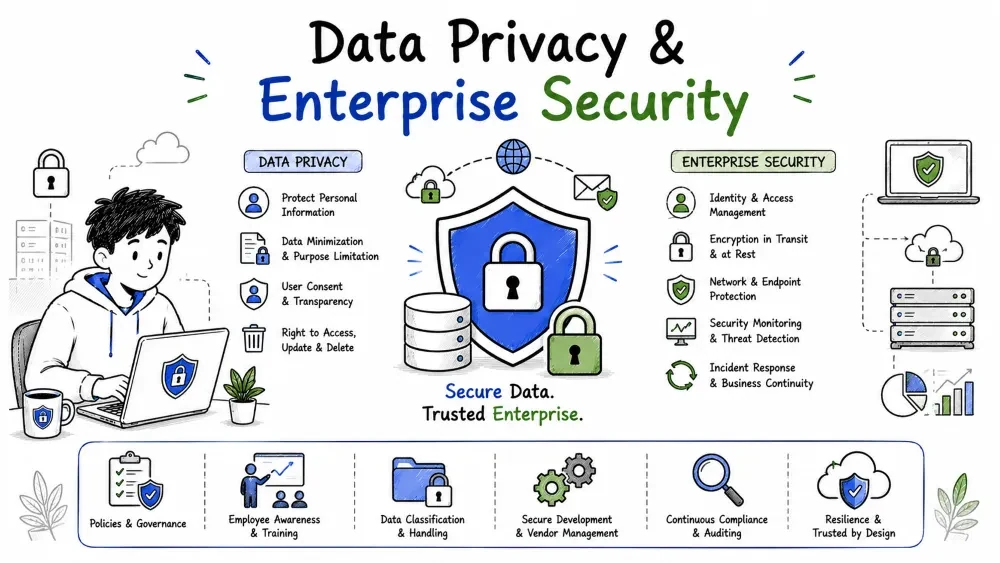
As an FDE, your work lands inside a customer's business — which means you inherit their legal duties (whose data you may hold, how long, under which rules) and their security requirements (how a company proves to auditors it's protecting data). This final tutorial covers the two: data privacy — PII, consent, purpose limitation, and data-protection laws like GDPR — and enterprise security requirements — the compliance frameworks, security reviews, and identity/access standards a real company will hold your integration to.
The two words travel together, but they are not the same job:
Security keeps the vault locked; privacy decides what may go in the vault at all, who decides, and for how long. You can be technically very secure and still be far from private — collecting everything, forever, with no consent.
Personal data (also PII — Personally Identifiable Information) is any data that identifies a real person, directly or indirectly:
For an FDE the golden rule is: the moment your integration touches names, emails, HR, medical, or financial fields, you've entered personal-data territory, and the privacy principles below apply.
Many regulations treat some data as special and much more restricted:
If your integration syncs a customer's HR records, health records, payroll, or medical claims, you're handling special-category data. Expect explicit user consent and far stricter rules than for an ordinary contact name. The acceptable-use bar is higher, and so is the regulator's interest.
A short list of principles recurs across the main data-protection laws (GDPR, CCPA). Honor these and you satisfy most of the world's privacy regimes:
| Principle | Means |
|---|---|
| Lawful purpose | collect data only for a clear, legitimate reason |
| Minimization | collect only what the purpose needs |
| Consent / transparency | say what you do with it; get consent where required |
| Access & rights | let people view and correct their data |
| Limited retention | keep it only as long as needed, then delete it |
| Security | protect it (everything in this series) |
You don't need to memorize clauses. You need to answer, for every field — including the ones you don't obviously need — "why am I collecting this, and how long will I keep it?"
Purpose is the honest reason you collect a piece of data. Consent is the user's explicit, informed agreement where the law requires it (marketing, special-category data). They combine:
Consent is not a checkbox you tick by default; it is granular, informed, and revocable.
Data minimization means: don't collect what you don't need. If your integration only needs a name and email to send invoices, it does not need the person's salary, their family details, or their history.
Needed:    first name, email, order total
Not needed: date of birth, job history, medical history
The less you hold, the less can leak, the smaller any breach, and the fewer privacy obligations you owe. Minimization is your cheapest security control.
Data should carry a lifetime: a defined "why" and a plan for deletion:
Keeping customer data "just in case, forever," with no policy, is a classic privacy defect that turns an ordinary request into a compliance failure.
Apply privacy at the wiring level of every customer integration:
When your integration pulls from a customer's system, ask for just the fields you need — "the contact fields we need" — not a full export you then hold.
Several regimes exist; which applies depends on where data subjects live and where you operate:
| Law | Covers | Key rights |
|---|---|---|
| GDPR (EU) | EU residents | explicit consent, access, erasure ("right to be forgotten") |
| CCPA/CPRA (California) | California consumers | know what's collected, see/erase, opt-out of sale |
| HIPAA (health, US) | US health data | strict health-data protection and breach notice |
You don't need to be a lawyer to be an FDE, but you do need to know the rules most relevant to your customer's data — usually GDPR plus your home region's law — and to ship the consent, access, and deletion hooks nearly all of them require.
Privacy by design means building privacy in, not retrofitting it after lunch. Practically: minimize what the UI/API requests, define retention, support deletion, log access to special data. It's the principle regulators most want to see written down in your design, not promised in a slide.
When a customer's security team reviews your product, they ask structured questions — not out of curiosity but to assess you before handing over their data. Expect vendor questionnaires covering access control, encryption, data retention, SSO, and incident response. As an FDE you should know these answers about your own product and be able to point to the evidence, because the door to the customer often runs through security.
Frameworks are standard ways to prove you meet security and privacy requirements:
| Framework | What it attests | When it matters |
|---|---|---|
| SOC 2 | security, availability, and privacy controls | near-universal for enterprise SaaS |
| ISO 27001 | an information-security management system | international, formal |
| HIPAA | health-data protection | if you touch US health data |
| PCI DSS | card-data protection | if you handle card numbers |
The practical point: which frameworks your company attests to, and where the control evidence lives, are the answers a customer's security team will scale from a demo to a vendor call.
Enterprises expect you to plug into their identity system, not to create your own set of users and passwords:
Security meaning: you inherit their access-control decisions (Tutorial 3) — instantly revoking on off-boarding — and you gain trust partly because you don't hold credentials.
Every enterprise expects a review of your integration, before and after it goes in:
Whatever the form, the substance is this series' controls: least privilege, secrets, encryption, access control, validation, and a documented incident plan. A security review is really a test of how many of those you built.
A typical enterprise "security requirements" page asks the same handful of questions. Keep a fill-in template in your back pocket:
1. Where does the data live? (region — EU / US / …)
2. How is data encrypted — at rest and in transit?
3. Who can access it, and how is access controlled? (least privilege, SSO)
4. How long is data retained, and how is it deleted?
5. Do you hold certifications / attestations? (SOC 2, ISO 27001 …)
6. How do you detect and respond to a breach?
These aren't abstract; they map one-to-one to chapters of this tutorial. If you can answer all six coherently, your enterprise security readiness moves from "demo" to "production."
These aren't optional, whatever your org chart:
Before your integration touches a real customer, these are the things you must already be able to do, because they are also the customer's security questionnaire.
Save your progress and earn XP for completing tutorials.
4 questions · Pass with 70%+
1The EU law centered on explicit consent and erasure is…
2Minimizing the data you collect is…
3Enterprises expect you to use their identity system via…
4Which framework attests to security/availability/privacy for SaaS?
Technology
Forward Deployed Engineer
Lesson group
Security for FDEs
Progress
100% complete