Preparing your learning space...
100% through Common Table Expressions tutorials
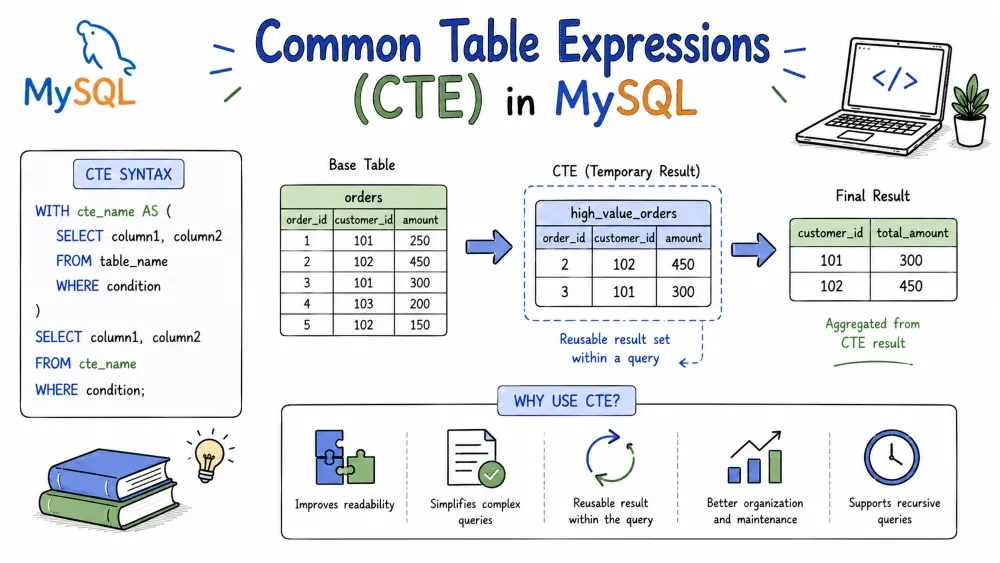
A CTE (Common Table Expression) is a temporary named result set that exists only for the duration of a single query. Think of it as a helper query you define once and reuse inside the same statement.
A CTE lets you give a subquery a name and then use that name like a table in the rest of your query. It makes complex queries easier to read because you break them into named steps.
WITH cte_name AS (
    SELECT ...
)
SELECT * FROM cte_name;
The WITH keyword defines the CTE. The SELECT that follows can reference cte_name as if it were a real table.
WITH high_earners AS (
    SELECT employee_id, first_name, last_name, salary
    FROM employees
    WHERE salary > 100000
)
SELECT * FROM high_earners;
This creates a CTE called high_earners that holds all employees earning over 100k, then queries it. Same result as a subquery or a view, but the CTE only lives for this one statement and keeps the query organized.
You can define several CTEs in a single WITH clause, separated by commas. Each CTE can reference the ones defined before it.
WITH
    cte1 AS (
        SELECT ...
    ),
    cte2 AS (
        SELECT ...
        FROM cte1
    )
SELECT * FROM cte2;
WITH
    regional_sales AS (
        SELECT region, SUM(amount) AS total_sales
        FROM sales
        GROUP BY region
    ),
    top_region AS (
        SELECT region, total_sales
        FROM regional_sales
        ORDER BY total_sales DESC
        LIMIT 1
    )
SELECT * FROM top_region;
top_region reuses regional_sales to find the single best-performing region. Without CTEs you'd need a subquery inside another subquery or a temporary table.
A recursive CTE is a CTE that calls itself. It is useful for working with hierarchical or tree-structured data — org charts, category trees, bill of materials, and so on.
WITH RECURSIVE cte_name AS (
    -- Anchor member: the base result
    SELECT ...
    UNION ALL
    -- Recursive member: references the CTE itself
    SELECT ...
    FROM cte_name
    WHERE ...
)
SELECT * FROM cte_name;
Two parts:
UNION ALL combines the results. You can use UNION DISTINCT if you need to remove duplicates, but UNION ALL is faster and more common.
Generate numbers 1 through 5:
WITH RECURSIVE numbers AS (
    SELECT 1 AS n
    UNION ALL
    SELECT n + 1
    FROM numbers
    WHERE n < 5
)
SELECT * FROM numbers;
| n |
|---|
| 1 |
| 2 |
| 3 |
| 4 |
| 5 |
How it runs:
n = 1.n = 1 → produces 2.n = 2 → produces 3.n >= 5.Given an employees table where each row has a manager_id pointing to another employee:
WITH RECURSIVE org_chart AS (
    -- Anchor: the CEO (no manager)
    SELECT employee_id, first_name, last_name, manager_id, 1 AS level
    FROM employees
    WHERE manager_id IS NULL

    UNION ALL

    -- Recursive: direct reports of the previous level
    SELECT e.employee_id, e.first_name, e.last_name, e.manager_id, oc.level + 1
    FROM employees e
    INNER JOIN org_chart oc ON e.manager_id = oc.employee_id
)
SELECT * FROM org_chart ORDER BY level, employee_id;
Each iteration peels off one layer of the hierarchy. The level column tracks how many steps from the CEO each person sits.
cte_max_recursion_depth (default 1000). You can raise it:
SET SESSION cte_max_recursion_depth = 10000;
GROUP BY), DISTINCT, ORDER BY, or LIMIT directly — those are applied after the recursion finishes.Generate a list of all dates in a month:
WITH RECURSIVE dates AS (
    SELECT '2026-04-01' AS dt
    UNION ALL
    SELECT dt + INTERVAL 1 DAY
    FROM dates
    WHERE dt < LAST_DAY('2026-04-01')
)
SELECT * FROM dates;
Useful for filling gaps in reports — left-join your sales data against this to see days with zero sales.
WITH RECURSIVE category_tree AS (
    SELECT id, name, parent_id, name AS path
    FROM categories
    WHERE parent_id IS NULL

    UNION ALL

    SELECT c.id, c.name, c.parent_id, CONCAT(ct.path, ' > ', c.name)
    FROM categories c
    INNER JOIN category_tree ct ON c.parent_id = ct.id
)
SELECT * FROM category_tree;
The path column builds a breadcrumb like Electronics > Laptops > Gaming.
Save your progress and earn XP for completing tutorials.
Keep learning
Technology
MySQL
Lesson group
Common Table Expressions
Progress
100% complete