Preparing your learning space...
50% through Stored Procedures tutorials
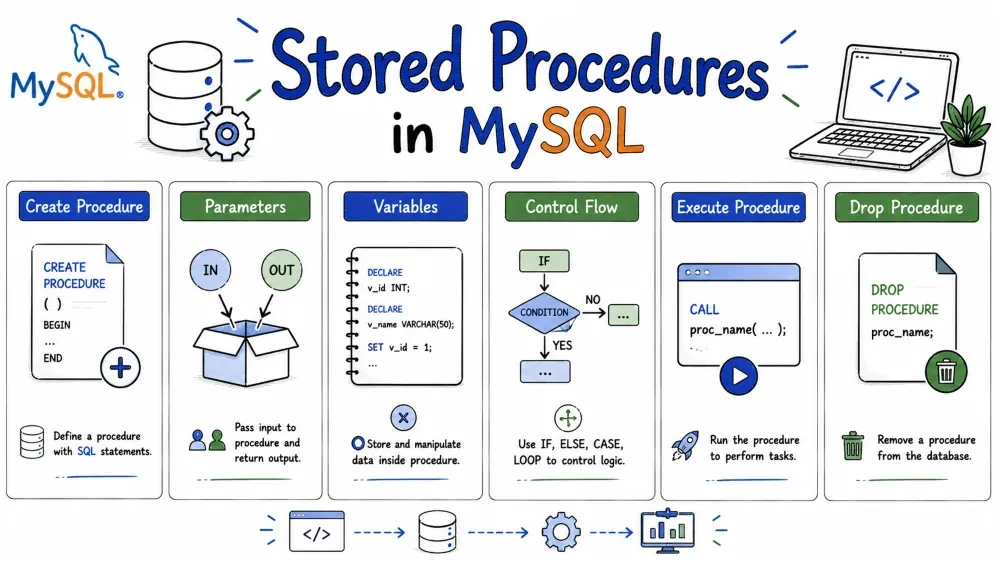
A stored procedure is just a bunch of SQL statements saved on the server under one name. Instead of sending five queries from your app, you send one CALL and MySQL runs everything server-side.
DELIMITER //

CREATE PROCEDURE procedure_name()
BEGIN
    -- your SQL here
END //

DELIMITER ;
The DELIMITER thing trips everyone up at first. MySQL normally treats ; as the end of a statement. But your procedure has ; inside it — so you switch the delimiter to // temporarily, write the procedure, then switch back.
Here's a simple one:
DELIMITER //

CREATE PROCEDURE GetTotalUsers()
BEGIN
    SELECT COUNT(*) AS total_users FROM users;
END //

DELIMITER ;
Run that once, and now GetTotalUsers lives on the server. Call it anytime.
Variables hold temporary data while your procedure runs.
DECLARE variable_name datatype [DEFAULT value];
DELIMITER //

CREATE PROCEDURE ShowUserCount()
BEGIN
    DECLARE user_count INT DEFAULT 0;

    SELECT COUNT(*) INTO user_count FROM users;

    SELECT user_count AS 'Total Users';
END //

DELIMITER ;
Three keywords to remember:
DECLARE — creates the variableSET — assigns a valueSELECT ... INTO — stuffs a query result into a variableOne tip: prefix your variable names (like v_count or _count). If your variable has the same name as a column, MySQL gets confused.
Parameters let you pass data in and out of a procedure.
| Type | What it does |
|---|---|
IN | Pass a value into the procedure (default) |
OUT | Get a value back from the procedure |
INOUT | Pass a value in, get a different one back |
DELIMITER //

CREATE PROCEDURE GetUserByEmail(IN user_email VARCHAR(100))
BEGIN
    SELECT id, name, email
    FROM users
    WHERE email = user_email;
END //

DELIMITER ;
DELIMITER //

CREATE PROCEDURE CountUsersByStatus(IN status_val VARCHAR(20), OUT total INT)
BEGIN
    SELECT COUNT(*) INTO total
    FROM users
    WHERE status = status_val;
END //

DELIMITER ;
When you call it, use a session variable (@whatever) to catch the output:
CALL CountUsersByStatus('active', @result);
SELECT @result;
DELIMITER //

CREATE PROCEDURE IncreaseScore(INOUT score INT, IN amount INT)
BEGIN
    SET score = score + amount;
END //

DELIMITER ;
SET @my_score = 10;
CALL IncreaseScore(@my_score, 5);
SELECT @my_score;  -- shows 15
DELIMITER //

CREATE PROCEDURE CheckStock(IN product_id INT)
BEGIN
    DECLARE stock_count INT;

    SELECT quantity INTO stock_count
    FROM inventory
    WHERE id = product_id;

    IF stock_count = 0 THEN
        SELECT 'Out of stock' AS status;
    ELSEIF stock_count < 10 THEN
        SELECT 'Low stock' AS status;
    ELSE
        SELECT 'In stock' AS status;
    END IF;
END //

DELIMITER ;
Good when you have more than a couple conditions.
DELIMITER //

CREATE PROCEDURE GetDiscount(IN customer_type VARCHAR(20))
BEGIN
    CASE customer_type
        WHEN 'premium' THEN SELECT 0.20 AS discount_rate;
        WHEN 'regular' THEN SELECT 0.10 AS discount_rate;
        ELSE SELECT 0.00 AS discount_rate;
    END CASE;
END //

DELIMITER ;
WHILE — runs as long as the condition is true:
DELIMITER //

CREATE PROCEDURE GenerateNumbers(IN limit_val INT)
BEGIN
    DECLARE counter INT DEFAULT 1;

    WHILE counter <= limit_val DO
        SELECT counter AS number;
        SET counter = counter + 1;
    END WHILE;
END //

DELIMITER ;
REPEAT — runs until the condition becomes true:
DELIMITER //

CREATE PROCEDURE Countdown(IN start_val INT)
BEGIN
    DECLARE counter INT DEFAULT start_val;

    REPEAT
        SELECT counter AS countdown;
        SET counter = counter - 1;
        UNTIL counter < 0
    END REPEAT;
END //

DELIMITER ;
The difference: WHILE checks the condition before running, REPEAT checks after (so REPEAT always runs at least once).
Simple — use CALL:
CALL GetTotalUsers();
CALL GetUserByEmail('john@example.com');
CALL CountUsersByStatus('active', @count);
Procedures can call other procedures too:
DELIMITER //

CREATE PROCEDURE ProcessNewUser(IN email VARCHAR(100), IN name VARCHAR(100))
BEGIN
    INSERT INTO users (email, name) VALUES (email, name);
    CALL LogActivity(email, 'user_created');
END //

DELIMITER ;
DROP PROCEDURE IF EXISTS GetTotalUsers;
IF EXISTS saves you from errors if someone already deleted it.
In MySQL 8.0+ you can also do this instead of drop + recreate:
DELIMITER //

CREATE OR REPLACE PROCEDURE GetTotalUsers()
BEGIN
    SELECT COUNT(*) AS total FROM users WHERE active = 1;
END //

DELIMITER ;
Here's a procedure that places an order — checks stock, inserts the order, updates inventory, and tells you what happened.
DELIMITER //

CREATE PROCEDURE PlaceOrder(
    IN p_user_id INT,
    IN p_product_id INT,
    IN p_quantity INT,
    OUT p_order_id INT,
    OUT p_message VARCHAR(100)
)
BEGIN
    DECLARE v_price DECIMAL(10, 2);
    DECLARE v_stock INT;

    -- check stock and get price
    SELECT price, quantity INTO v_price, v_stock
    FROM products WHERE id = p_product_id;

    IF v_stock >= p_quantity THEN
        INSERT INTO orders (user_id, product_id, quantity, total)
        VALUES (p_user_id, p_product_id, p_quantity, v_price * p_quantity);

        SET p_order_id = LAST_INSERT_ID();

        UPDATE products
        SET quantity = quantity - p_quantity
        WHERE id = p_product_id;

        SET p_message = 'Order placed successfully';
    ELSE
        SET p_order_id = 0;
        SET p_message = 'Insufficient stock';
    END IF;
END //

DELIMITER ;
Call it:
CALL PlaceOrder(1, 5, 2, @order_id, @message);
SELECT @order_id, @message;
That's the gist of stored procedures. Start with something small — wrap a query you write often, add a parameter or two, then build up from there.
Save your progress and earn XP for completing tutorials.
Keep learning
Technology
MySQL
Lesson group
Stored Procedures
Progress
50% complete

