Preparing your learning space...
75% through The Future Ready Teacher tutorials
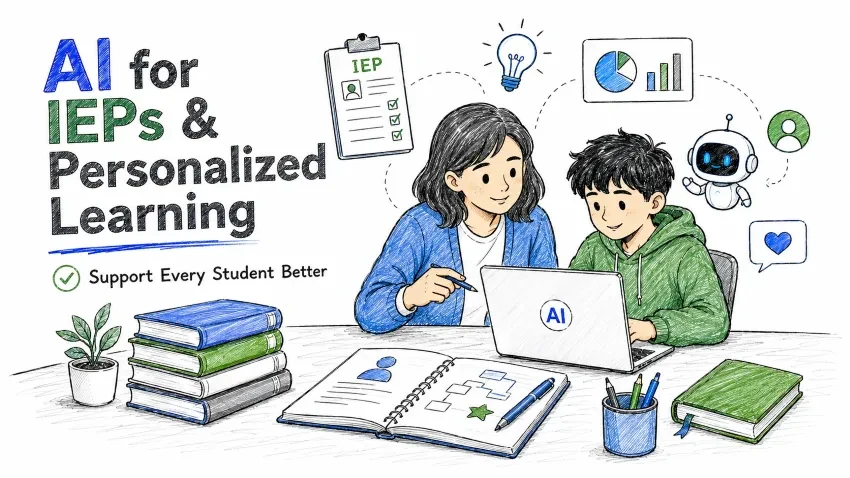
In this tutorial, you will learn how teachers can use AI to:
You do not need technical skills to start.
Personalized learning means adjusting education based on each student's unique abilities, pace, and interests.
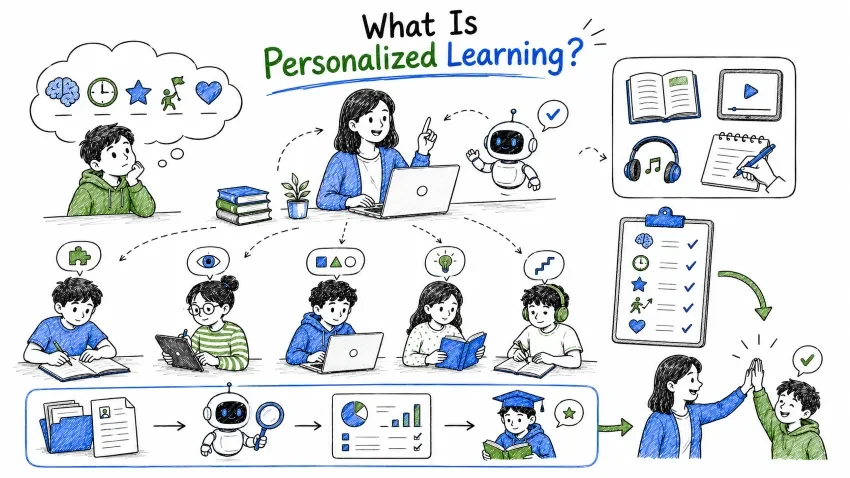
Personalized learning means adjusting education based on:
Not every student learns the same way.
Some students may need:
AI can help teachers create more personalized educational experiences.
IEP stands for Individualized Education Program — a plan designed to support students with specific learning needs or disabilities.
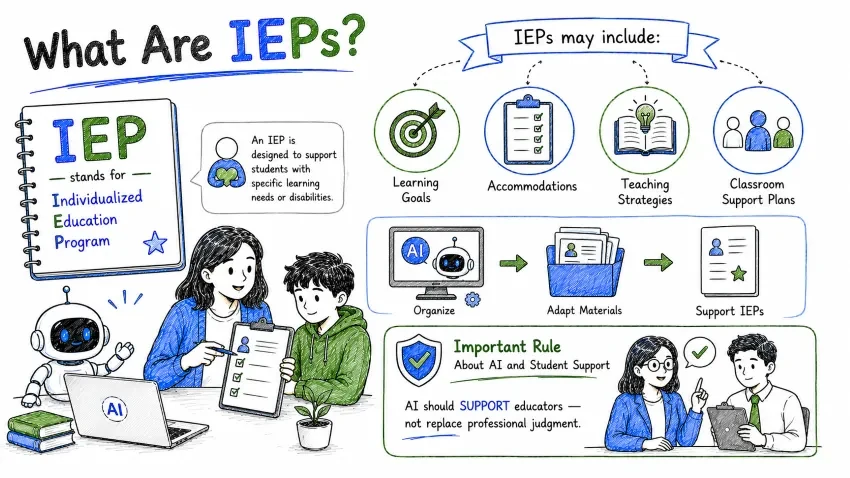
IEP stands for:
Individualized Education Program
An IEP is designed to support students with specific learning needs or disabilities.
IEPs may include:
AI can assist teachers in organizing and adapting educational materials for IEP support.
AI should support educators — not replace professional judgment. Teachers and specialists make final decisions.
AI should SUPPORT educators — not replace professional judgment.
Teachers, specialists, and parents still make final decisions.
AI cannot fully understand:
Human care and expertise remain essential.
A practical example showing how a teacher (Mrs. Verma) uses AI to support diverse learners in her classroom.
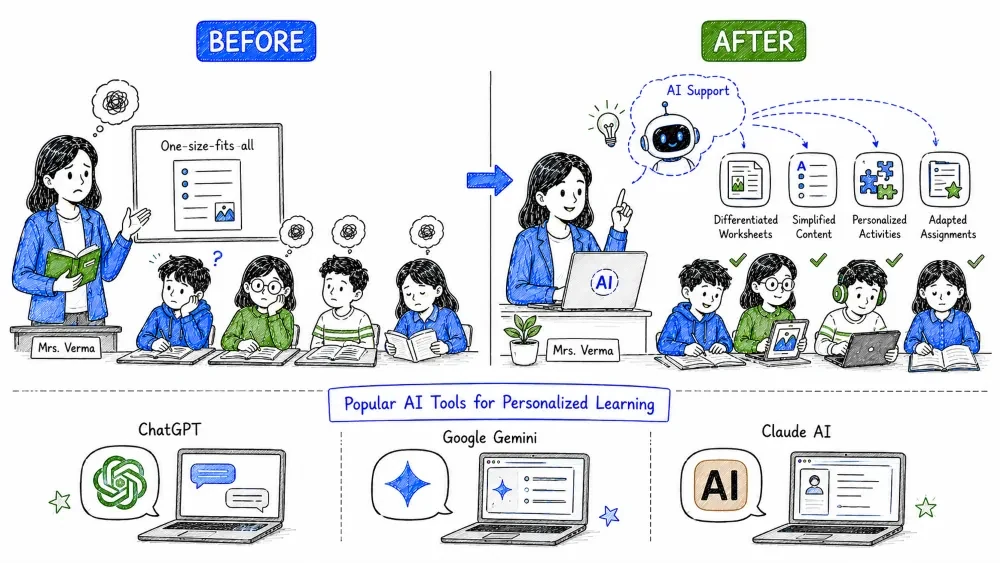
Mrs. Verma teaches a classroom with students who learn at different levels.
Some students:
Using AI, Mrs. Verma:
As a result:
A quick overview of popular AI assistants teachers can use to support personalized learning and IEP planning.
Teachers commonly use:
These tools help with:
Learn how AI can rewrite complex lessons in simpler language to support students who need extra help.
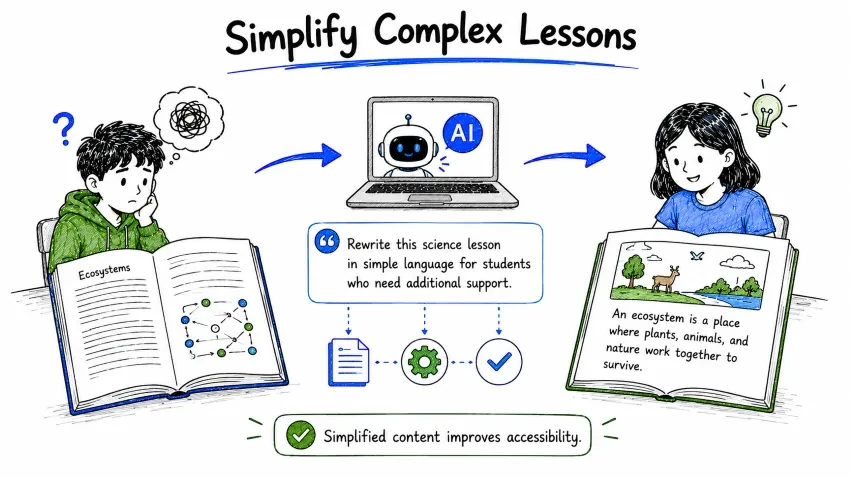
AI can rewrite lessons in simpler language.
Example Prompt:
Rewrite this science lesson in simple language for students who need additional learning support.
Original Content — Complex explanation about ecosystems.
Simplified Version — An ecosystem is a place where plants, animals, and nature work together to survive.
Simplified content improves accessibility.
Use AI to create assignments at different difficulty levels — beginner, intermediate, and advanced.
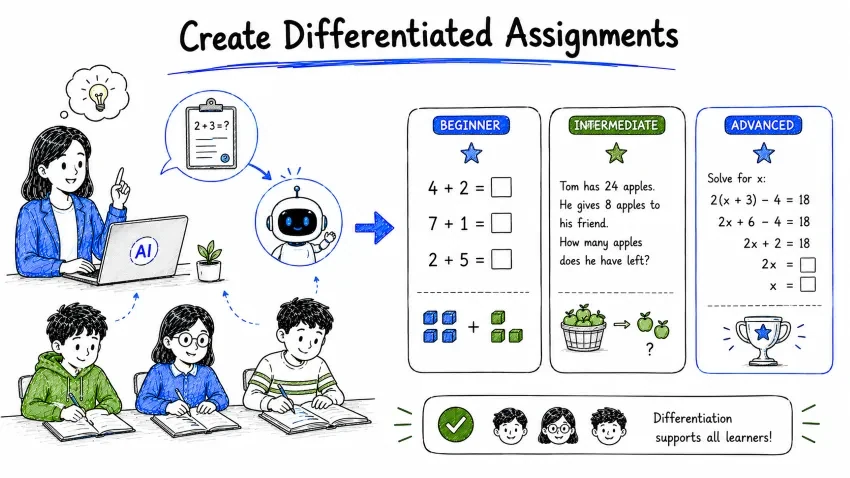
Different students may need different difficulty levels.
AI can generate:
Example Prompt:
Create three versions of this math worksheet:
- beginner
- intermediate
- advanced
| Level | Example |
|---|---|
| Beginner | Simple addition |
| Intermediate | Word problems |
| Advanced | Multi-step equations |
Differentiation supports all learners.
AI can help create clear, measurable learning objectives tailored to each student's needs.
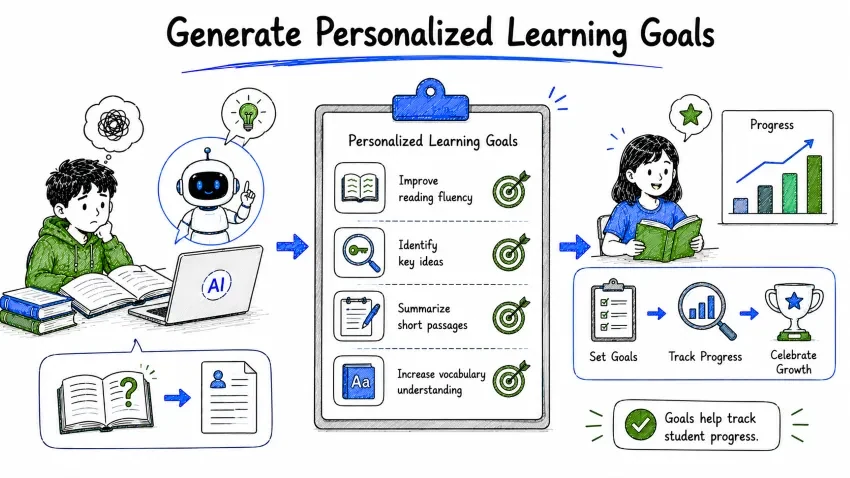
AI can help organize learning objectives.
Example Prompt:
Generate personalized learning goals for a student struggling with reading comprehension.
Goals help track student progress.
Adjust your teaching materials for visual, auditory, hands-on, and discussion-based learners.
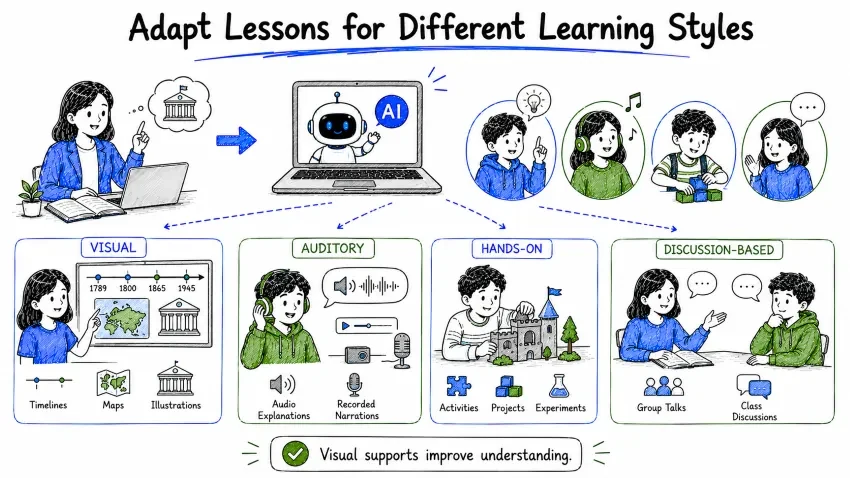
Students learn differently.
AI can help create:
Example Prompt:
Adapt this history lesson for visual learners.
Visual supports improve understanding.
Generate inclusive activities that promote collaboration, skill-building, and confidence for all students.
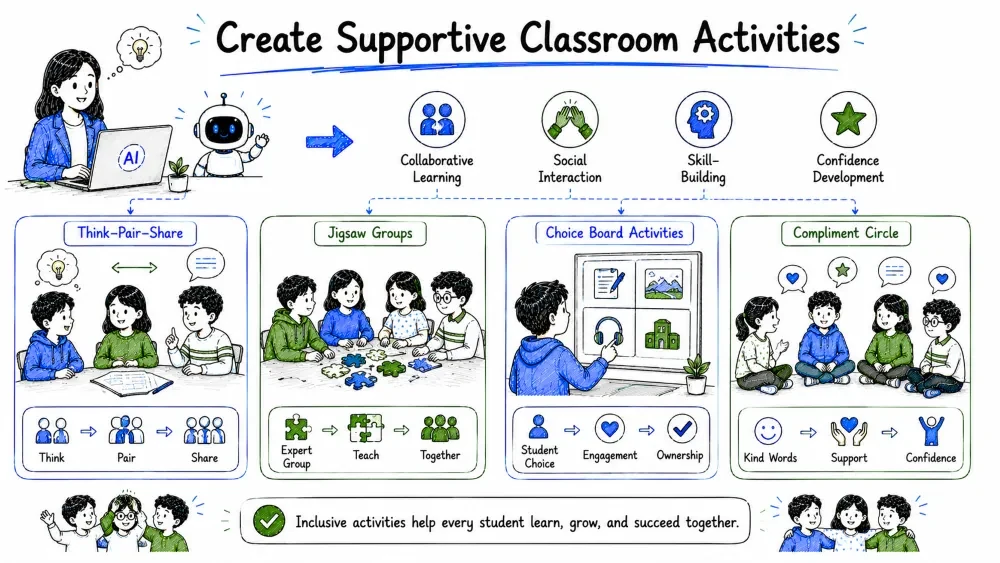
AI can generate activities for:
Example Prompt:
Generate inclusive classroom activities for mixed-ability students.
Use AI to simplify reading passages for students with reading difficulties, language barriers, or comprehension challenges.
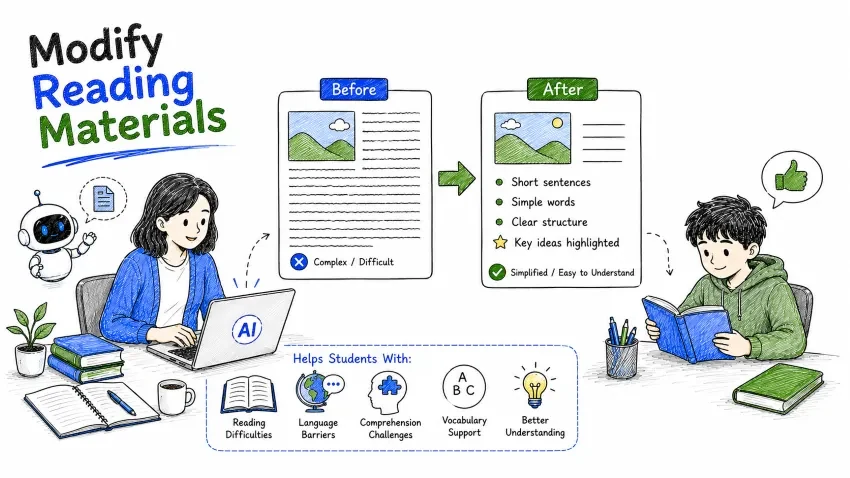
AI can simplify reading passages for students with:
Example Prompt:
Simplify this reading passage for elementary-level comprehension.
This improves accessibility for more learners.
AI can suggest positive classroom strategies to support students who struggle with focus or behavior.
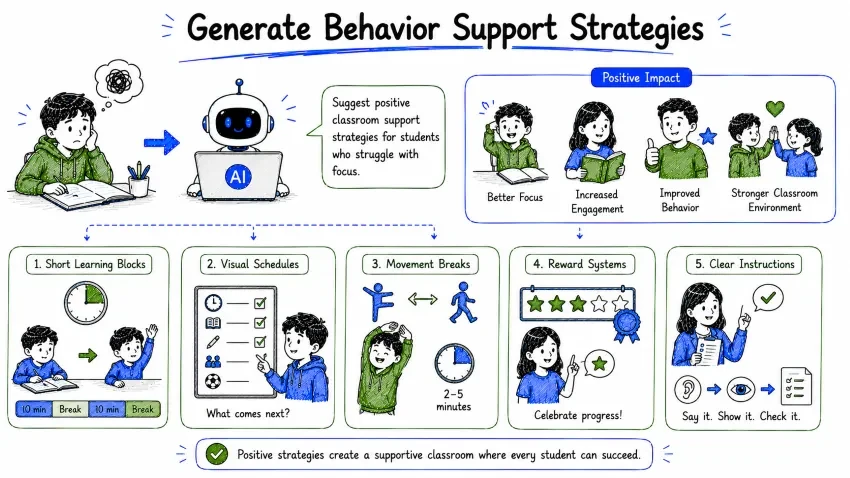
AI can suggest classroom support strategies.
Example Prompt:
Suggest positive classroom support strategies for students who struggle with focus.
These strategies support classroom engagement.
Generate targeted exercises based on each student's specific learning needs.
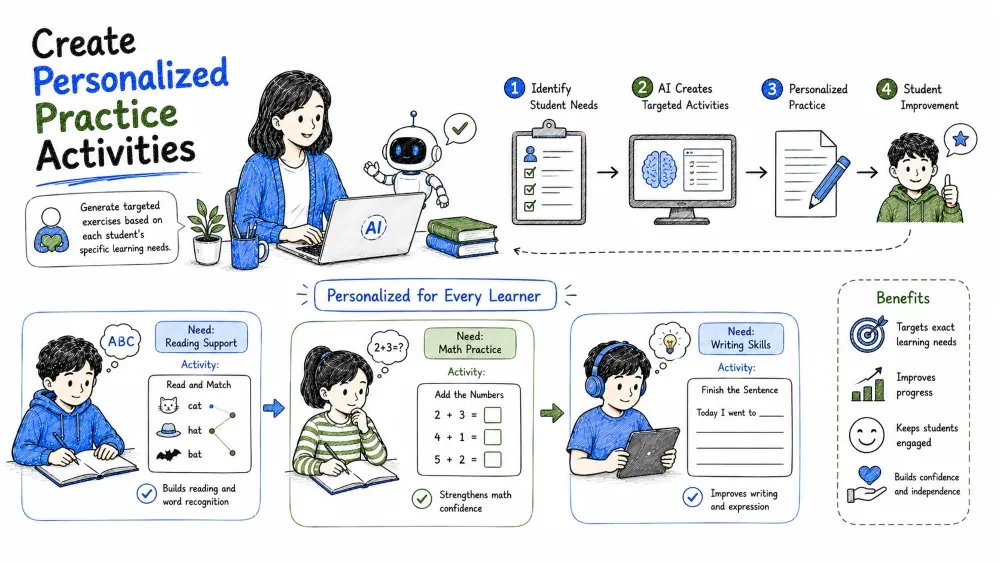
AI can generate targeted exercises based on student needs.
Example Prompt:
Create additional grammar practice for students struggling with sentence structure.
Personalized practice improves skill development.
AI can help multilingual learners by simplifying instructions, translating concepts, and generating vocabulary lists.
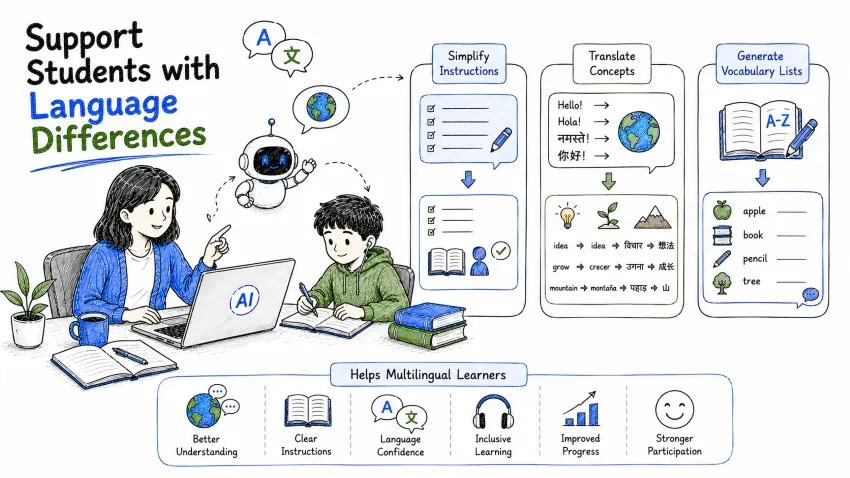
AI can help multilingual learners by:
Example Prompt:
Explain this lesson using simple English for ESL students.
This supports inclusive classrooms.
Create charts, comparison tables, step-by-step guides, and other visual aids with AI.
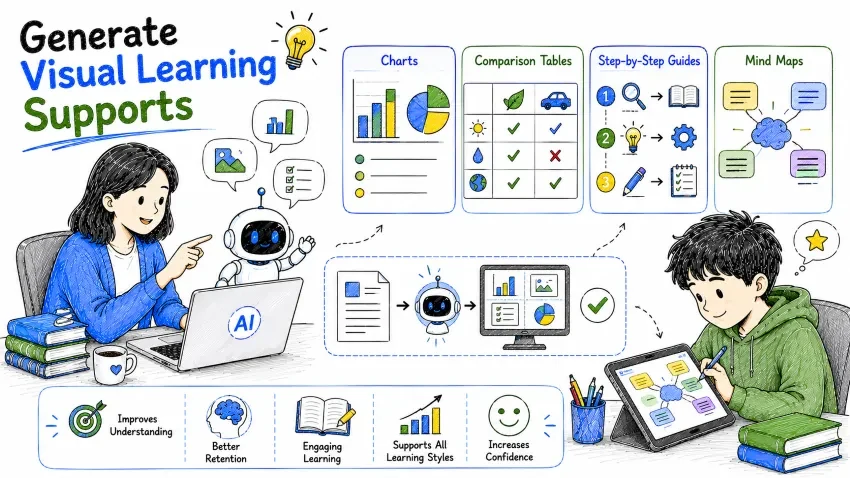
AI can help teachers create:
Example Prompt:
Create a visual step-by-step guide for solving fractions.
Visual supports improve comprehension.
AI can help create oral assessments, visual projects, simplified quizzes, and interactive activities for diverse learners.
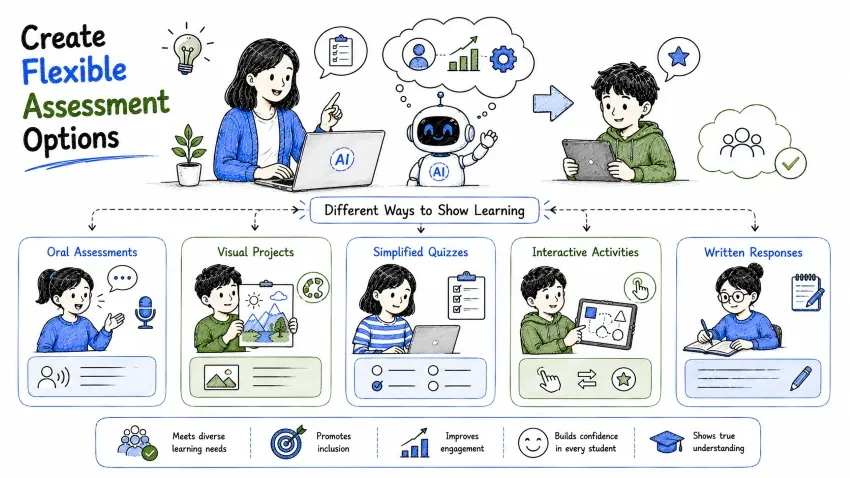
Not all students demonstrate learning the same way.
AI can help create:
Example Prompt:
Suggest alternative assessment methods for students with writing difficulties.
Flexible assessments improve fairness.
AI can organize student strengths, challenges, improvement areas, and support recommendations.
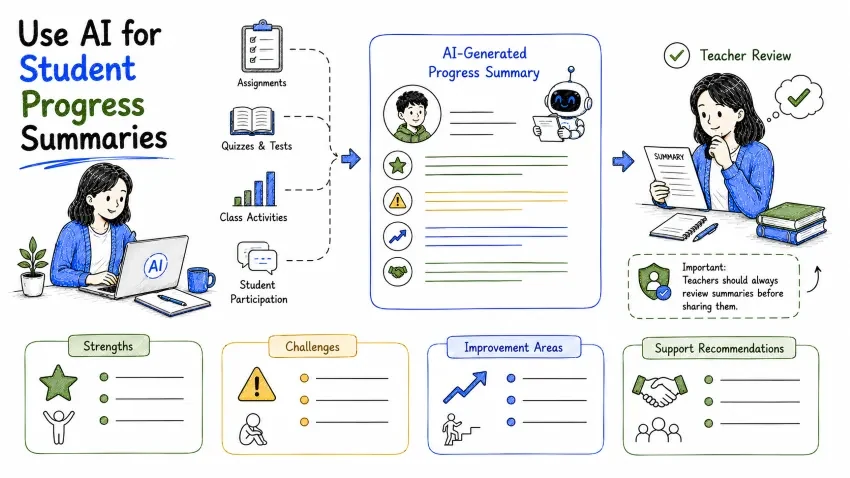
AI can organize:
Example Prompt:
Create a professional student progress summary based on these observations.
Important: Teachers should always review summaries before sharing them.
Use AI to write clear, supportive updates about student progress for parents and families.
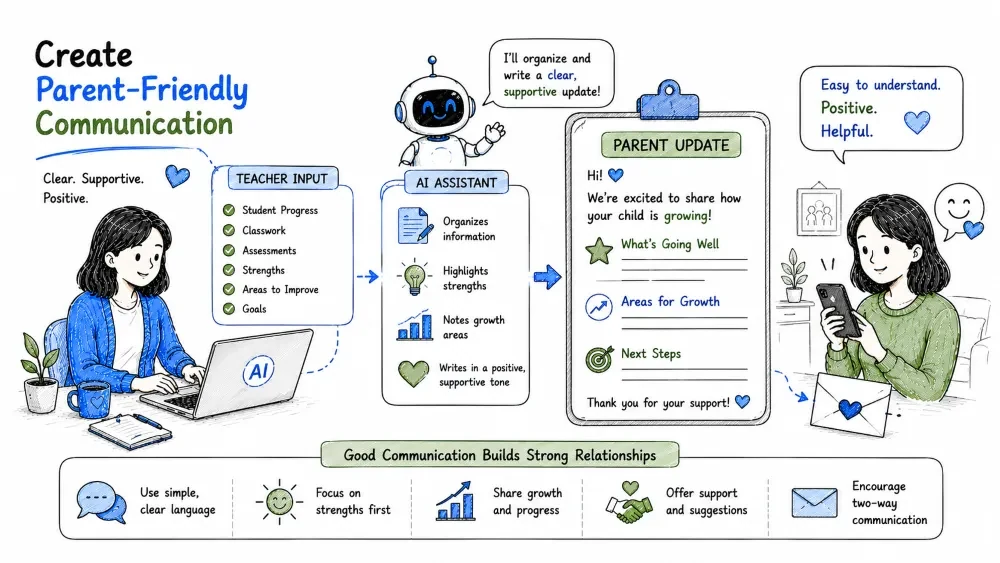
AI can help teachers explain student progress clearly and professionally.
Example Prompt:
Write a supportive parent update about a student improving in reading skills.
Clear communication strengthens collaboration with families.
Learn how AI can support accessibility, differentiated learning, equitable instruction, and classroom inclusion.
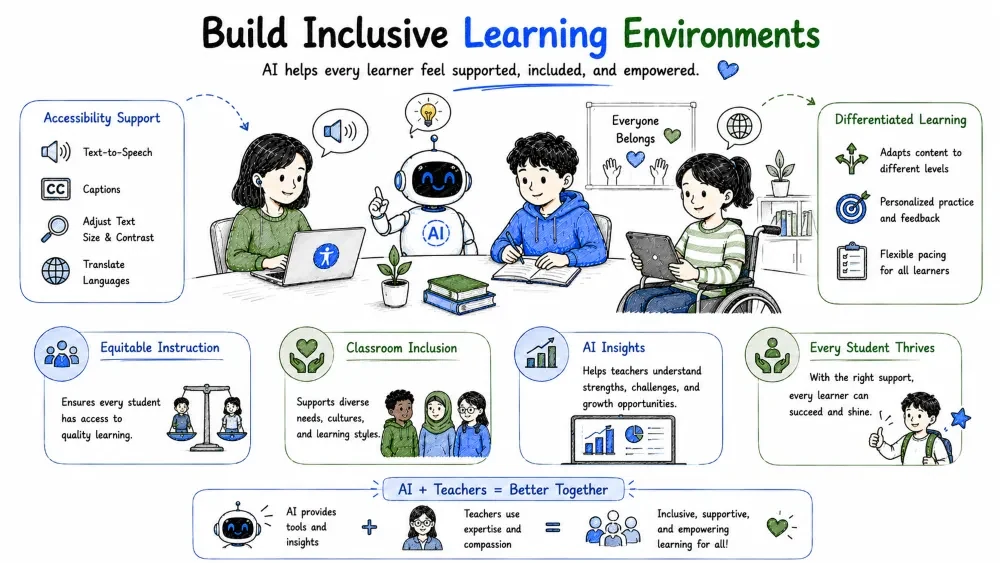
AI can support:
But inclusion still depends primarily on:
A collection of ready-to-use AI prompts for common personalization tasks like simplification, differentiation, and goal setting.
Rewrite this lesson in simpler language.
Create beginner, intermediate, and advanced versions of this activity.
Generate personalized learning goals for this student.
Suggest classroom strategies for improving student focus.
Generate inclusive classroom activities for diverse learners.
Practical strategies to get the most out of AI for personalized learning while keeping students at the center.
Personalized learning should support:
Not just weaknesses.
Different students need:
AI can help teachers adapt quickly.
Students benefit from:
AI can simplify communication.
AI does not fully understand:
Teacher judgment is essential.
Common pitfalls teachers face when using AI for personalized learning and how to avoid them.
Students have unique learning needs.
Personalization matters.
Never upload:
Protect student privacy at all times.
AI cannot replace:
Human support remains critical.
Simple and clear modifications are often most effective.
Guidelines for using AI responsibly in personalized learning — balancing innovation with student dignity and privacy.
Teachers should use AI responsibly.
Good Uses:
Bad Uses:
Student dignity and privacy must always come first.
A hands-on task to practice using AI for personalized learning with a real or sample classroom lesson.
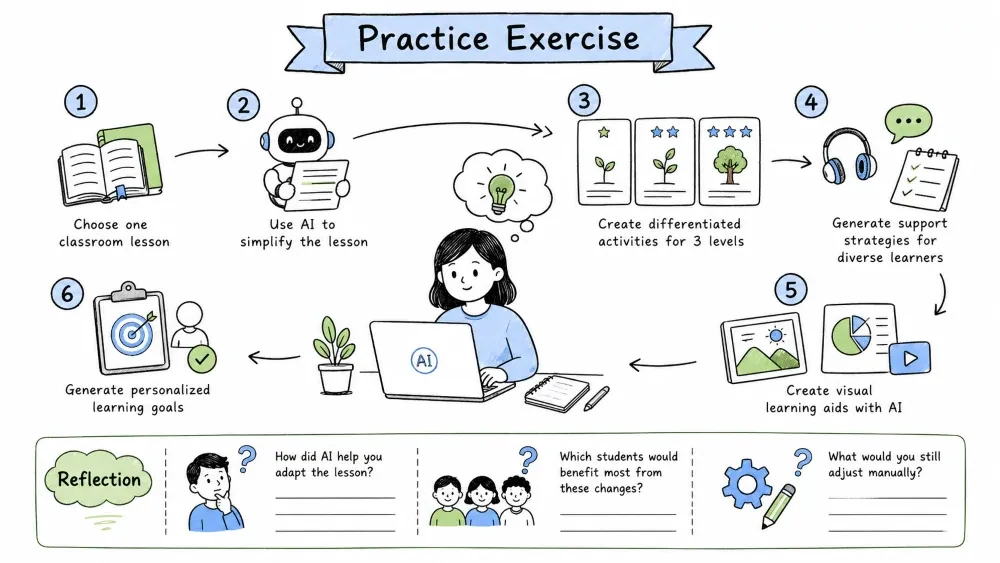
Goal: Use AI to support personalized learning for one classroom lesson.
| Step | Task | Done? |
|---|---|---|
| 1 | Choose one classroom lesson (any subject) | ☐ |
| 2 | Use AI to simplify the lesson | ☐ |
| 3 | Create differentiated activities for 3 levels | ☐ |
| 4 | Generate support strategies for diverse learners | ☐ |
| 5 | Create visual learning aids with AI | ☐ |
| 6 | Generate personalized learning goals | ☐ |
Use AI personalization strategies for one full week and track how it affects student engagement and learning.
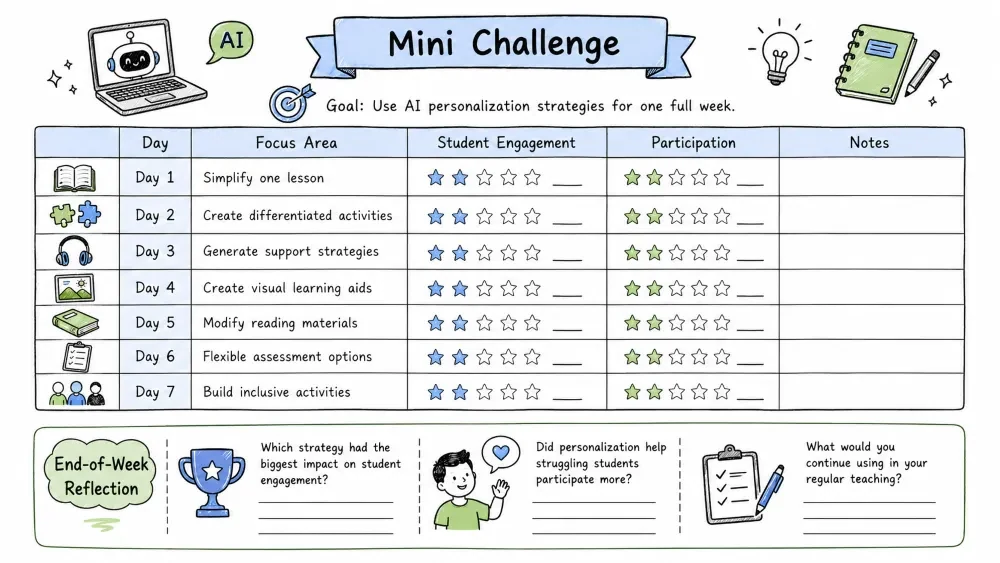
Goal: Use AI personalization strategies for one full week.
| Day | Focus Area | Student Engagement | Participation | Notes |
|---|---|---|---|---|
| Day 1 | Simplify one lesson | ⭐⭐___ | ⭐⭐___ | |
| Day 2 | Create differentiated activities | ⭐⭐___ | ⭐⭐___ | |
| Day 3 | Generate support strategies | ⭐⭐___ | ⭐⭐___ | |
| Day 4 | Create visual learning aids | ⭐⭐___ | ⭐⭐___ | |
| Day 5 | Modify reading materials | ⭐⭐___ | ⭐⭐___ | |
| Day 6 | Flexible assessment options | ⭐⭐___ | ⭐⭐___ | |
| Day 7 | Build inclusive activities | ⭐⭐___ | ⭐⭐___ |
The key advantages of using AI to create more inclusive, adaptable, and personalized learning experiences.
AI helps teachers:
Understanding what AI cannot do in personalized education and why human teachers remain irreplaceable.
AI cannot:
Teachers and specialists remain essential.
Continue your journey — learn how AI can help teachers communicate better with parents and families.
AI Parent Communication — Build Better School-Home Connections
Learn how teachers can use AI to:
Save your progress and earn XP for completing tutorials.
Technology
AI for everyone
Lesson group
The Future Ready Teacher
Progress
75% complete