Preparing your learning space...
25% through The High Performance Student tutorials
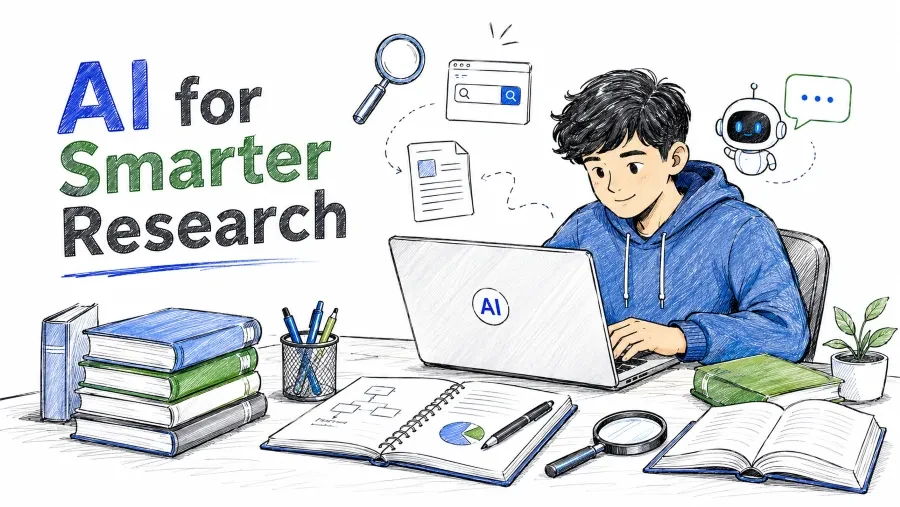
In this tutorial, you will learn a practical AI-assisted research workflow for students:
You do not need advanced technical knowledge or research experience to start.
Using AI tools to collect, summarize, explain, and organize research information faster.
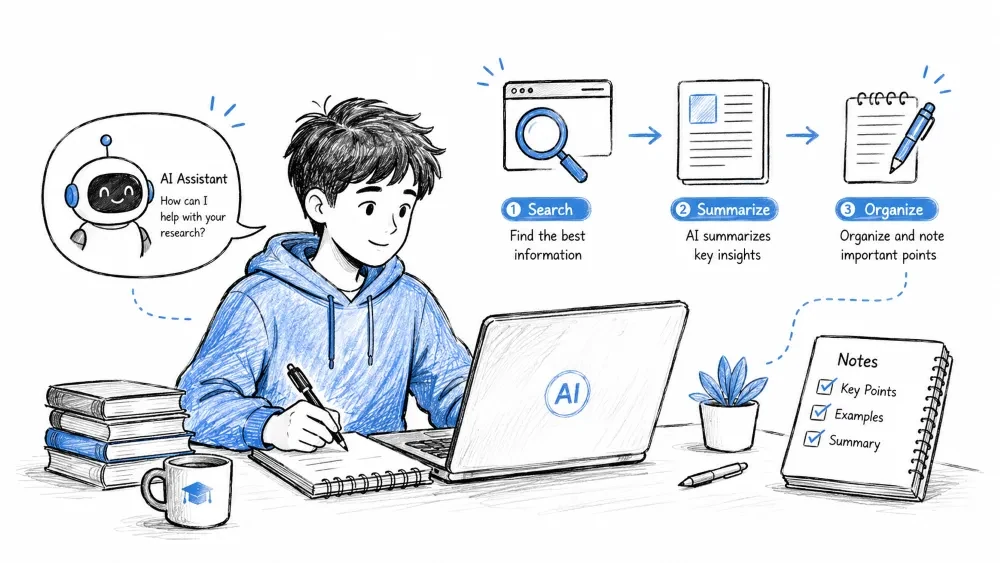
AI-assisted research means using AI tools to help:
AI acts like a research assistant.
It helps students save time and focus on understanding instead of searching endlessly.
AI reduces manual research effort so students learn faster with less frustration.
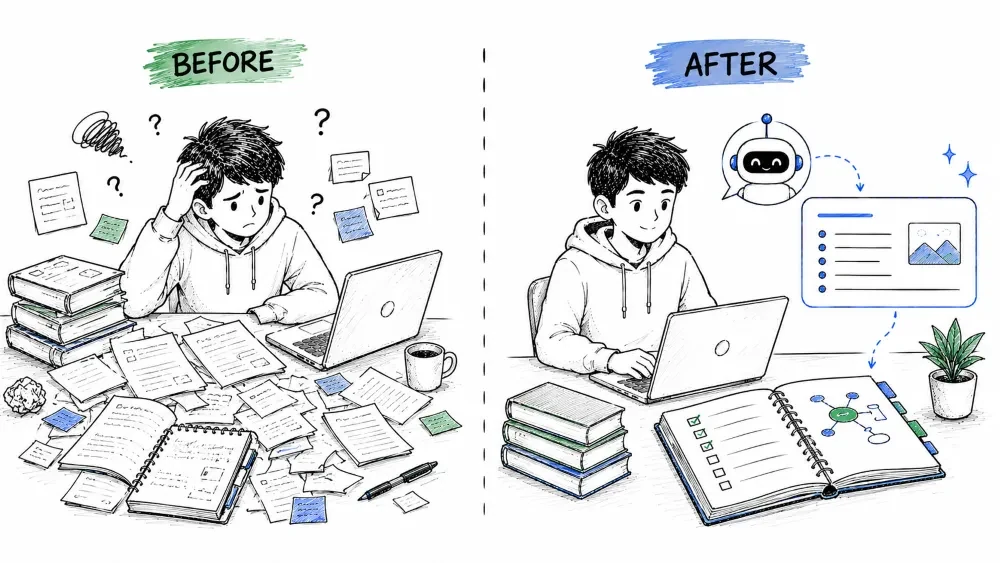
Traditional research can be slow because students spend hours:
AI can simplify these tasks.
Benefits include:
A concrete example showing how AI solves common student research problems.
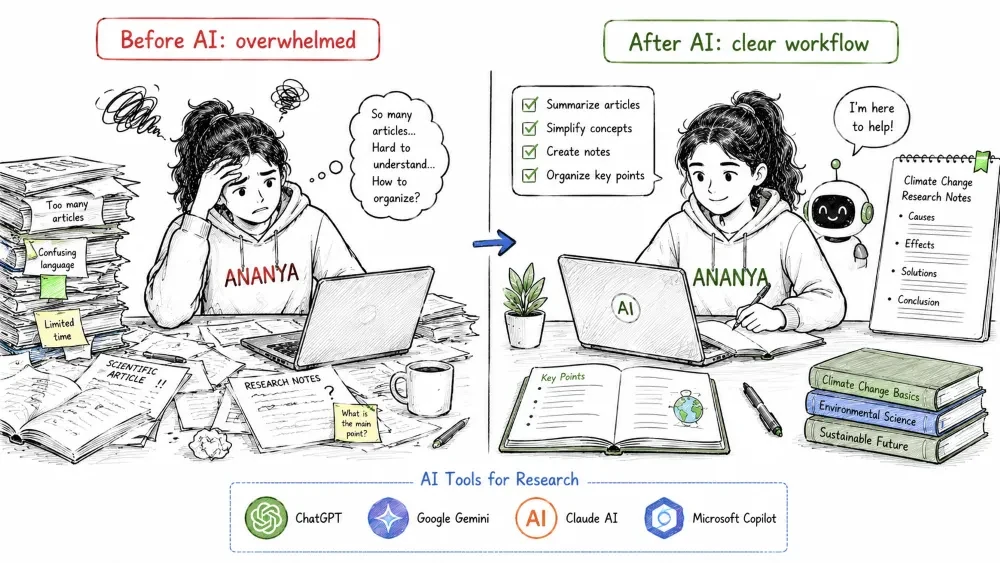
Ananya has to prepare a research project about climate change.
Problems:
Using AI, Ananya:
As a result:
Popular AI chatbots that can summarize, explain, and organize research content.
Popular AI tools include:
These tools can help:
AI can hallucinate facts — always verify before trusting.
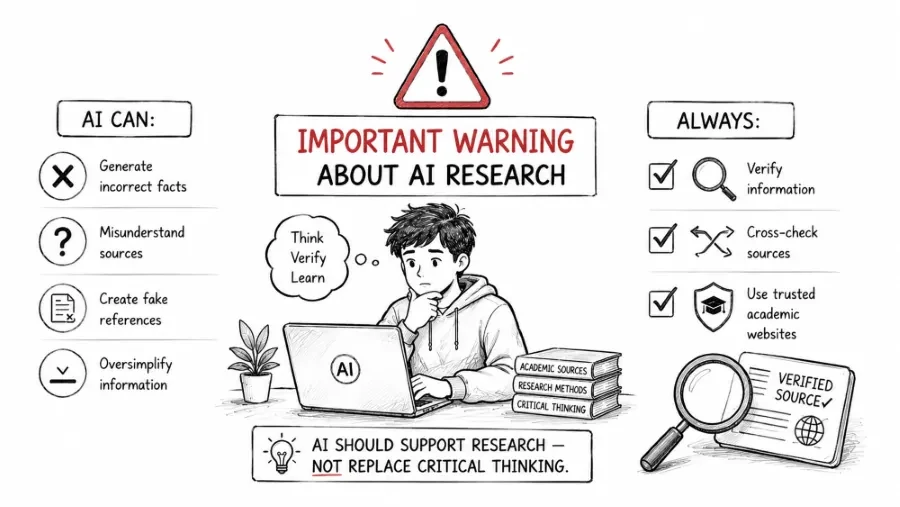
AI is helpful, but it is NOT always correct.
AI can:
Always:
AI should support research — not replace critical thinking.
A focused question guides AI to give relevant, useful answers instead of generic ones.
Good research begins with a clear question.
Bad Example:
Tell me about space.
Good Example:
How does climate change affect agriculture in India?
Specific questions improve AI responses.
Get a simple overview first to build a mental framework before diving into details.
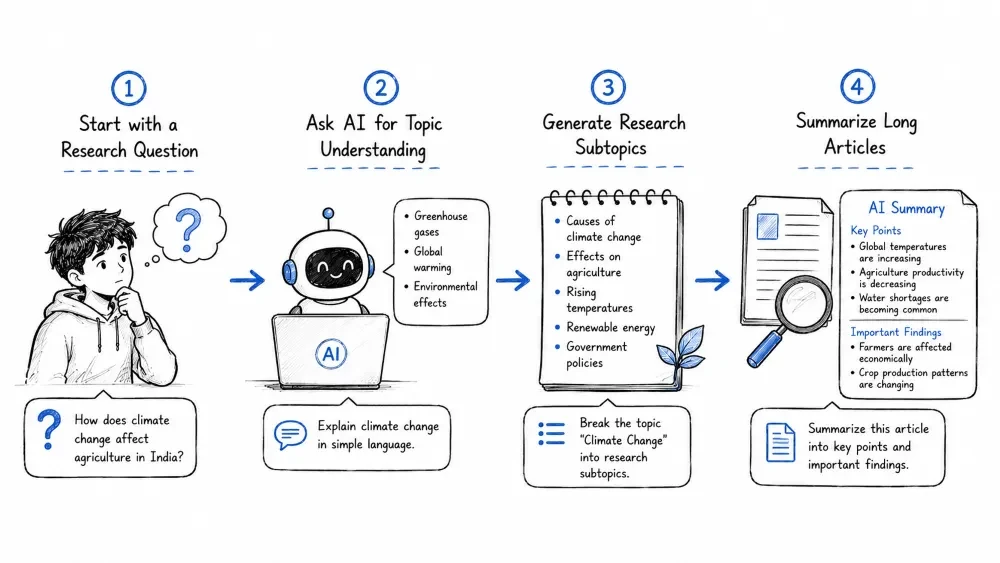
Before deep research, use AI to understand the topic.
Example Prompt:
Explain climate change in simple language for a high school student.
AI may explain:
This creates a strong foundation before advanced research.
Breaking a big topic into smaller sections makes research manageable and organized.
Large topics are easier when divided into smaller sections.
Example Prompt:
Break the topic "Climate Change" into research subtopics.
Example Output:
Subtopics make research organized and manageable.
AI condenses long papers into key points so you grasp the core ideas in minutes.
Research papers and articles are often difficult to read.
AI can summarize them quickly.
Example Prompt:
Summarize this article into key points and important findings.
Paste the article below the prompt.
This saves time while reading.
AI translates technical jargon into plain language so you actually understand the idea.
Many academic topics contain technical language.
AI can explain them in simpler words.
Example Prompt:
Explain photosynthesis in very simple language.
Or:
Explain quantum computing like I am 12 years old.
This improves understanding significantly.
AI builds side-by-side comparisons so you can evaluate different viewpoints quickly.
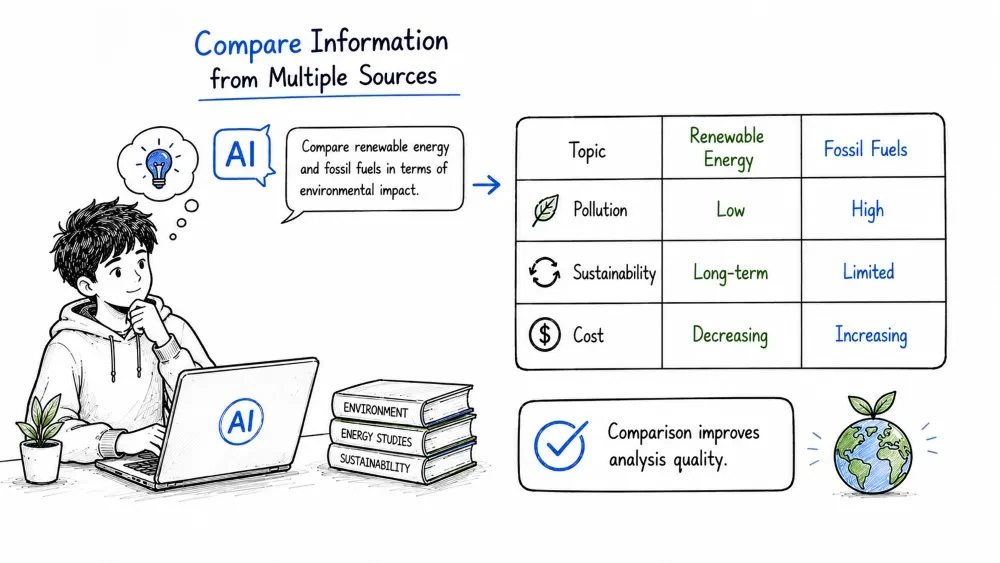
Research requires comparing viewpoints.
Example Prompt:
Compare renewable energy and fossil fuels in terms of environmental impact.
AI may generate:
| Topic | Renewable Energy | Fossil Fuels |
|---|---|---|
| Pollution | Low | High |
| Sustainability | Long-term | Limited |
| Cost | Decreasing | Increasing |
Comparison improves analysis quality.
AI structures raw information into organized notes with headings, bullets, and categories.
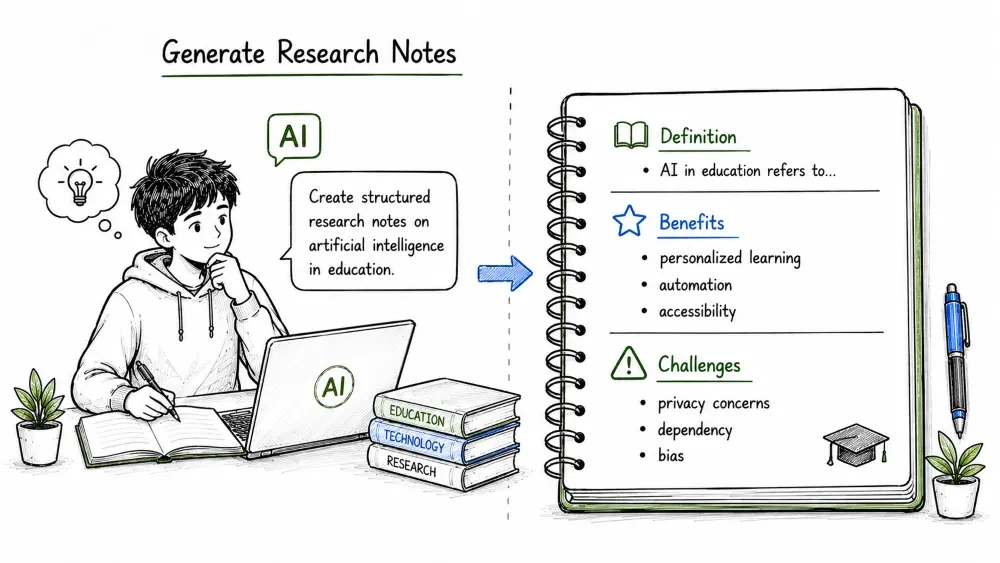
AI can create organized notes automatically.
Example Prompt:
Create structured research notes on artificial intelligence in education.
Example Output:
AI in education refers to...
AI generates practice questions for active recall and exam preparation.
AI can generate revision questions.
Example Prompt:
Create 10 important questions from this topic.
Useful for:
AI creates a logical structure for your paper so writing flows smoothly.
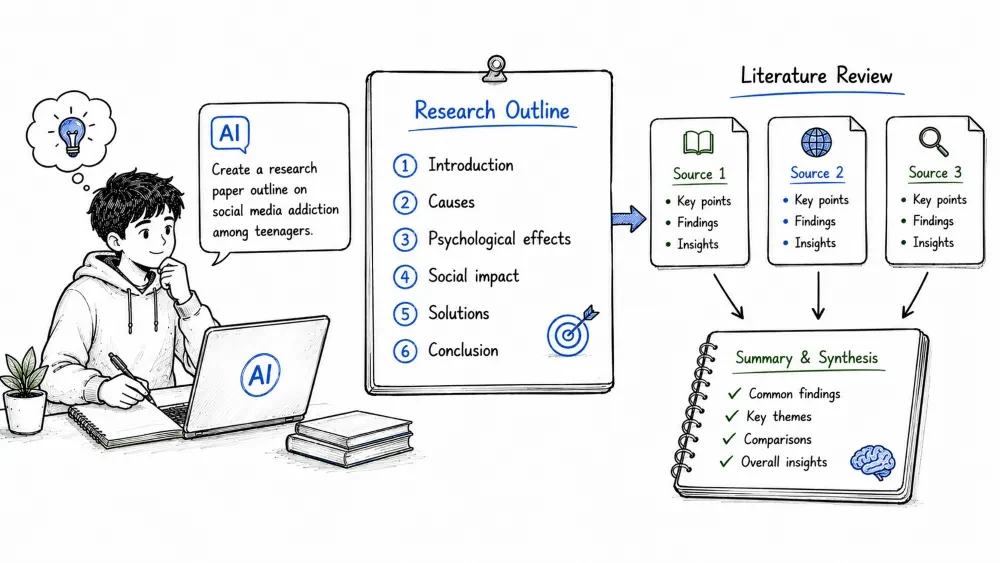
Research papers become easier with outlines.
Example Prompt:
Create a research paper outline on social media addiction among teenagers.
Example Output:
Outlines improve writing structure.
AI synthesizes multiple sources to reveal patterns, agreements, and gaps across papers.
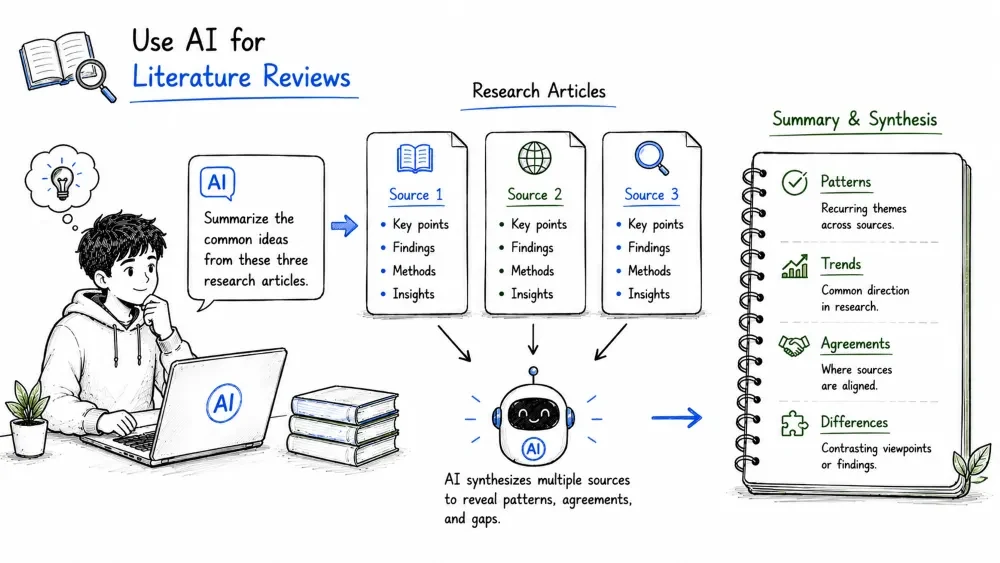
AI can summarize multiple sources together.
Example Prompt:
Summarize the common ideas from these three research articles.
This helps students identify:
AI turns scattered facts into tables, timelines, categories, or bullet points for fast review.
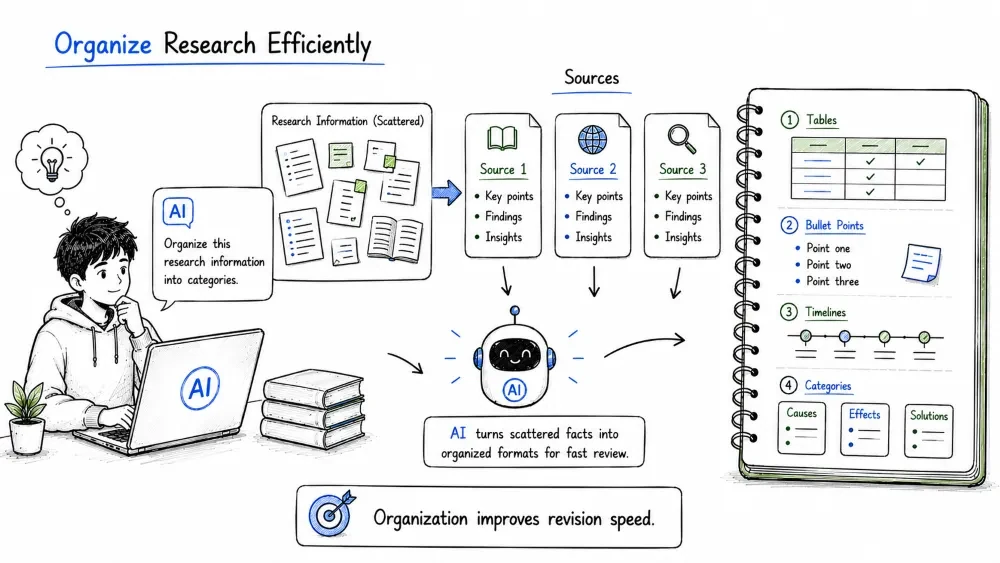
AI can help organize information into:
Example Prompt:
Organize this research information into categories.
Organization improves revision speed.
AI converts notes into Q&A cards for spaced repetition and quick self-testing.
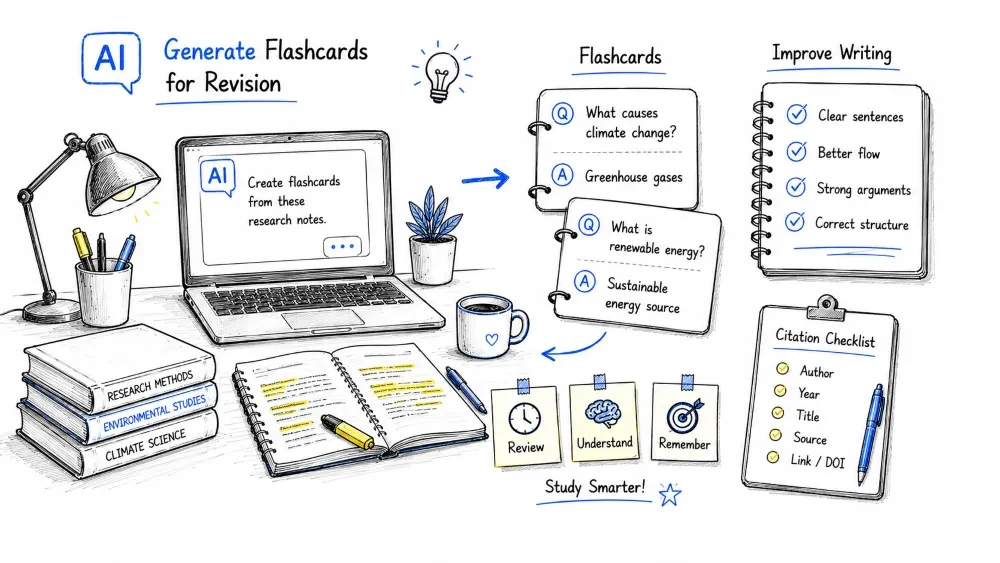
AI can create flashcards automatically.
Example Prompt:
Create flashcards from these research notes.
Example:
| Question | Answer |
|---|---|
| What causes climate change? | Greenhouse gases |
| What is renewable energy? | Sustainable energy source |
AI polishes grammar, clarity, and flow — but you must keep your own voice and ideas.
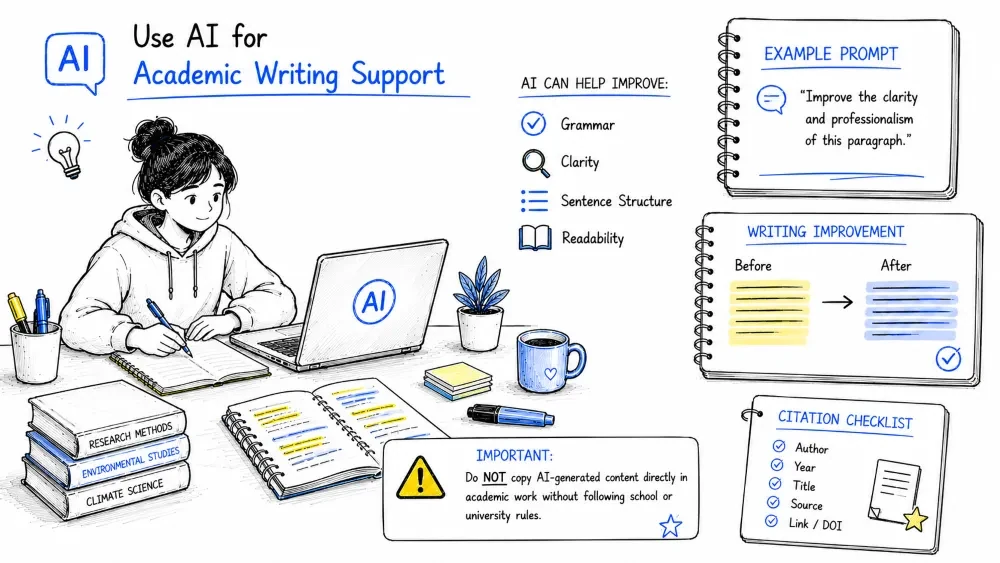
AI can help improve:
Example Prompt:
Improve the clarity and professionalism of this paragraph.
Important: Do NOT copy AI-generated content directly in academic work without following school or university rules.
AI explains citation formats and helps verify source details — but you must manually confirm every reference.
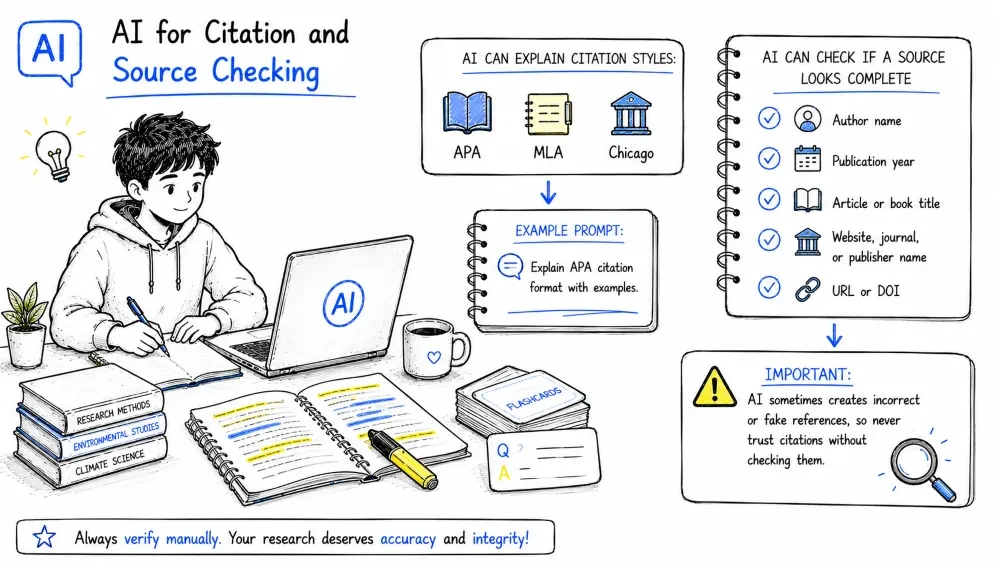
AI can explain citation styles like:
Example Prompt:
Explain APA citation format with examples.
AI can also help you check whether a source looks complete.
Always verify manually:
AI sometimes creates incorrect or fake references, so never trust citations without checking them.
Proven workflows that help you research systematically instead of randomly prompting AI.
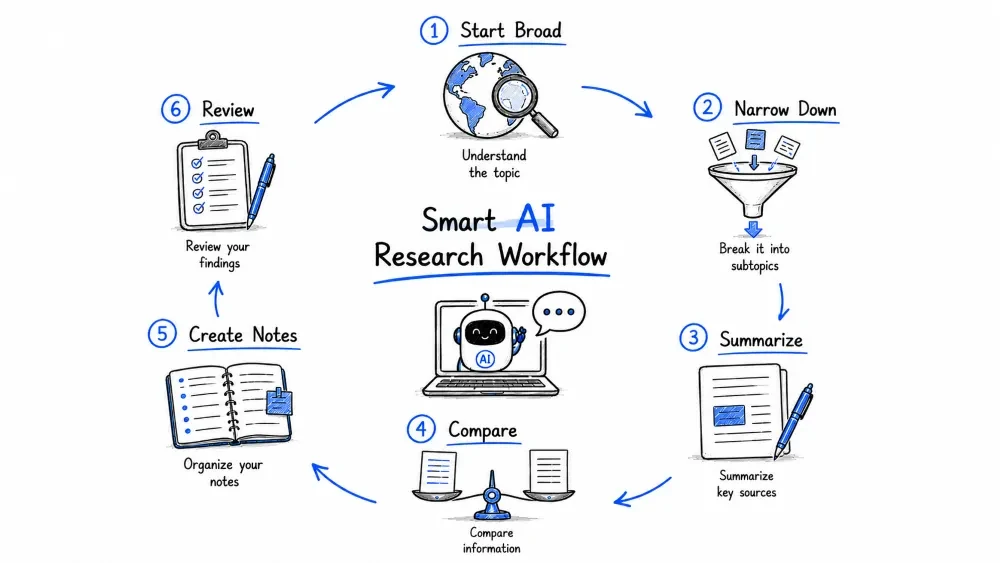
Start broad, then narrow the topic step by step:
AI works best with this kind of structured workflow.
Do not stop after one answer.
Example:
Explain more deeply.
Or:
Give real-world examples.
Follow-up questions help you move from summary to understanding.
Always verify:
Use trusted academic sources, and compare AI output with at least one reliable source.
Ready-to-use prompt templates for the most common research tasks.
Explain this topic in simple language.
Summarize this research article into key findings.
Compare these two concepts with examples.
Create a structured research outline for this topic.
Generate important exam questions from this topic.
Frequent pitfalls that lead to poor research outcomes when using AI carelessly.
AI can make mistakes.
Always verify information.
Research is about learning — not just generating text.
Understand the topic before using AI output.
AI sometimes creates incorrect citations.
Verify every source manually.
Critical thinking remains essential.
AI should assist your thinking, not replace it.
Guidelines for using AI honestly in academic work without cheating or plagiarism.
Students should use AI responsibly.
Good Uses:
Bad Uses:
Academic honesty is important.
How AI speeds up research while improving organization and understanding.
AI helps:
What AI cannot do — human judgment, accuracy guarantees, and original thinking still required.
AI cannot:
Human analysis remains necessary.
A guided workflow to practice the full AI research process on a topic you enjoy.
Choose one topic you enjoy and complete this workflow:
If you want a harder challenge, repeat the same process with 3 sources and compare the results.
A capstone exercise to apply everything you've learned with clear deliverables and verification steps.
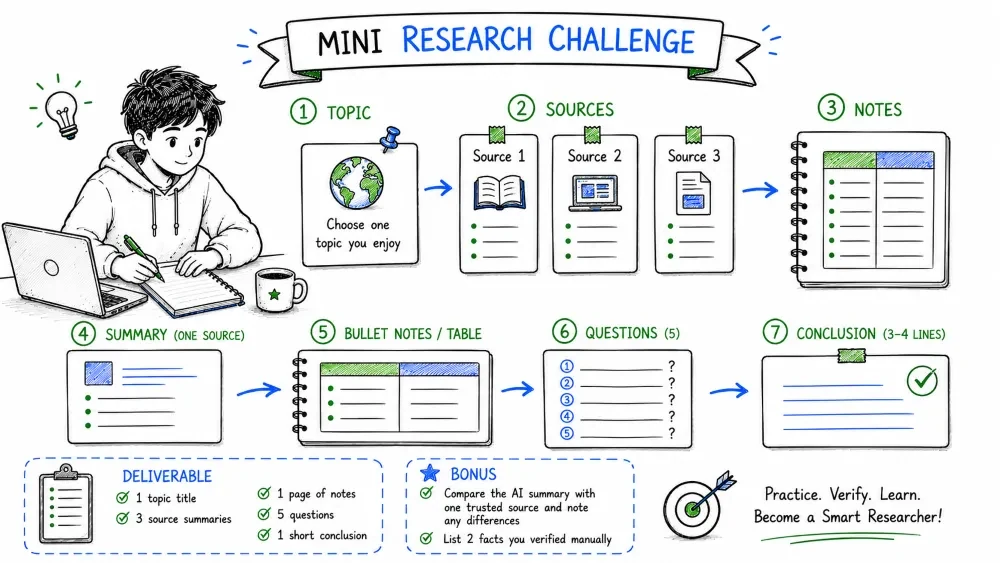
Complete a short research project using AI assistance.
Requirements:
Deliverable:
Bonus:
Save your progress and earn XP for completing tutorials.
Technology
AI for everyone
Lesson group
The High Performance Student
Progress
25% complete