Preparing your learning space...
33% through Cyber Laws tutorials
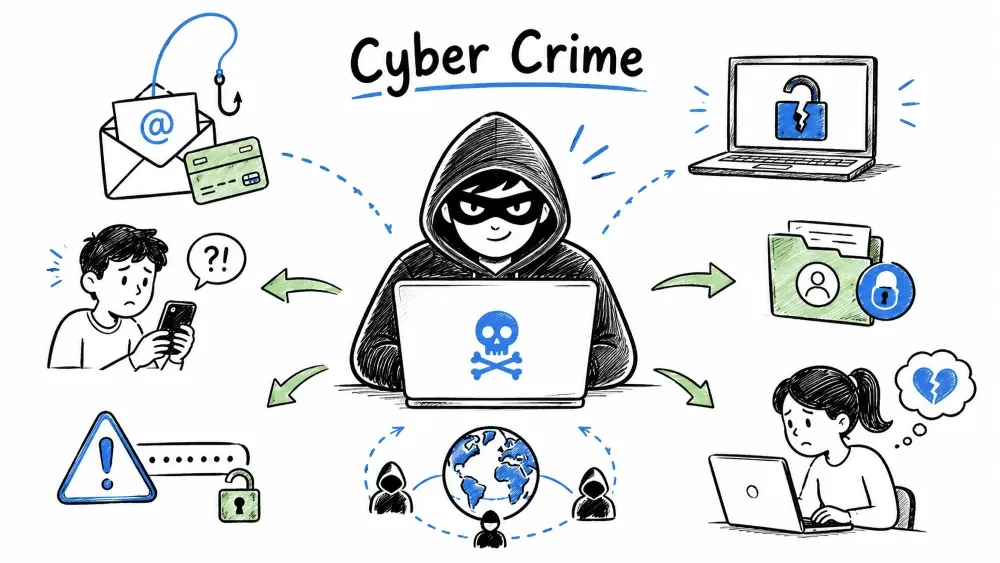
Cyber crime refers to any illegal activity that involves a computer, a networked device, or a network. The computer may be the tool of the crime, the target of the crime, or the evidence of the crime.
In simple terms — any criminal act carried out using digital technology is a cyber crime.
Cyber crimes are broadly classified into three categories:
| Crime | Description |
|---|---|
| Cyber Stalking | Using the internet to harass or stalk someone repeatedly |
| Cyber Bullying | Using digital platforms to intimidate, threaten, or humiliate someone (common among teens) |
| Identity Theft | Stealing someone's personal information to impersonate them |
| Phishing | Fraudulent emails/messages that trick users into revealing sensitive data |
| Cyber Defamation | Publishing defamatory content about someone online |
| Email Spoofing | Faking the sender address of an email |
| Crime | Description |
|---|---|
| Credit Card Fraud | Unauthorised use of credit/debit card details |
| Intellectual Property Theft | Stealing copyrighted content, software, or trade secrets |
| Cyber Squatting | Registering domain names similar to popular brands to extort money |
| Data Theft | Stealing confidential business data |
| Crime | Description |
|---|---|
| Cyber Terrorism | Using the internet to disrupt national security or critical infrastructure |
| Cyber Warfare | State-sponsored attacks on another nation's digital systems |
| Child Pornography | Creating, distributing, or possessing exploitative content of minors |
| Hacking Government Systems | Unauthorised access to classified government information |
Unauthorised access to a computer system or network.
Flooding a server with traffic to make it unavailable to legitimate users.
| Type | Description |
|---|---|
| Phishing | Fake emails appearing to be from trusted sources |
| Spear Phishing | Targeted phishing aimed at a specific individual/company |
| Vishing | Voice phishing over the phone |
| Smishing | SMS-based phishing |
| Baiting | Leaving malware-infected devices (USB drives) where victims will find them |
The attacker secretly intercepts communication between two parties to steal data.
Injecting malicious SQL code into a web application's database query to access or manipulate data.
Injecting malicious scripts into web pages viewed by other users.
| Type | Description |
|---|---|
| Brute Force Attack | Trying every possible combination of characters until the password is cracked |
| Dictionary Attack | Using a list of common passwords / dictionary words |
| Credential Stuffing | Using leaked username-password pairs from one site to access accounts on another site |
| Keylogging | Recording keystrokes to capture passwords as they are typed |
A vulnerability in software that is unknown to the vendor and has no patch available. Cyber criminals exploit these before developers can fix them.
Zero-day attacks are among the most dangerous because no defence exists at the time of the attack.
Note: Numbers change rapidly — these illustrate scale.
| Year | Global Cyber Crime Cost (Estimated) |
|---|---|
| 2020 | ~$1 Trillion USD |
| 2025 | ~$10.5 Trillion USD (projected) |
| 2030 | ~$15+ Trillion USD (projected) |
| Profile | Description |
|---|---|
| Script Kiddies | Amateurs using pre-built tools; low skill |
| Hacktivists | Attack for political or social causes (e.g., Anonymous) |
| Insider Threats | Employees or contractors misusing access |
| Cyber Terrorists | Target critical infrastructure to cause fear |
| State-Sponsored Actors | Backed by a government for espionage/warfare |
| Organised Crime Groups | Motivated by financial gain |
Save your progress and earn XP for completing tutorials.
Technology
Cyber Security & Networking
Lesson group
Cyber Laws
Progress
33% complete