Preparing your learning space...
14% through Ethical Hacking tutorials
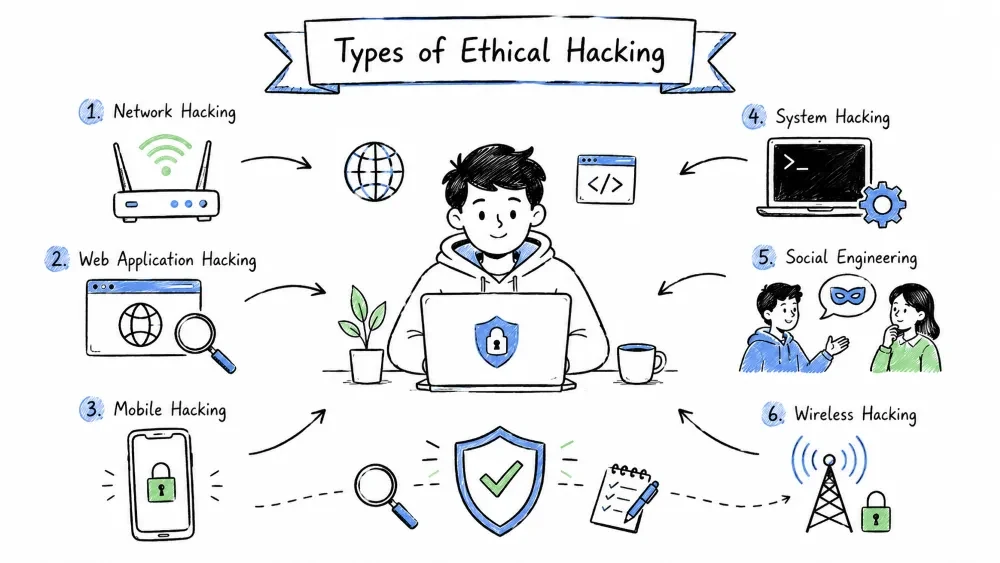
Hacking refers to the act of identifying weaknesses in a computer system or network to exploit its vulnerabilities and gain unauthorized access. The term originated in the 1960s at MIT, where "hacking" initially described clever, elegant solutions to programming problems — a positive term among early computer enthusiasts.
Today, however, the media has popularized hacking as a criminal activity. In reality, not all hacking is malicious — the intent and authorization behind the act determine whether it is ethical or criminal.
| Era | Key Event | Significance |
|---|---|---|
| 1960s | MIT hackers (Tech Model Railroad Club) | "Hack" meant an elegant technical solution |
| 1970s | Phone Phreaking (John Draper / Captain Crunch) | Blue boxes exploited telephone systems |
| 1980s | Kevin Mitnick, Legion of Doom | First high-profile cyber-criminal cases |
| 1986 | Computer Fraud and Abuse Act (CFAA) | US law criminalizing unauthorized access |
| 1990s | Rise of the internet, Morris Worm (1988) | Hacking went global; first worm caused $100M+ damage |
| 2000s | Ethical hacking formalized (CEH launched 2003) | Hacking became a legitimate profession |
| 2010s | Advanced Persistent Threats (APTs), Stuxnet | State-sponsored hacking entered mainstream |
| 2020s | Ransomware boom, AI-powered attacks | Cybercrime projected to cost $10.5 trillion annually by 2025 |
Ethical Hacking (also called Penetration Testing or White Hat Hacking) is the practice of legally and authorizedly breaking into systems, networks, or applications to discover security vulnerabilities that malicious hackers could exploit.
Ethical hackers use the same tools, techniques, and methods as malicious hackers — but with permission and a constructive purpose: to improve security.
| Principle | Description |
|---|---|
| Authorization | Written permission must be obtained before testing — a signed contract/RoE |
| Scope | Testing is limited to agreed-upon systems, IPs, and applications |
| Confidentiality | All findings remain confidential until disclosed responsibly to the client |
| Reporting | A detailed report of vulnerabilities and fixes is provided |
| No Damage | Testing should not cause harm to systems, data, or business operations |
| Certification | Issuer | Focus | Prestige Level |
|---|---|---|---|
| CEH (Certified Ethical Hacker) | EC-Council | Broad ethical hacking concepts | Entry-Mid |
| OSCP (Offensive Security Certified Professional) | Offensive Security | Hands-on penetration testing | High |
| GPEN (GIAC Penetration Tester) | SANS Institute | Enterprise penetration testing | High |
| PNPT (Practical Network Penetration Tester) | TCM Security | Real-world pentesting methodology | Mid-High |
| CISSP (Certified Info Systems Security Professional) | ISC² | Broad security management | Expert-level |
Example Career Path: Many ethical hackers start with CompTIA Security+ (foundational), move to CEH (concepts), then prove hands-on skills with OSCP (the gold standard for pentesters), and later specialize with OSWE (web apps), OSEP (evasion), or OSED (exploit development).
Hackers are broadly classified into three categories based on their intent, authorization, and methods.
"The Good Guys"
White Hat hackers are security professionals who work with explicit permission to find and fix security flaws. They are bound by legal contracts, codes of ethics, and professional standards.
Characteristics:
Typical Employers:
Famous White Hat Hackers:
| Name | Known For |
|---|---|
| Charlie Miller | First to hack a iPhone, MacBook Air, and Jeep Cherokee (remotely) |
| Jayson E. Street | Social engineering expert, physical pentesting |
| Georgia Weidman | Smartphone exploitation, author of "Penetration Testing" |
| Katie Moussouris | Bug bounty pioneer, created Microsoft's first bounty program |
| Marcus Hutchins | Stopped the WannaCry ransomware (accidentally) — later became a researcher |
Real-World Example:
In 2019, a White Hat team from Synack (a pentesting platform) was hired by a major bank to test their mobile banking app. The team discovered that the app's API exposed account balances and transaction history without authentication. The bank patched the API within 24 hours — potentially preventing a massive data breach.
"The Bad Guys"
Black Hat hackers break into systems without authorization for personal gain, malice, or other illegal purposes. This is what most people imagine when they hear "hacker."
Characteristics:
Common Motivations:
Notorious Black Hat Hackers:
| Name / Group | Known For | Damage |
|---|---|---|
| Kevin Mitnick | Once the "Most Wanted Hacker" in the US | Social engineering, stole source code from Nokia, Motorola |
| Anonymous | Hacktivist collective | Attacks on Sony, CIA, Westboro Baptist Church |
| APT29 (Cozy Bear) | Russian state-sponsored | SolarWinds hack — compromised 18,000+ organizations |
| Lazarus Group | North Korean state-sponsored | Sony Pictures hack, WannaCry, Bangladesh Bank heist ($81M) |
| REvil (Sodinokibi) | Russian ransomware group | Kaseya supply chain attack — $70M ransom demand |
| MageCart | Credit card skimming group | Injected skimmers into thousands of e-commerce sites |
Real-World Example:
In 2020, the SolarWinds cyberattack (linked to APT29 / Cozy Bear) compromised the software build pipeline of SolarWinds Orion. When customers installed the (backdoored) update, attackers gained access to 18,000+ organizations including the US Departments of Treasury, Justice, Energy, and Homeland Security. The attack was not discovered for 8 months.
"The In-Between"
Grey Hat hackers fall somewhere between White and Black. They may break into systems without permission (technically illegal) but do so to expose vulnerabilities — usually not for malicious reasons. This is the most controversial category.
Characteristics:
The Controversy:
| Argument For Grey Hats | Argument Against Grey Hats |
|---|---|
| "They find problems companies ignore" | "They violate the law regardless of intent" |
| "Public disclosure forces action" | "Public disclosure helps criminals before a fix exists" |
| "Companies won't fix things without pressure" | "Companies have a right to fix on their own timeline" |
| "Many companies have no bug bounty program" | "Grey Hats sometimes demand payment — extortion" |
Famous Grey Hat Incidents:
| Year | Incident | Outcome |
|---|---|---|
| 2008 | Researcher found a SQL injection in MySQL.com | Publicly disclosed without notice — Oracle patched under pressure |
| 2015 | Chris Roberts accessed United Airlines avionics | Claimed he could change flight paths — FBI raided his home |
| 2017 | Google Project Zero (arguably Grey Hat) | 90-day deadline for vendors — some considered this too aggressive |
| 2021 | Researcher found Amazon Ring API leak | Posted proof on Twitter before Amazon fixed it |
Real-World Example:
In 2015, security researcher Chris Roberts tweeted about breaching in-flight entertainment systems on United Airlines. He told the FBI he could potentially alter engine thrust settings. While he likely didn't actually control the engines, the FBI raided his home, seized his electronics, and he was banned from flying United. Grey Hat activities carry real legal consequences — even when done for research.
| Criteria | White Hat | Grey Hat | Black Hat |
|---|---|---|---|
| Authorization | Yes (written contract) | No | No |
| Legality | Legal | Illegal | Illegal |
| Intent | Protective / Improve security | Mixed / Self-promotion | Malicious / Financial gain |
| Disclosure Method | Responsible (private → fix → publish) | May be public or demand fee | Never discloses to vendor |
| Employment | Organizations, consulting firms | Self-employed, independent | Criminal groups, nation-states |
| Tools Used | Nmap, Burp Suite, Metasploit (legit) | Same tools, same techniques | Same tools, same techniques |
| Impact on Security | Positive ✅ | Mixed ⚠️ | Negative ❌ |
| Criminal Prosecution Risk | None (authorized) | High (depends on jurisdiction) | Very high |
| Community Status | Respected professional | Controversial | Condemned |
Beyond the three "hats," cybersecurity professionals recognize several more classifications:
| Type | Description | Examples |
|---|---|---|
| Red Team | Offensive security team simulating real attacks (pen testers) | "Pretend to be the enemy" |
| Blue Team | Defensive team monitoring and protecting systems | SOC analysts, incident responders |
| Purple Team | Collaboration between Red and Blue to maximize effectiveness | Red + Blue working together |
| Red/Blue Team Lead | Coordinates the exercise, defines objectives | Senior consultant |
| Type | Description |
|---|---|
| Elite / 1337 Hacker | Expert-level, writes custom exploits, reverse engineers |
| Script Kiddie | Inexperienced; uses pre-written tools without understanding them |
| Hacktivist | Hacks for political or social causes (Anonymous is the most well-known) |
| State-Sponsored / APT | Employed by a government for cyber warfare, espionage, sabotage |
| Cyber Criminal | Professional criminal specializing in digital theft/fraud |
| Type | Description |
|---|---|
| Phreaker | Hacks telephone systems (now largely obsolete) |
| Crypto Hacker | Targets cryptocurrency wallets, exchanges, blockchain |
| Supply Chain Hacker | Compromises software/hardware vendors to infect their customers |
| IoT Hacker | Targets smart devices, medical devices, industrial control systems |
| Social Engineer | Hacks humans, not computers (phishing, pretexting) |
Understanding the severity spectrum helps contextualize why ethical hacking matters:
Less Severe ──────────────────────────────────────► More Severe
     │           │               │                      │
     ▼           ▼               ▼                      ▼
  Social     Data leak       Ransomware            Nation-state
  Media      misconfigured    (data held            cyber warfare
  Scams      S3 bucket        hostage)              (Stuxnet)
                                                    Zero-day
                                                    exploits
| Country | Primary Law | Key Provision |
|---|---|---|
| USA | Computer Fraud and Abuse Act (CFAA) | Unauthorized access is a felony; penalties up to 10 years |
| UK | Computer Misuse Act 1990 | Unauthorized access (3 months) to causing damage (10 years) |
| EU | Directive 2013/40/EU + GDPR | Attacks against information systems; data breach penalties up to 4% revenue |
| Canada | Criminal Code Section 342.1, PIPEDA | Unauthorized interception; privacy breach penalties |
| Australia | Cybercrime Act 2001, Privacy Act | Serious computer offenses; penalties up to 10 years |
| India | IT Act 2000 (Section 66, 70) | Hacking penalty: up to 3 years + ₹500,000 fine |
Important: Even if your intent is good (like Grey Hat hacking), you are still violating these laws. Ethical hacking requires explicit written authorization to be legal.
Most professional security organizations follow a code of ethics:
ISC² Code of Ethics:
EC-Council Code of Ethics (CEH):
Practical Implications:
Save your progress and earn XP for completing tutorials.
Technology
Cyber Security & Networking
Lesson group
Ethical Hacking
Progress
14% complete