Preparing your learning space...
33% through Advanced FDE Skills tutorials
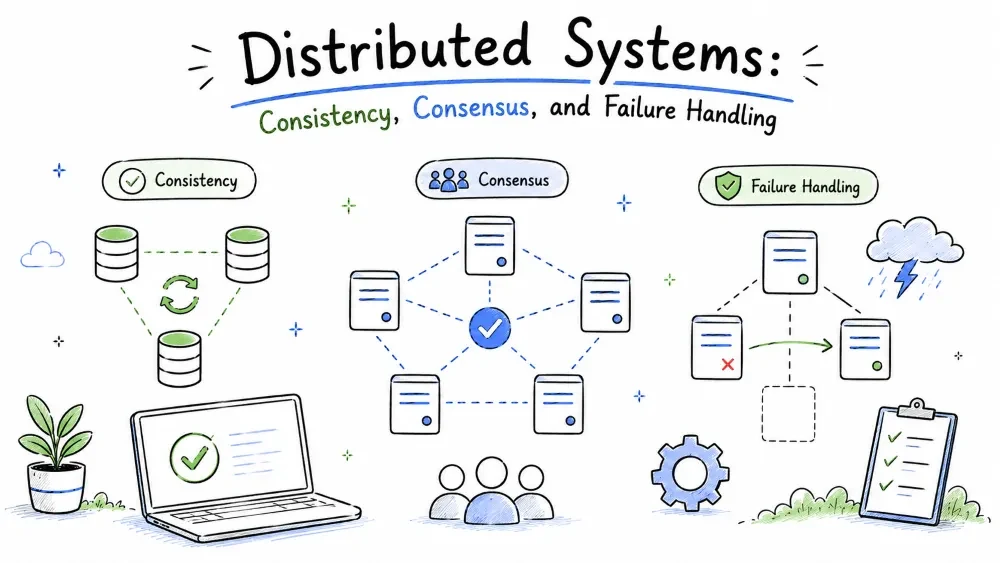
A distributed system is many machines working together as if they were one. They give you scale and fault tolerance — and in exchange, they give you network failures, partial outages, and clock problems. This tutorial covers the core concepts and patterns you need to design and reason about them.
A distributed system is a set of independent computers that coordinate over a network to appear as a single coherent system to users.
Examples: a database cluster, Kubernetes, Kafka, a microservice fleet, even the internet itself.
Why distribute at all? Single machines hit hard limits on CPU, memory, and — most importantly — reliability. One box failing takes everything down.
Engineers new to distribution assume things that aren't true:
When a network partition happens, a distributed system must choose:
You can only keep two of the three. Since partitions are unavoidable in practice, the real choice is between CP (consistent but may refuse requests) and AP (available but possibly stale).
Bank account service → CP (wrong balance is worse than downtime)
Social feed service   → AP (slightly stale feed is fine)
Consistency is a spectrum, not a switch:
| Model | Guarantee | Example use |
|---|---|---|
| Strong / linearizable | Reads always see latest write | Inventory, payments |
| Sequential | Operations appear in order per process | Most databases (default) |
| Eventual | Replicas converge eventually | Caches, DNS, shopping carts |
| Read-your-writes | You see your own updates | User profiles |
# Read-your-writes via session pinning
def update_profile(user_id, data):
    db_primary.execute(update_query(user_id, data))
    session.pin_to_primary(user_id, ttl_seconds=30)

def get_profile(user_id):
    if session.pinned(user_id):
        return db_primary.read(user_id)
    return db_replica.read(user_id)
The explanation: after a write, that user's reads go to the primary for a short window. Everyone else can use fast replicas. This one trick eliminates the most common "why doesn't my change show up" bug.
Replication keeps copies of data on multiple nodes for durability and read scaling.
Single-leader flow:
  Client → Leader (write) → async replicate → Replica 1, Replica 2
  Reads → any replica (may be slightly stale)
With N replicas, write to W and read from R. If W + R > N, every read overlaps a recent write — you get consistency. Example: N=3, W=2, R=2.
Partitioning splits data across nodes so no single machine holds everything.
# Simple approach: hash partitioning
def shard_for(user_id: str, shard_count: int) -> int:
    return int(hashlib.md5(user_id.encode()).hexdigest(), 16) % shard_count
The explanation: hashing spreads users evenly. Plain modulo breaks when you add shards (everything remaps), which is why production systems use consistent hashing — adding a node only moves a small fraction of keys.
Partitioning rules of thumb:
When nodes must agree (who is the leader? is this write committed?), naive approaches fail: two nodes can both think they're leader after a network hiccup ("split brain").
Consensus algorithms — Raft and Paxos — solve this safely.
Raft in one paragraph: nodes elect a leader by majority vote. The leader replicates a log of operations; an entry is "committed" once a majority stores it. If the leader dies, a new election happens with the latest log. Majorities guarantee only one leader can exist per term.
Cluster of 5: majority = 3
Leader receives write → sends to followers → 3 nodes have it → committed
If only 2 nodes are reachable → cluster halts (CP behavior) rather than diverge
You cannot use wall clocks to order events across machines — clocks drift and jump.
# Detecting concurrent updates with vector clocks
# Replica A: {a: 2, b: 1}   Replica B: {a: 1, b: 2}
# Neither dominates → conflict → resolve via merge or last-writer-wins
def happens_before(v1, v2):
    return all(v1.get(k, 0) <= v2.get(k, 0) for k in set(v1) | set(v2)) and v1 != v2
Heartbeats + timeouts. A node is "suspect" after missing N heartbeats — but remember, a timeout only proves the network is slow or the node is dead; you can't always tell which.
Standby nodes take over when primaries die. The dangerous case: the old primary comes back while a new one is active. Prevent with fencing — a monotonically increasing epoch/token that old primaries are no longer allowed to write with.
When consumers can't keep up, producers must slow down rather than queue forever.
if queue.depth > MAX_DEPTH:
    producer.pause()          # or shed load with 503s
Classic ACID transactions don't span services. The Saga pattern breaks a workflow into local transactions with compensating actions for rollback.
# Saga: order placement across three services
steps = [
    (create_order,      cancel_order),      # Order service
    (reserve_inventory, release_inventory), # Inventory service
    (charge_payment,    refund_payment),    # Payment service
]

def run_saga(order):
    completed = []
    for action, compensate in steps:
        try:
            action(order)
            completed.append(compensate)
        except StepFailed:
            for undo in reversed(completed):   # roll back what succeeded
                undo(order)
            raise
The explanation: if payment fails, we release the reserved inventory and cancel the order — in reverse order. Each step must be idempotent, since retries may repeat them.
Save your progress and earn XP for completing tutorials.
4 questions · Pass with 70%+
1During a network partition, a bank balance service and a social feed service make different choices. Why?
2A cluster replicates to N = 3 nodes and writes require a quorum of W = 2. What read quorum R guarantees a read always sees the latest write?
3In Raft, when is a log entry considered committed?
4An order placement spans Order, Inventory, and Payment services. Payment fails after the order is created and inventory reserved. What does the Saga pattern do?
Technology
Forward Deployed Engineer
Lesson group
Advanced FDE Skills
Progress
33% complete