Preparing your learning space...
67% through Advanced FDE Skills tutorials
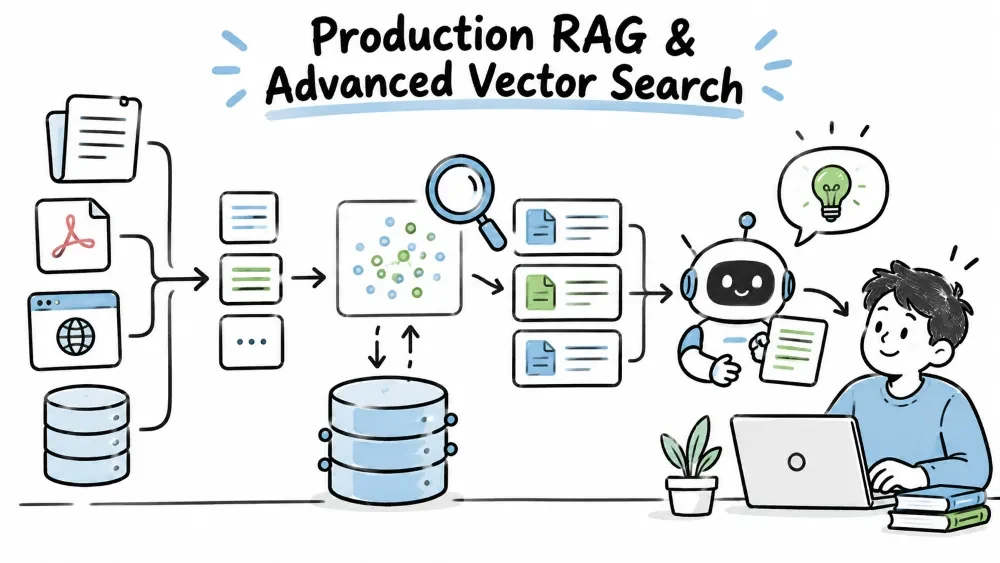
Retrieval-Augmented Generation grounds an LLM in your own data instead of relying on what it memorized during training. Getting RAG from a weekend demo to a production system is mostly about retrieval quality — which is where advanced vector search comes in. Both are covered here.
RAG has two phases:
User: "What is our refund window?"
      ↓ embed query
Vector DB: top-k similar chunks  →  "Refunds allowed within 30 days..."
      ↓
LLM answers using the retrieved chunks, with citations
Why it's useful: fresh data, fewer hallucinations, citations, and no fine-tuning bill every time your docs change.
Chunking is the highest-leverage decision in RAG. Too small → chunks lose context. Too large → retrieval gets noisy and the prompt fills up.
def chunk_with_overlap(text: str, size: int = 800, overlap: int = 120):
    chunks = []
    start = 0
    while start < len(text):
        end = min(start + size, len(text))
        # don't cut mid-sentence
        if end < len(text):
            end = text.rfind(". ", start, end) + 1 or end
        chunks.append(text[start:end].strip())
        start = end - overlap
    return chunks
The explanation: chunks of roughly 300–1000 tokens with 10–20% overlap work well for prose. Better still: split on document structure (headings, paragraphs, tables) so chunks are semantically whole.
Notes:
An embedding is a list of numbers (a vector) that captures meaning: similar texts end up close together in vector space.
from openai import OpenAI

client = OpenAI()

def embed(texts: list[str]) -> list[list[float]]:
    resp = client.embeddings.create(model="text-embedding-3-small", input=texts)
    return [d.embedding for d in resp.data]
The explanation: embed(["How do I reset my password?"]) returns a vector where questions about logins cluster together, regardless of exact wording.
Key rules:
A vector database stores embeddings and answers "which stored vectors are closest to this query vector?"
| Database | Good fit |
|---|---|
| pgvector | Already using Postgres; moderate scale (millions) |
| Pinecone | Fully managed, fast start |
| Qdrant / Weaviate / Milvus | Self-hosted or high scale, rich filtering |
| FAISS | In-process library, no server |
# pgvector example
CREATE EXTENSION IF NOT EXISTS vector;

CREATE TABLE chunks (
    id          SERIAL PRIMARY KEY,
    content     TEXT,
    metadata    JSONB,
    embedding   vector(1536)
);

CREATE INDEX ON chunks USING hnsw (embedding vector_cosine_ops);
-- Nearest neighbors for a query embedding
SELECT content, metadata, embedding <=> :query_vec AS distance
FROM chunks
ORDER BY embedding <=> :query_vec
LIMIT 8;
The explanation: <=> is cosine distance. The HNSW index makes the search approximate-but-fast instead of exact-but-slow.
| Metric | Measures | Typical use |
|---|---|---|
| Cosine similarity | Angle between vectors (direction) | Text embeddings (default) |
| Dot product | Direction + magnitude | Recommendation systems |
| Euclidean (L2) | Straight-line distance | Image embeddings, clustering |
import numpy as np

def cosine(a, b):
    a, b = np.array(a), np.array(b)
    return float(a @ b / (np.linalg.norm(a) * np.linalg.norm(b)))
The explanation: cosine ignores vector length and compares direction only — for most text models this is the right choice, and many providers already normalize vectors so cosine and dot product become equivalent.
Exact search compares the query against every vector — fine at 100k, hopeless at 500M. Approximate Nearest Neighbor (ANN) indexes trade a little recall for huge speed.
HNSW (Hierarchical Navigable Small World) builds layered graphs: coarse "highways" on top for fast traversal, dense layers below for precision. Search starts at the top and greedily descends.
# Tuning knobs (pgvector / Qdrant / hnswlib all expose these)
# m          — links per node. Higher = better recall, more memory.
# ef_construction — build-time effort. Higher = better graph, slower build.
# ef_search  — query-time effort. Higher = better recall, slower query.
CREATE INDEX ON chunks USING hnsw (embedding vector_cosine_ops)
WITH (m = 16, ef_construction = 64);

SET hnsw.ef_search = 100;
The explanation: measure recall@k (how many of the true top-k you actually get) against latency, and tune ef_search until the trade-off fits your SLA. 95–99% recall is usually indistinguishable in answer quality.
Pure vector search misses exact terms: it will happily retrieve "return policy" for a query about "SKU-8842", because embeddings capture meaning, not identifiers.
Hybrid search combines vector similarity with keyword search (BM25) and merges results.
def hybrid_search(query: str, k: int = 8):
    vec_hits = vector_search(embed(query), k=20)       # semantic
    kw_hits  = bm25_search(query, k=20)                # exact terms
    return reciprocal_rank_fusion(vec_hits, kw_hits, k=k)

def reciprocal_rank_fusion(*ranked_lists, k=60):
    scores = {}
    for hits in ranked_lists:
        for rank, chunk in enumerate(hits):
            scores[chunk.id] = scores.get(chunk.id, 0) + 1 / (k + rank + 1)
    return sorted(scores, key=scores.get, reverse=True)
The explanation: RRF rewards chunks that appear high in both lists. Hybrid search is the single biggest quality upgrade for most production RAG systems — especially with product codes, names, and error messages.
Users type bad queries. Fix them before retrieval:
def rewrite_with_history(query: str, history: list) -> str:
    return llm.chat([{
        "role": "user",
        "content": f"Rewrite as a standalone search query.\nHistory: {history}\nQuery: {query}"
    }])
The explanation: "and what about refunds?" becomes "What is the refund policy?" — which is actually searchable.
First-stage retrieval (vector + BM25) is fast but crude. A reranker — a cross-encoder model — reads the query and each candidate together and scores relevance precisely.
def rerank(query: str, candidates: list, top_n: int = 5):
    scores = cross_encoder.predict([
        (query, c.content) for c in candidates
    ])
    ranked = sorted(zip(candidates, scores), key=lambda x: x[1], reverse=True)
    return [c for c, s in ranked[:top_n]]
The explanation: retrieve 50 cheaply, rerank down to the best 5. The LLM then sees only high-quality context — fewer distractions, better answers, and a smaller prompt.
def answer(question: str) -> str:
    chunks = rerank(question, hybrid_search(question))
    context = "\n\n".join(
        f"[{i+1}] ({c.metadata['source']}) {c.content}" for i, c in enumerate(chunks)
    )
    return llm.chat([{
        "role": "system",
        "content": (
            "Answer using ONLY the provided context. "
            "Cite sources as [1], [2]. "
            "If the context doesn't contain the answer, say you don't know."
        ),
    }, {
        "role": "user",
        "content": f"Context:\n{context}\n\nQuestion: {question}"
    }])
The explanation: numbered chunks make citations trivial. The "only use provided context" instruction plus an explicit "say you don't know" escape hatch are what keep hallucination down.
Evaluate retrieval and generation separately:
def faithfulness(answer: str, context: str) -> float:
    claims = llm.extract_claims(answer)
    verdicts = [llm.supported_by(claim, context) for claim in claims]
    return sum(verdicts) / max(len(verdicts), 1)
The explanation: break the answer into individual claims and check each against the retrieved context. Low faithfulness means the model is inventing things the documents never said.
Build a golden test set of question → expected source chunk → expected answer, and run it on every pipeline change.
-- Permission-aware retrieval: filter, THEN search
SELECT content, embedding <=> :query_vec AS distance
FROM chunks
WHERE tenant_id = :tenant_id
  AND (metadata->'acl') ?| ARRAY[:user_roles]
ORDER BY embedding <=> :query_vec
LIMIT 8;
Save your progress and earn XP for completing tutorials.
4 questions · Pass with 70%+
1What is the single biggest quality upgrade for most production RAG systems?
2Your indexing pipeline uses text-embedding-3-small, but you switch the query-time model to a cheaper one. What happens?
3 In an HNSW index, what does raising ef_search do?
4In a permission-aware RAG system, why must you filter by the user's access before ranking by similarity?
Technology
Forward Deployed Engineer
Lesson group
Advanced FDE Skills
Progress
67% complete