Preparing your learning space...
29% through Business & Domain Understanding tutorials
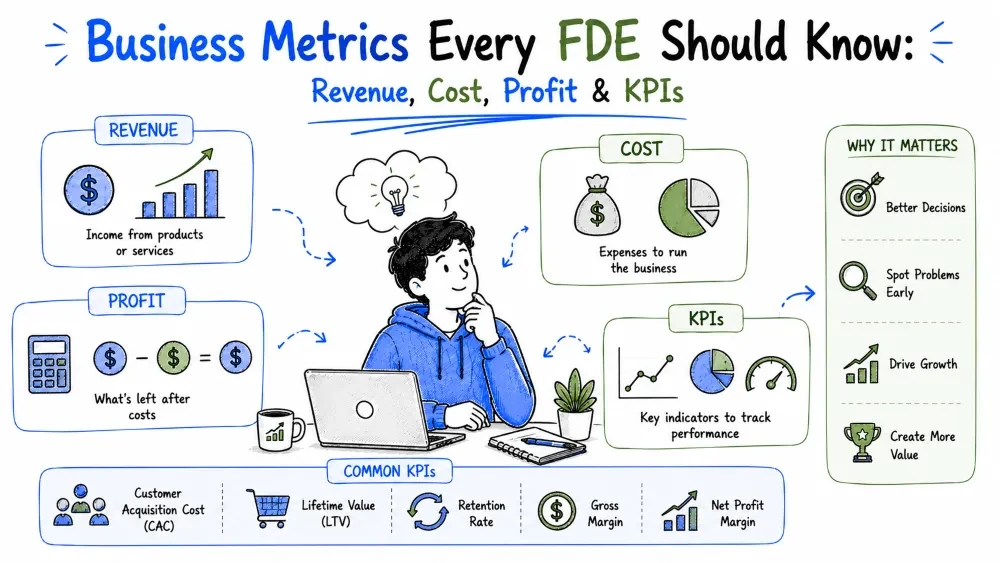
Customers measure success in numbers, not features. An FDE who understands revenue, cost, profit, and KPIs can translate a technical build into business value — and prove it after launch. This tutorial covers the metrics vocabulary you'll hear in every engagement.
Every customer project exists to move a number: more revenue, lower cost, fewer errors, faster turnaround. If you don't know which number, you can't prioritize work, and you can't show the project succeeded.
You don't need to become an accountant. You need enough vocabulary to ask "which metric does this improve?" and understand the answer.
Revenue (also called sales or the top line) is the total money a company earns from its customers before any expenses are subtracted.
Common revenue terms you'll hear:
| Term | Meaning |
|---|---|
| Gross revenue | Total money in, no deductions |
| Net revenue | Gross revenue minus refunds and discounts |
| Recurring revenue | Predictable income that renews (subscriptions) |
| MRR / ARR | Monthly / Annual Recurring Revenue — the subscription staple |
| Average order value (AOV) | Average amount a customer spends per purchase |
Example: a SaaS company has 400 customers paying $50/month.
MRR = 400 customers × $50 = $20,000 / month
ARR = $20,000 × 12 = $240,000 / year
Note: revenue is not profit. A company can earn millions in revenue and still lose money. Never assume "big revenue" means "healthy business."
Costs are everything the company spends to earn that revenue. They split into two types:
Two derived numbers matter constantly in FDE work:
| Term | Meaning |
|---|---|
| COGS (Cost of Goods Sold) | Direct cost of producing what you sell |
| CAC (Customer Acquisition Cost) | What it costs to win one customer (marketing + sales spend ÷ new customers) |
Example: an online store spends $10,000 on ads and gains 200 customers.
CAC = $10,000 ÷ 200 = $50 per customer
If that customer's first order only nets $30 profit, the store loses money on every new customer — a fact that reshapes what software should do for them (e.g., improve repeat purchases, not just new ones).
Profit is what's left: Revenue − Cost = Profit. It comes in layers, each answering a different question:
| Layer | Formula | Answers |
|---|---|---|
| Gross profit | Revenue − COGS | Does the product itself make money? |
| Operating profit | Gross profit − operating expenses | Does the business run profitably? |
| Net profit (bottom line) | Operating profit − taxes, interest | What actually remains? |
Margin is profit expressed as a percentage of revenue — easier to compare across companies and time:
Gross margin = Gross profit ÷ Revenue × 100

Example:
Revenue        = $100,000
COGS           = $40,000
Gross profit   = $60,000
Gross margin   = 60%
Why this matters to you: automation projects usually attack costs. If your integration saves 20 hours a week at $30/hour, that's ~$31,000/year of cost reduction — which flows straight into profit. Saying "saves 20 hours" is true; saying "adds ~$31k/year to the bottom line" is persuasive.
A KPI (Key Performance Indicator) is a metric a business actively tracks because it signals whether a goal is being met. "Key" is the important word — a KPI is a metric tied to a target and watched by someone who can act on it.
Goal:    Reduce support backlog
KPI:     Average first-response time
Target:  Under 2 hours
Current: 9 hours   -> clearly off track, action needed
A KPI without a target and an owner is just a number on a dashboard.
Every KPI is a metric, but most metrics aren't KPIs:
| Metric | KPI | |
|---|---|---|
| Definition | Any number you can measure | A metric tied to a goal |
| Example | Page views, tickets closed | First-response time < 2h |
| Who cares | Analysts, dashboards | Decision-makers |
| Action | Describes | Triggers action when off target |
Common Mistake: building a customer dashboard with 30 metrics because "more data is better." Executives want the 3–5 KPIs that tell them if the goal is on track. Everything else is drill-down detail.
These show up across nearly every engagement, grouped by area:
| Area | Common KPIs |
|---|---|
| Sales | Conversion rate, pipeline value, win rate, sales cycle length |
| Marketing | CAC, cost per lead, email open/click rate |
| Customer success | Churn rate, retention, NPS, first-response time |
| Operations | Order cycle time, error rate, utilization, backlog size |
| Finance | Gross margin, cash runway, days sales outstanding (DSO) |
Two deserve special attention because they decide so much:
Churn = customers lost ÷ customers at start × 100. At 5% monthly churn, a subscription business loses roughly 46% of its customer base in a year (0.95¹² ≈ 0.54 remain); growth becomes a bucket with a hole in it.Conversion = buyers ÷ visitors × 100. Small conversion improvements multiply across all traffic, which is why customers obsess over them.When a customer asks "what should we track?", hold their candidates against this checklist:
Best Practice: for every KPI you put in a build, ask the user "what would you do if this number dropped 20% tomorrow?" If they can't answer, it's not a KPI — remove it or demote it to a detail metric.
The real skill is mapping your work to a metric before you build, then measuring after:
Before:  "Which KPI should this improve, and what is it today?"
         -> Baseline: invoice processing takes 12 min each, 50/week

Build:   automate invoice data entry

After:   "Did the KPI move?"
         -> Now 3 min each: 9 min saved × 50/week × 50 weeks
            = 375 hours/year ≈ $11k/year at $30/hour
This baseline → build → measure loop is how FDE projects earn their second phase. Numbers you collected yourself are unarguable; "it feels faster" is not.
Common Mistake: measuring only after launch. Without a baseline, you can never prove improvement — and the customer's memory of "how bad it was" fades fast.
Save your progress and earn XP for completing tutorials.
4 questions · Pass with 70%+
1 A company has revenue of $200k and COGS of $80k. What is its gross margin?
2What separates a KPI from a regular metric?
3At 5% monthly churn, roughly what share of customers is lost over a year?
4Why must you capture a baseline before building?
Technology
Forward Deployed Engineer
Lesson group
Business & Domain Understanding
Progress
29% complete