Preparing your learning space...
14% through Business & Domain Understanding tutorials
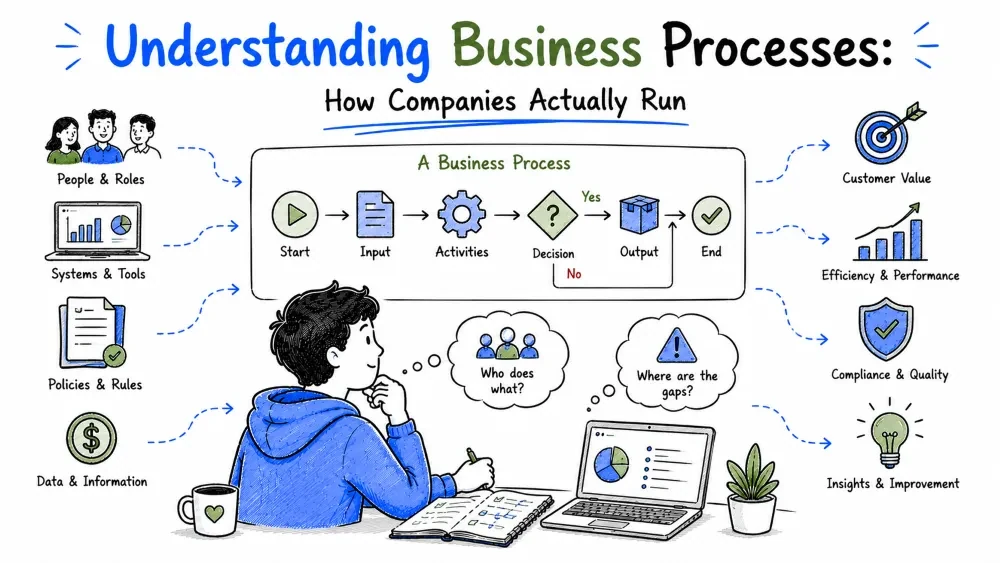
Every company runs on processes — repeatable sequences of steps that turn inputs into outcomes. Before an FDE can improve, automate, or replace any of them, they need to read a business process the way a developer reads code: inputs, steps, decisions, outputs, and failure paths.
A business process is a repeatable sequence of steps, performed by people or systems, that turns inputs into a defined outcome. "Onboard a new employee," "fulfill an order," "close the monthly books" — each is a process with a trigger, a series of steps, and an end state.
The key word is repeatable. A process is something the organization does again and again, which is exactly why it matters to you: repeatable work is the work worth understanding, improving, and automating.
Why it matters: customers rarely ask for "a process fix." They ask for software. But the software only creates value if it changes how a process runs. If you can't describe the process, you can't tell whether your build actually helps.
Every business process, from a two-step approval to a month-long audit, is built from the same parts:
| Part | Meaning | Example (order fulfillment) |
|---|---|---|
| Trigger | The event that starts it | Customer places an order |
| Inputs | What the process consumes | Order details, payment, stock data |
| Steps | The ordered work | Pick items, pack, generate label |
| Decisions | Branch points | In stock? → ship; out of stock? → backorder |
| Handoffs | Where work passes between people/systems | Warehouse → courier |
| Outputs | The end result | Delivered package + invoice |
Read a process like a function: it takes inputs, runs steps with branches, and returns outputs. The handoffs and decisions are where most real-world problems live — that's where work gets dropped, delayed, or done twice.
Not all processes are equal. Companies sort them into three layers:
Note: when a customer says "we need to be faster," they almost always mean a core process. When they say "we're drowning in admin," they mean a support process. Knowing which layer you're in tells you what success looks like — revenue impact for core, hours saved for support.
The practical skill is tracing one process from trigger to output without skipping steps. Here's a simple trace of "handle a refund request":
Trigger: customer emails "I want a refund"
   |
   v
[Support agent reads email, finds the order]      <- 5 min, 2 systems
   |
   v
[Check refund policy: within 30 days?]
   |-- No  -> polite decline email                 <- done
   |-- Yes
   v
[Agent asks manager for approval if > $100]       <- wait: up to 2 days
   |
   v
[Refund issued in payment system]                 <- manual re-entry of order ID
   |
   v
[Confirmation email sent manually]
Output: money returned, customer notified
To trace one yourself:
Common Mistake: tracing the documented process instead of the real one. The official version skips the workaround spreadsheet and the "just ping Sarah on Slack" step. Trace what people actually do — the workarounds are the most valuable information you'll collect.
These three get mixed up constantly in customer conversations. Keep them apart:
| Definition | Repeats? | Example | |
|---|---|---|---|
| Task | One unit of work | No | "Approve this invoice" |
| Process | Repeatable sequence of tasks | Yes, by design | "Process invoices" |
| Project | One-time effort with a deadline | No | "Migrate to the new ERP" |
The distinction matters because the fix differs: a slow task needs a better tool, a broken process needs redesign or automation, and a struggling project needs scope and planning help. When a customer says "invoicing is a mess," figure out which of the three they're describing before proposing anything.
Three reasons make process-thinking a core FDE skill:
Best Practice: in every new engagement, pick the customer's single most important core process and trace it end to end within the first week. That one trace will generate more good ideas than any brainstorming session.
Save your progress and earn XP for completing tutorials.
4 questions · Pass with 70%+
1What makes a business process different from a one-off task?
2In the "anatomy of a process," where do most real-world problems live?
3A customer says "we're drowning in admin work." Which process layer are they describing?
4When tracing a process, what is the most valuable information to capture?
Technology
Forward Deployed Engineer
Lesson group
Business & Domain Understanding
Progress
14% complete