Preparing your learning space...
57% through Business & Domain Understanding tutorials
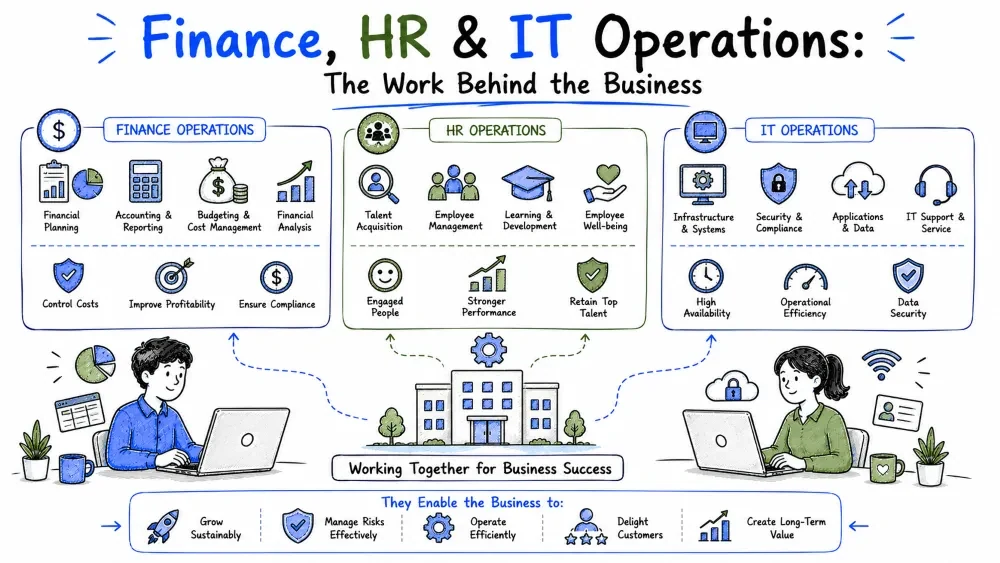
The finance team's daily work orbits around money moving in and out, and the records that must match reality. Three workflows dominate:
1. Accounts Payable (AP) — money going out. The company receives invoices from suppliers and must pay them correctly:
Invoice arrives (email/PDF)
   -> data entered into the accounting system      <- often by hand
   -> matched against the purchase order & delivery ("three-way match")
   -> approval routed (amount-based rules)
   -> payment scheduled
   -> recorded in the ledger
2. Accounts Receivable (AR) — money coming in. The company invoices customers and chases payment: send invoice, track due dates, send reminders, reconcile what arrived against what was billed.
3. Expense management. Employees submit expenses, managers approve, finance reimburses and books them.
Key terms: the ledger is the master record of every transaction; reconciliation is checking that two records that should match actually do (bank statement vs. ledger, invoice vs. payment).
Where it hurts: invoice data entry is the classic pain — PDFs re-typed by hand, typos causing payment errors, approvals stuck in inboxes. Reconciliation is the second: hours of line-by-line comparison every month.
Note: finance work is deadline-driven and audit-sensitive. A mistake here isn't an inconvenience — it can mean a wrong payment, a missed tax filing, or a failed audit. Accuracy beats speed in every finance conversation.
Once a month, finance "closes the books": verifying that every transaction for the month is recorded and producing the reports the business runs on. It typically takes 5–10 business days of intense work.
Collect data from all systems
   -> reconcile bank, AR, AP
   -> post adjustments
   -> produce financial statements
   -> management reports go out
The close is a natural FDE target because it's scheduled, repetitive, and measurable — "close in 3 days instead of 8" is a result any CFO understands.
HR's processes center on the employee lifecycle, and two of them generate most of the paperwork:
1. Onboarding — the most automatable HR process:
Offer signed
   -> contract & paperwork prepared
   -> payroll, benefits, IT accounts set up        <- 3+ separate systems
   -> equipment ordered
   -> first-day schedule & training assigned
Each step lives in a different system, and the handoffs are usually manual emails ("IT, new starter Monday — please create accounts"). One missed step and the new hire sits without a laptop or login on day one.
2. Offboarding — the mirror image, with higher stakes: revoke access, recover equipment, run final payroll. A missed access revocation is a real security risk.
Other recurring workflows: leave requests (employee asks → manager approves → calendar and payroll updated), payroll processing (hours collected → calculated → reviewed → paid), and performance review cycles.
Key metrics: time-to-hire, onboarding completion time, payroll error rate, HR tickets per employee.
Where it hurts: the same employee data re-entered into HR system, payroll, and IT tools; approval chains that live entirely in email threads.
IT operations keeps internal systems running and employees unblocked. Its core workflow is the ticket:
Request/incident reported
   -> logged in the ticketing system
   -> categorized & prioritized
   -> resolved by IT (or escalated)
   -> closed, with a record of the fix
Common request types: password resets and account access (often 30–50% of all tickets), software installation, hardware issues, and new-starter setup.
Key metrics: tickets per week, average resolution time, backlog size, percentage of tickets that are repeats.
Where it hurts: repetitive requests that a self-service portal or automation could handle instantly, and knowledge that lives in individual engineers' heads instead of a runbook — so every absence creates a bottleneck.
Best Practice: ask IT "what's your most-hated recurring ticket?" The answer is almost always automatable (password resets, access requests, standard installs) and gives you a fast, visible win with a team that controls access to everything else you'll need.
Finance, HR, and IT all run on approval chains — work that pauses until the right person says yes:
| Function | Typical approval | Rule |
|---|---|---|
| Finance | Pay an invoice | Over $5,000 → needs CFO sign-off |
| HR | Approve leave | Manager approves; > 5 days → director too |
| IT | Grant admin access | Requires security team approval |
And all three are bound by compliance: rules the company must follow (tax law, labor law, data protection, audit requirements). Compliance is why you'll hear "we need an audit trail" — every action must be traceable to who did it and when.
Common Mistake: automating an approval step out of the process to "make it faster." Approvals exist for control and compliance. Automate the routing (finding the right approver, chasing them, recording the decision) — never remove the human decision itself unless the customer explicitly owns that change.
The patterns that repeat across these functions:
In all three functions, keep a human reviewing exceptions. The pattern is: automate the 90% that's routine, escalate the 10% that's unusual.
Save your progress and earn XP for completing tutorials.
4 questions · Pass with 70%+
1Accounts Payable (AP) is:
2Why is the month-end close a strong FDE automation target?
3What makes offboarding higher-stakes than onboarding?
4When automating approval chains, the right approach is:
Technology
Forward Deployed Engineer
Lesson group
Business & Domain Understanding
Progress
57% complete