Preparing your learning space...
71% through Business & Domain Understanding tutorials
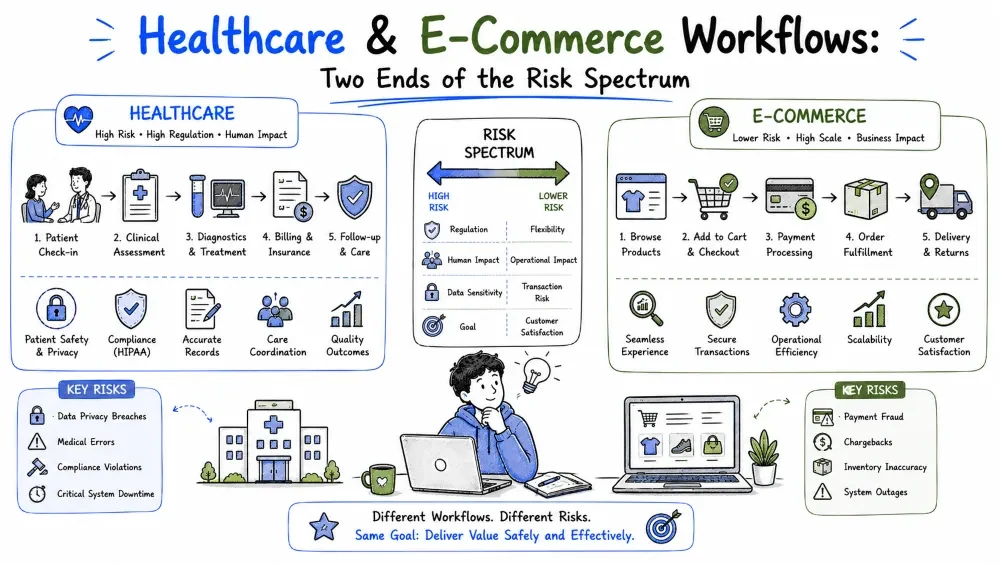
Healthcare runs on clinical and administrative processes: treating patients, and the mountain of scheduling, recording, and billing that surrounds every treatment. An FDE in healthcare usually works on the administrative side — where the hours leak — but everything touches patient data, so the rules are strict.
Most healthcare processes hang off one backbone: the patient journey.
Scheduling -> Registration/intake -> Triage -> Consultation/treatment
   -> Documentation -> Orders (labs, prescriptions) -> Billing -> Follow-up
Key workflows along it:
Key terms: triage (ranking patients by urgency), claim (invoice to an insurer), denial (a rejected claim), EHR/EMR (electronic health record — the system of record for patient data).
| System | Role |
|---|---|
| EHR/EMR (Epic, Cerner, OpenEMR) | Patient records — the system of record |
| Practice management | Scheduling, billing, claims |
| Lab & pharmacy systems | Test results, prescriptions |
| Patient portal | What patients see and do online |
Two rules dominate everything you build here:
Note: in healthcare, "move fast and break things" does not apply. A wrong automation here can mean a patient's record mixed with another's. Every automation needs a human verification step and a way to undo it.
E-commerce is the business of selling online, and its processes form a tight loop from product listing to delivered package — plus the reverse loop when things come back. Volume is high, margins are thin, and nearly every step is already digital, which makes it ideal for integration work.
The backbone is the order lifecycle:
Customer places order
   -> payment authorized
   -> stock checked & reserved
   -> order sent to warehouse/fulfillment
   -> picked, packed, shipped (tracking number issued)
   -> delivery confirmed
   -> post-purchase emails (review request, support)
Supporting workflows:
Key metrics: conversion rate, average order value, cart abandonment rate, fulfillment time, return rate.
Returns are a workflow of their own, and in some categories (fashion) they decide profitability:
Return requested -> approved (against policy) -> item shipped back
   -> received & inspected -> refund or exchange issued -> stock updated
Every step touches a different system (storefront, support desk, warehouse, payments), so returns are a classic place where data falls through the cracks.
Healthcare and e-commerce teach the same meta-lesson: the domain sets your constraints, not the other way around.
| Healthcare | E-Commerce | |
|---|---|---|
| Cost of an error | Patient harm, legal exposure | Lost order, refund, bad review |
| Governing rules | HIPAA / data protection law | Payment rules (PCI), consumer law |
| Speed expectation | Slow, verified, reversible | Fast, high-volume |
| Automation style | Human verifies every exception | Automate fully, handle exceptions after |
Three habits for any high-stakes domain:
Common Mistake: treating a regulated domain like a normal integration project and discovering the compliance blocker in week six. The rules conversation belongs in week one.
Save your progress and earn XP for completing tutorials.
4 questions · Pass with 70%+
1In healthcare, a "denial" is:
2Why can't you move data freely between healthcare systems?
3"WISMO" in e-commerce refers to:
4 The key automation-style difference between healthcare and e-commerce:
Technology
Forward Deployed Engineer
Lesson group
Business & Domain Understanding
Progress
71% complete