Preparing your learning space...
86% through Business & Domain Understanding tutorials
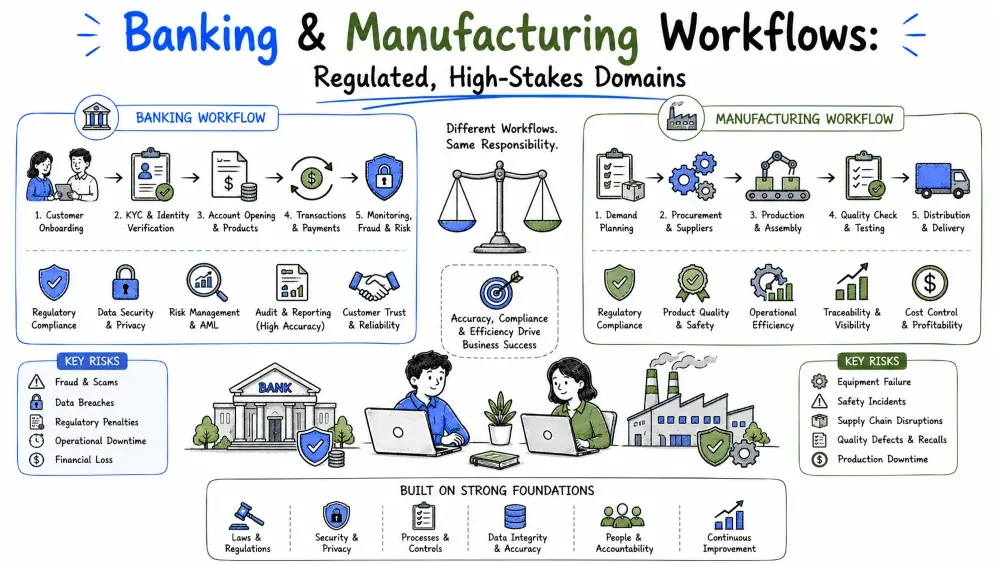
Banking and manufacturing are the two heavyweight domains: one moves money under strict regulation, the other moves physical goods through tightly sequenced steps. Both reward FDEs who learn their vocabulary and their constraints — and both punish anyone who ignores them.
Banks and financial institutions run on processes where every step is regulated, recorded, and reversible-by-law. The work an FDE touches is usually the operational side: onboarding customers, processing transactions, and keeping regulators satisfied — not the trading floor.
Three workflows cover most engagements:
1. Account opening / loan origination. The journey from applicant to active customer:
Application submitted
   -> identity verified (KYC checks)
   -> risk/credit assessment
   -> approval (rule-based + human)
   -> account created, documents issued
2. Payments processing. Money moving between accounts and institutions: authorization, clearing, settlement, and reconciliation. Each payment passes through several systems and must balance to the cent at the end of every day.
3. Reconciliation and reporting. Banks constantly compare internal records against each other and against counterparties (other banks, card networks). Mismatches become exceptions that staff investigate manually.
Key terms: settlement (the actual movement of money completing a transaction), counterparty (the other side of a transaction), exception (a record that doesn't match and needs human review).
Three regulatory realities shape every build in this domain:
Note: in banking, approval is not a formality. Changes typically pass through compliance, risk, and security review before deployment. Build those review cycles into your timeline — a two-week build can sit in approval for a month.
Best Practice: frame every automation as "automate the routine, escalate the exception, log everything." That framing matches how banks already think about risk, so it gets approved; "fully autonomous" does not.
Manufacturing turns raw materials into finished goods through a physical pipeline of planning, sourcing, producing, and shipping. The processes are tightly sequenced — a missing part stops a production line, which can cost thousands per hour — so data accuracy here has physical consequences.
The backbone is the flow from order to shipped product:
Customer order / forecast
   -> production planning (what to make, when)
   -> materials check & procurement (buy what's missing)
   -> production (work orders run on the line)
   -> quality checks
   -> finished goods into inventory
   -> shipping & delivery
Key terms: a work order is the instruction to produce a specific batch; the BOM (Bill of Materials) is the recipe — the full list of parts and quantities needed to build one unit; the shop floor is where production physically happens.
Three supporting workflows keep the line running:
| Workflow | Job | Key metric |
|---|---|---|
| Production planning | Schedule what gets made and when | Line utilization, on-time delivery |
| Inventory & procurement | Keep materials available without overstocking | Stockouts, inventory carrying cost |
| Quality control | Inspect output, track defects, trace bad batches | Defect rate, scrap rate |
Most factories run an ERP (Enterprise Resource Planning system — SAP, Oracle, Microsoft Dynamics) as the system of record for orders, inventory, and planning, with the shop floor often still running on paper travelers, whiteboards, and spreadsheets.
Common Mistake: assuming the ERP is the source of truth. The ERP holds what should have happened; the shop floor knows what did. Your discovery has to visit the line, not just the system.
Banking and manufacturing look nothing alike, but they teach the same FDE lessons:
Save your progress and earn XP for completing tutorials.
4 questions · Pass with 70%+
1KYC stands for:
2The framing that gets banking automations approved by risk teams is:
3In manufacturing, the BOM is:
4Why shouldn't you treat the ERP as the source of truth in a factory?
Technology
Forward Deployed Engineer
Lesson group
Business & Domain Understanding
Progress
86% complete