Preparing your learning space...
100% through Business & Domain Understanding tutorials
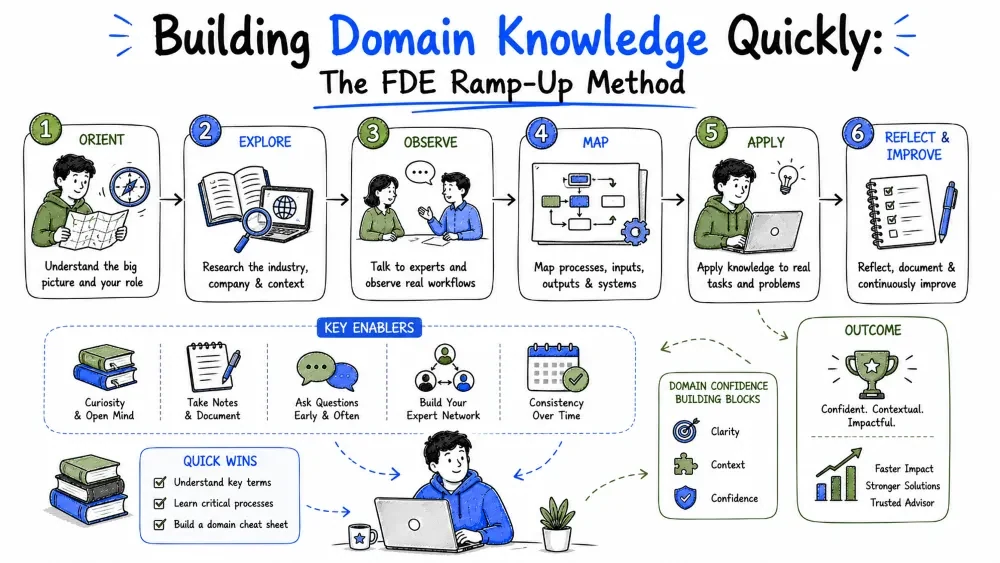
Every new engagement drops you into an industry you've never worked in — healthcare on Monday, logistics on Thursday. FDEs don't have months to become experts; they need working domain knowledge in days. This tutorial is the method: how to learn a domain fast, what to learn first, and how to prove you've learned it.
You don't need to become a doctor to build a scheduling tool, or a banker to automate KYC document checks. You need three things:
That's the target. Depth beyond that comes later, driven by the actual work — not by reading the whole industry's Wikipedia tree in week one.
Common Mistake: front-loading too much generic research. Reading industry reports for a week feels productive but produces knowledge you can't use. Ten hours of talking to the customer's staff beats forty hours of reading about their industry.
In any new domain, hunt these five in order:
Not all learning sources pay equally. Ordered by return on time invested:
| Rank | Source | Why it's fast |
|---|---|---|
| 1 | The people who do the work | Real process, real vocabulary, real pain — in one conversation |
| 2 | The systems themselves | Screens, fields, and reports show the actual data model |
| 3 | Internal docs & training material | Written for newcomers already; skim for vocabulary |
| 4 | The customer's own website & sales material | How they describe their business to outsiders |
| 5 | Industry articles & videos | Background context only — keep this to hours, not days |
Best Practice: ask for the new-hire training material. Every company has something they give day-one employees — it's a pre-built domain crash course that nobody thinks to offer you. Ask for it explicitly.
Domain vocabulary evaporates from memory within hours. Capture it as you hear it:
| Term        | Plain meaning                          | Where I heard it |
|-------------|----------------------------------------|------------------|
| Denial      | Insurer rejecting a claim              | Billing team     |
| WISMO       | "Where is my order?" support ticket    | Support lead     |
| Three-way   | Invoice vs. PO vs. delivery match      | Finance manager  |
|   match     |                                        |                  |
Three rules for the glossary:
The glossary doubles as a requirements tool: the exact terms in it are the ones your software's labels, fields, and messages should use. A build that speaks the customer's language feels custom; one that invents its own terms feels foreign.
How do you know you've actually learned the domain? Teach it back.
At the end of week one, ask your main contact for fifteen minutes: "Let me play back my understanding of how order processing works — correct me wherever I'm wrong." Then walk through the workflow, the vocabulary, and the constraints in your own words.
Two things happen:
Note: schedule the teach-back before you write requirements, not after. A misunderstanding caught in the teach-back costs five minutes; the same misunderstanding caught in a requirements review costs a rewrite.
Three traps eat ramp time:
Put the method on a schedule:
| Day | Focus | Output |
|---|---|---|
| 1 | Business model: who pays, how money flows | One-paragraph "how they make money" note |
| 2–3 | Shadow the people your project touches | Rough trace of the target workflow |
| 3–4 | Systems tour: screens, fields, reports | Glossary started, data model sketched |
| 4 | Constraints interview: rules, deadlines, regulations | Constraint list |
| 5 | Teach-back with your main contact | Corrected workflow + glossary v1 |
By Friday you have what most projects don't get in month one: a verified picture of the workflow, in the customer's own words.
Best Practice: keep the artifacts — glossary, workflow trace, constraint list — in a shared doc the customer can edit. Domain knowledge that lives in your head walks out the door with you; knowledge in a shared doc compounds across the whole engagement.
Save your progress and earn XP for completing tutorials.
4 questions · Pass with 70%+
1How much domain knowledge does an FDE need in week one?
2 The fastest source of domain knowledge is:
3 What is the teach-back test?
4Why keep a glossary as you learn a domain?
Technology
Forward Deployed Engineer
Lesson group
Business & Domain Understanding
Progress
100% complete