Preparing your learning space...
100% through Enterprise AI Deployment tutorials
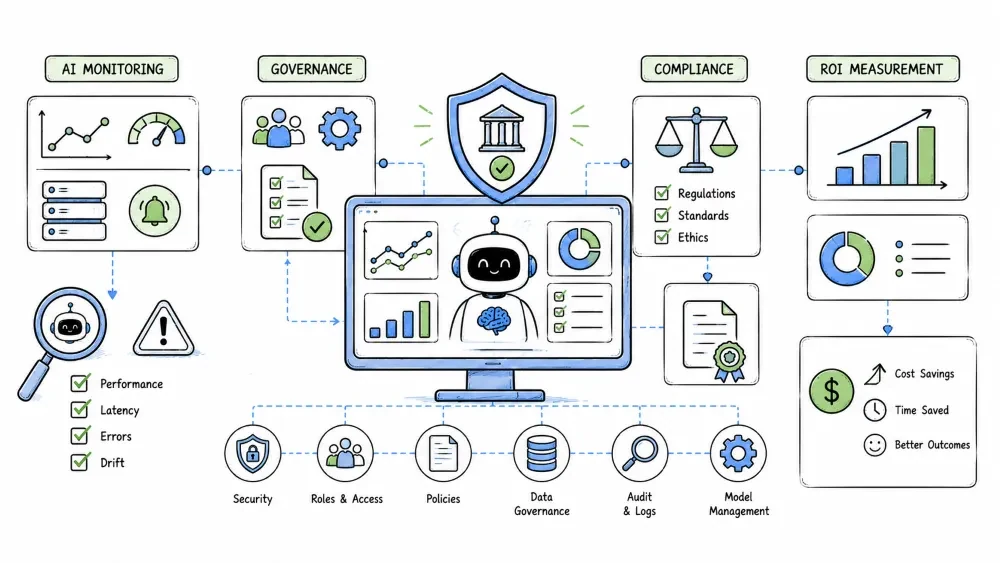
An enterprise AI system must be watched, governed, and proven to deliver value. This chapter brings together the sustaining practices: monitoring for drift and quality, establishing governance and compliance guardrails, and measuring ROI so the business sees the payoff. Together, these turn a technical demo into a trusted, accountable capability.
Once an AI system is in production, it must be watched — and measured for the right things. A model that drifts, a prompt that breaks, or an access policy that relaxes can silently degrade quality or security.
Traditional monitoring watches uptime and latency of a stable function. AI systems have moving parts — models change, inputs change, even prompts change — so you must also watch quality, drift, and trust.
Traditional:  "Is the API up and fast?" — yes, it always was.
AI system:    "Is the API up and fast, AND answering correctly,
               AND not drifting, AND not leaking data?"
Monitoring an AI system means measuring the same layers the stack diagram showed.
The data your model sees in production can change shape without anyone noticing — new vocabulary, new fields, new distributions. That is drift.
Monitor:   token overlap / embedding centroid vs training data
Flag:      >10% of recent requests outside the expected shape
Response:  warm up + evaluate + maybe re-label / retrain
If a single drift detection fires and is ignored, the quality decay follows quietly.
You have to define "done well" and measure it on live data.
def smoke_test():
    for q, expected in KNOWN_QUESTIONS:
        out = assistant(q)
        assert contains_roughly(out, expected), f"regressed on {q}"
Quality monitoring is not just "how confident was the model"; it is "did it say the right thing."
Prompts drift too, and they are the most fragile part. Monitoring means tracking what you actually sent the model and comparing over time.
prompt_version: "v2024-08-customer-support-strict"
last_checked:   "2024-08-27"
regression_tests_passing: 42/42
Security monitoring is part of AI monitoring because models read and write data, and the blast radius is large.
Alert:  user X pulled >10x its normal doc count in 5 minutes
Action: flag the session, freeze retrieval, review
The model side: token cost, latency, and availability. The business side: throughput and error rate. Monitor together.
p95 latency:  820 ms
token cost:   $0.0004 per call, $127/day budget, currently $98/day
availability:  99.8% (SLA target 99.5%)
errors:      0.3% → mostly prompt length exceeded
When a metric is tied to a budget, you finally get management attention.
Good alerts are paired with owners and runbooks.
drift:
  owner: "ml-platform"
  runbook: "promote candidate model, re-evaluate"
cost_spike:
  owner: "finops"
  runbook: "audit prompt length, cap concurrency"
access_anomaly:
  owner: "secops"
  runbook: "suspend session, investigate, notify DPO"
If nobody would act on it, do not send it.
Enterprise AI does not operate in a legal or ethical vacuum. Governance is the framework that decides who owns an AI decision, how it is accountable, and what rules it must follow. Compliance is the act of meeting those rules — and demonstrating it.
AI governance is the set of policies, roles, and controls that ensure AI systems behave as the company intends — ethically, legally, and reliably.
Governance:   Who owns the system?  Who can change it?
              What rules must it follow?
Compliance:   Can we prove it follows those rules?
If governance defines the rules, compliance proves you followed them. Both are required in enterprise environments.
Every AI system needs a named owner — the person accountable for its outcomes.
Owner responsibilities:
  - Approves changes to model, prompt, or data pipeline
  - Reviews quality metrics monthly
  - Signs off on access changes
  - Responds to incidents within 24 hours
Without an owner, no one is accountable. Without accountability, quality and compliance drift quietly.
Not every AI system carries the same risk. Classify each system before deployment to know how much oversight it needs.
risk_levels:
  low:
    examples: ["internal search", "draft email assist"]
    oversight: "owner review quarterly"
  medium:
    examples: ["customer support draft", "document classification"]
    oversight: "monthly quality audit, human review 5%"
  high:
    examples: ["loan decision", "hiring screening", "medical triage"]
    oversight: "pre-deployment review board, ongoing audit, explainability required"
High-risk systems need a review board, documented justification, and continuous monitoring before they ever touch a real user.
People affected by an AI decision have a right to understand why — and in some jurisdictions, a legal right to an explanation.
GDPR Article 22:  "The data subject shall have the right... to obtain
                  an explanation of the decision."
For high-stakes decisions, your system must be able to explain:
Decision:     Application declined.
Reason:      "Income below threshold for product category."
Contributing: income_declared=32000, required=35000, tenure=6mo.
For a simple RAG system, citation and source is the explanation. For a scoring model, SHAP values or a simpler proxy explanation is needed.
AI can absorb and amplify the biases in the data it was trained on. Proactively measuring fairness is a governance requirement, not an afterthought.
def fairness_check(predictions, protected_groups):
    rates = {g: positive_rate(predictions, g) for g in protected_groups}
    disparities = {g: rates[g] / rates[reference] for g in rates}
    max_disparity = max(disparities.values())
    if max_disparity > 1.25:
        alert_owner("fairness threshold breached")
Bias audits need to be run regularly, not just at launch.
Depending on your industry and geography, different rules apply:
EU AI Act (2024):   Risk-based classification, high-risk systems
                   require conformity assessments, transparency for
                   users interacting with AI.

GDPR:               Data minimisation, purpose limitation, right
                    to explanation for automated decisions.

HIPAA (US):         PHI must not be exposed in model outputs or logs.

PCI DSS:            Cardholder data must not enter an LLM prompt.

SOC 2 Type II:      Audit of controls over security, availability,
                    confidentiality, and privacy over a period (e.g., 6–12 mo).
                    Required for SaaS vendors running AI in customer data.

ISO 27001:          Information security management system (ISMS)
                    certification; covers AI as part of scope.
Map your AI systems to the relevant regulations before launch. Compliance is always cheaper to plan than to retrofit.
A model card is a structured record of what a model does, what data it was trained on, its known limitations, and how it should not be used.
model_card: v2_support_intent_classifier
  purpose:          "classify inbound support ticket intent"
  training_data:    "support tickets 2022–2023, labelled by agents"
  known_limitations: "low accuracy on sarcasm; not trained on Spanish"
  acceptable_uses:  "routing internal tickets"
  prohibited_uses:  "making decisions about account closure"
  evaluated:        "2024-08-01 by ML team, approved by Legal"
Treat model cards as living documents — updated on every model change.
Compliance is not a one-time event. Set a cadence.
Daily:   error rates and access anomalies.
Monthly: quality metrics, fairness checks, drift reports.
Quarterly: policy review, model card update, access audit.
Annually: full compliance review against AI Act / GDPR / HIPAA.
Always assume an auditor will ask for last year's logs, prompt versions, and model change approvals. If you cannot produce them, you have a compliance gap.
Enterprise AI must pay for itself, not just be a technical showcase. When you build, you need a way to measure whether it creates real value — and a way to show it to the business.
ROI = (value of change – cost of change) / cost of change. For enterprise AI, that is:
Benefit:   productivity saved, revenue increased, compliance cost reduced.
Cost:      compute, people time, model training, monitoring, and maintenance.
A mature program tracks ROI monthly, measures efficiency, demonstrates quality gains, and shows how the system helps the business meet its targets.
Before you build, decide what outcome you want. You need a concrete baseline and a target.
Baseline:  Email support handled by humans — 15 minutes per ticket,
           80k tickets/year, costing $6 million in staff time.
Target:   AI handles 40% of those tickets, freeing staff for higher-value work.
The metric must be quantifiable, attributable to the AI, and aligned with your department’s objectives (e.g., HR wants better hiring quality, Legal wants less manual review).
Track three layers of value:
Example:  AI deflects 40% of tickets — 32k tickets — saves 192k staff hours.
           Average salary $120k → $23M saved.
Model cost: $2.5M/year → net savings $20.5M.
ROI:        860% per year.
Baseline needs data that answers: "What would the process look like if the AI never existed?"
Store this baseline in a config file (e.g., data/baseline.yml) and reference it monthly.
Simple formula:
benefit = (manual_time_before - manual_time_after) × average_salary
- model_cost - new_people_cost
roi = benefit / (benefit + model_cost + new_people_cost) * 100
Use the same denominators and attribution methodology every month, so you can trend correctly.
Make ROI calculation a scheduled, repeatable process, not a once-off executive deck.
def monthly_roi():
    baseline = load_baseline()
    usage = get_usage_last_month()
    cost = get_model_cost_last_month() + get_ops_cost_last_month()
    benefit = calculate_benefit(baseline, usage)
    roi = (benefit - cost) / (benefit + cost) * 100
    store_result({
        "timestamp": now(),
        "benefit": benefit,
        "cost": cost,
        "roi": roi,
    })
Publish this report to a dashboard (Power BI / Tableau / Notion) so owners see changes weekly.
Save your progress and earn XP for completing tutorials.
4 questions · Pass with 70%+
1AI monitoring fundamentally differs from traditional monitoring because AI systems also need to track:
2 An AI system used to make loan decisions is classified as:
3The simple ROI formula is:
4The compliance frameworks table now includes SOC 2 Type II and ISO 27001 separately. What does SOC 2 Type II specifically audit?
Technology
Forward Deployed Engineer
Lesson group
Enterprise AI Deployment
Progress
100% complete