Preparing your learning space...
100% through Introduction tutorials
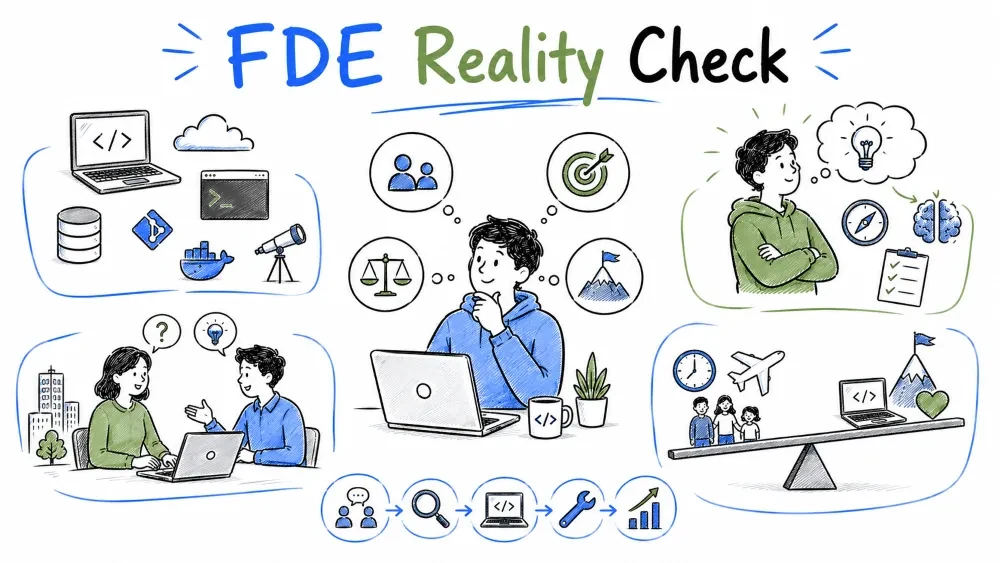
Beyond workflows and skills, FDE is defined by the tools you reach for, how you relate to customers, the mindset that keeps you effective, and the real trade-offs nobody mentions in job posts. This final tutorial covers all four.
FDEs are tool generalists. The exact stack varies by company, but the categories are stable:
| Category | Examples | Why FDEs use it |
|---|---|---|
| Languages | Python, SQL | Quick data work and scripting |
| Notebooks | Jupyter, Colab | Fast prototyping and demos |
| Data & APIs | Postgres, REST/GraphQL, pandas | Connecting to customer systems |
| AI tooling | LLM APIs, vector DBs, eval frameworks | Building AI features per customer |
| Collaboration | Slack, Notion, Zoom, shared repos | Staying close to customer and team |
Best Practice: Learn to be fluent in fewer tools rather than dabbling in many. An FDE who can pull, clean, and demo data in Python + SQL + one notebook tool will out-execute one who knows ten half-understood frameworks.
The relationship is different from sales or support. You are not there to close a deal or answer a ticket — you are there to make the thing work alongside them.
Key habits:
Common Mistake: Becoming the customer's permanent free dev team. If every small change routes to you, you've failed at enablement. Build so they can self-serve.
The mindset is what separates a good FDE from a frustrated one. Three attitudes matter most:
FDEs who burn out usually fought the ambiguity or clung to "clean" solutions the customer didn't need. The ones who thrive treat messiness as the job, not a distraction from it.
The role is rewarding but comes with real costs. Know them before you commit:
| Trade-off | The downside | The upside |
|---|---|---|
| Depth vs breadth | You touch many things, master few | You understand the whole business |
| Coding vs context-switching | Less time on deep engineering | More impact per hour spent |
| Travel / intensity | On-site work and irregular hours | Strong relationships and trust |
| Career signal | Less "pure" engineering on your GitHub | Rare, high-leverage experience |
Note: The biggest personal risk is losing your coding edge if you spend years only configuring. Mitigate by keeping one deep technical practice alive — contributing to the product, a side project, or staying current on AI tooling.
Best Practice: Track your work as outcomes ("cut onboarding from 6 weeks to 1"), not lines of code. That framing protects you in performance reviews where pure-engineering metrics don't fit.
Save your progress and earn XP for completing tutorials.
4 questions · Pass with 70%+
1Which tools form the core stack most FDEs should master first?
2What is the main goal when working with customers?
3Which mindset is most important for an FDE?
4What is the biggest personal career risk of being an FDE?
Technology
Forward Deployed Engineer
Lesson group
Introduction
Progress
100% complete