Preparing your learning space...
71% through Production & Reliability tutorials
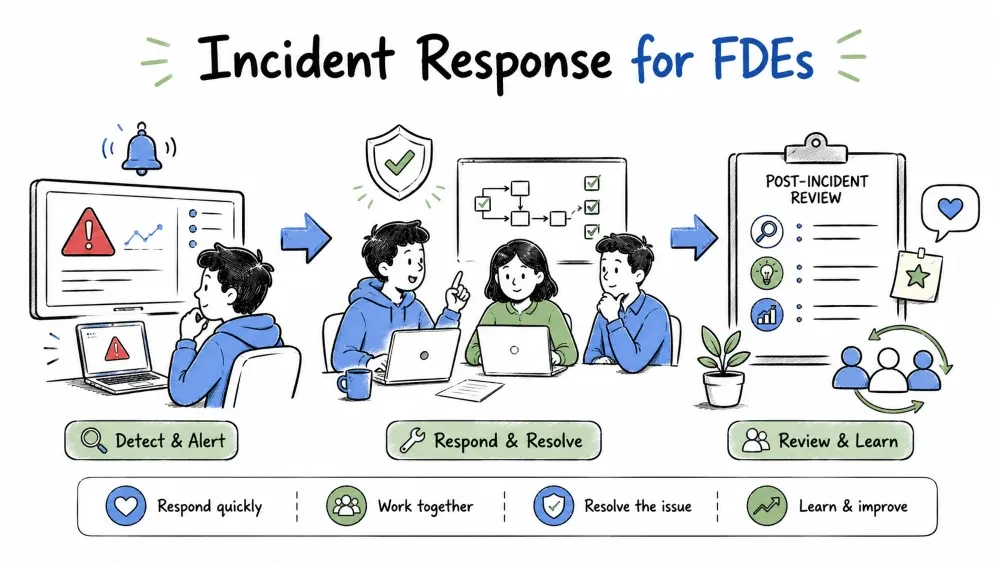
No system is incident-free forever. When something goes wrong on a live solution, the difference between a contained, calm response and an expensive, chaotic one comes down to process. This tutorial covers the two halves of the incident lifecycle: managing the incident while it's happening, and running the review afterward so it doesn't happen again.
Incident management is the coordinated process for responding to a serious problem: the steps, roles, and communication that stop a disruption from spreading, restore service fast, and keep everyone sane while it happens.
People improvise poorly under pressure. They fix symptoms, forget to tell anyone what they changed, and sometimes make things worse with a well-intentioned hotfix. A lightweight process fixes that: someone owns the response, everyone has a role, and communication becomes automatic. Good incident management doesn't slow you down — it makes the fast path the safe path.
An incident is a problem that materially affects users and needs urgent, coordinated action. A quick litmus test:
A bug that only hits one edge case and only during quiet hours — that's a ticket. A login page that's down for every user — that's an incident. The distinction matters because incidents get a process and a timeline. Everything else gets the normal queue.
Not every incident is the same size, and the response should scale to match. A simple severity ladder:
| Level | Impact | Response |
|---|---|---|
| SEV-1 | Service fully down or data at risk | Immediate, all hands, constant updates |
| SEV-2 | Major feature broken, most users affected | Same day, dedicated responders |
| SEV-3 | Minor bug, workaround exists | Normal queue, monitored |
The point of labels is that they tell people how to react without a meeting. When someone declares SEV-1, everyone already knows what's expected of them — no discussion needed to figure out the urgency.
During an incident, clarity beats democracy. Three roles cover almost everything:
One owner. No split-brain. If two people both think they're in charge, the incident takes longer. The commander is accountable for resolution, even if they never touch the code.
Incidents get found two ways: by your monitoring, or by your users. The first is cheap. The second is expensive — a user who hits a broken system is already frustrated, and you're the last to know.
Good alerts follow three rules:
An alert with no owner and no runbook isn't monitoring. It's a phantom beep. Either attach a response to it or turn it off.
The response follows a sequence that keeps order in chaos:
Detect -> Declare -> Contain -> Mitigate -> Resolve -> Review
Declare it early, with severity. A false alarm costs a few minutes; a silent outage costs everything. Contain before you diagnose — stop the bleeding first. Roll back the release, disable the feature, route traffic away from the broken part. You can debug a contained problem in peace; a spreading one gets worse while you study it.
Mitigate, then resolve. A workaround that restores service now beats a perfect fix that takes hours. Scale up, disable the bad path, restore the previous version. The user cares that it works again. The permanent fix comes after.
And keep a timeline. Note the time of each action, even roughly. It's the raw material for the post-incident review, and you will absolutely not remember the order of events tomorrow.
Best Practice: when unsure, roll back. Reverting to the last-known-good version is reversible and preserves the evidence for later debugging. Fixing forward under pressure is how incidents get worse.
Silence during an incident is its own failure. Stakeholders would rather get a one-line "we're investigating" update than nothing, and the same goes for your own team.
A post-incident review — often called a postmortem — is a structured, written examination of an incident after it's resolved: what happened, why, and what changes prevent it from happening again. It's the part that turns a bad day into lasting improvement.
An incident you learn nothing from is pure cost. The review is what makes that cost worthwhile. Done right, it changes the system so the same failure can't happen twice. It also protects the team by making the incident about the system, not the person.
The core principle: the goal is to fix the system, not blame a person. Everyone in the chain did something that seemed reasonable at the time. The question is never "who did this wrong?" — it's "what allowed this to happen?"
This isn't about being soft. It's about being effective. A culture that punishes mistakes gets people who hide them, and hidden mistakes happen again. A culture that asks "what failed in our system and process?" gets honesty — and honesty is what actually prevents recurrence.
When you catch yourself writing a postmortem that names a person as the cause, you haven't found the real cause yet. A person is never the root cause; something about the system, the tooling, or the process let it happen.
A good postmortem has five parts and can be written in an hour:
# Postmortem: Order export slow — 2026-08-14

## Summary
Exports took 8x longer than normal for ~40 minutes. 12 users affected.

## Timeline
09:02  Error rate rises (alert fires)
09:11  Declared SEV-2, commander assigned
09:20  Rolled back to previous export build — contained
09:38  Service back to normal
10:15  Incident closed

## Root Cause
A query added in the new build was missing an index. Under load
it scanned the full export table.

## Contributing Factors
- No staging test with production-sized data
- Release checklist didn't include a query plan review

## Action Items
- [ ] Add index migration (owner: ana, due 2026-08-18)
- [ ] Add prod-sized data load to staging test suite (owner: dev, due 2026-08-25)
- [ ] Add "review slow queries" step to release checklist (owner: ops, due 2026-09-01)
The timeline comes from the notes you kept during the incident — which is exactly why those notes matter. The root cause answers "why did it fail?" The contributing factors answer "what made it worse or harder to fix?" And the action items are the actual point: each one a concrete change with an owner and a date.
Most postmortems fail here. Action items that are vague, ownerless, unprioritized, and forgotten within a week. To avoid that:
orders" is.Also worth knowing: after an incident, teams tend to over-correct. They produce a storm of action items that exhausts everyone and then gets quietly abandoned. Prioritize. Which two or three changes actually prevent this class of failure? Do those well. Note the rest honestly as lower priority and move on.
Single incidents get fixed by single action items. Patterns of incidents get fixed by the review process itself. Watch the trends across all your postmortems:
The meta-lesson here: the review process should improve itself. If incidents keep happening for the same reasons, the problem is the process that was supposed to stop them.
Save your progress and earn XP for completing tutorials.
4 questions · Pass with 70%+
1What is the difference between an incident and an ordinary bug?
2 What does "contain before diagnose" mean during an incident?
3 What is the core principle of a blameless postmortem?
4What makes an action item in a postmortem actually close?
Technology
Forward Deployed Engineer
Lesson group
Production & Reliability
Progress
71% complete