Preparing your learning space...
100% through Rapid Prototyping tutorials
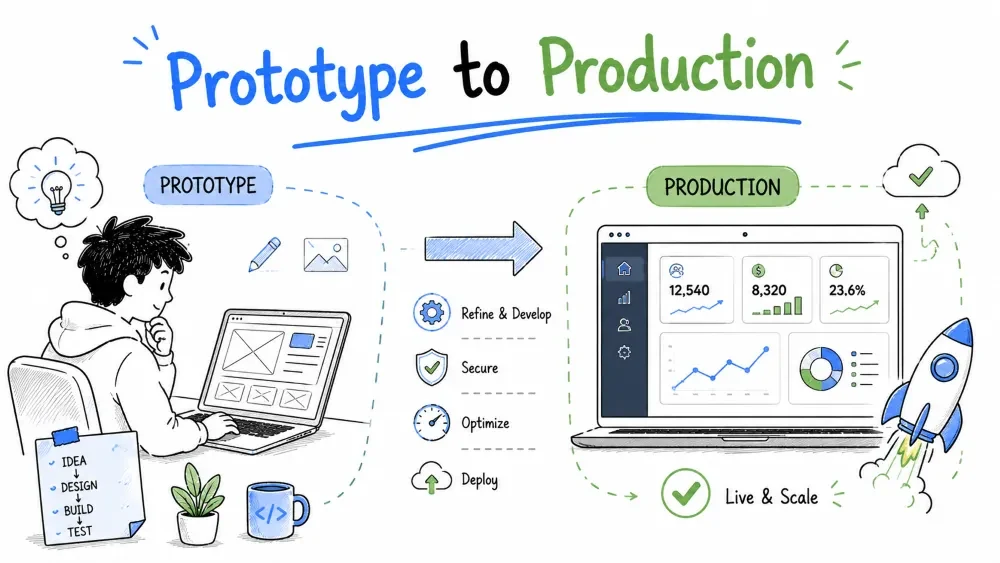
The prototype proved the idea; now it has to survive the real world. Moving from prototype to production is not "keep the same code and hope." It's a deliberate change in bar: reliability, security, data, and trust — the production dimension you first met in Tutorial 1. This tutorial covers when you're actually ready to make the shift, the seams where a prototype should stay a prototype, and how to turn your working demo into software that behaves the way real users deserve.
The crossing happens when a hypothesis has become an adoption. Signs you're ready to invest in production (and not a week too early):
The brutally honest test from Tutorial 1 still holds: "If this broke tomorrow, would a real user be harmed or lose trust?" The day that answer becomes yes, the prototype has grown into production — whether you named it yet or not.
Before you start hardening, write the "What must be true" statement for production — the list that ends your era of the throwaway and begins the era of the depended-on:
That list is your definition of production-ready. Anything not on it is a candidate to stay prototype-thin.
The single most common error: copying the prototype folder and calling it the product. The prototype proves an idea; production must own its absence of failure forever — different goals, different bars. Do not let the prototype's "the stakes are low" nature leak into the world where stakes are real:
The prototype was a question; production is the reliable answer. Different jobs, different standards.
Most of the gap is covered by the tutorials you already passed. Expect the shift from "nice demo" to "real system" to show up across these:
| Dimension | Prototype corners | Production honors |
|---|---|---|
| Data | Hard-coded / mock / a file | Real store, validated, audited |
| Credentials | In the code | In a vault, rotated, least-privilege |
| Errors | Printed / shown / silently swallowed | Fail loudly, alert, trace log |
| Re-run safety | Double-sends possibly | Idempotent; a retry left safe |
| Security | Minimal | A floor — auth, least-privilege, edge cases |
Cross them one at a time, not all at once. The moment you hook real money, real customer lists, or real health data into a thing — that's when each of these stops being optional.
The swap from mock to real is easy only if you kept the seam (Tutorial 6). If screens talk through access layer fetch_accounts(), replacing mock with the real API is one change, not a refactor. The hard part: expectation.
Pace it so a throwaway idea doesn't outlast its welcome: keep the mock seam until you're about to genuinely depend, then swap, and smoke-test the real path the moment you do (Tutorial 7).
Production begins with security. The floor, before anything with real data goes live: the thing lives behind some login and each caller carries an identity. Then the dangerous cases become the literally important cases:
Authorization, scopes, least-privilege roles)?DELETE guarded, money-path refuses anomalies like negative amounts)?Note: security is not a new vision; it's removing the demo-goggles. Don't bolt it on at the very edge; the floor is mostly default-deny so that an "oops" can't become a breach.
In prototype mode, "it just showed an error" was acceptable. In production it is the entire conversation. Two behaviors carry production:
Production software that hides its own illness cannot be cared for. The cheap prize: even small additions — an "alerts" endpoint, a health check, a run record — turn a silent box into a machine you can trust and repair.
Here is the same prototype from Tutorial 2, hardened just enough that a real user depending on it is safe. Notice what changed: inputs are checked at the boundary, a re-run cannot double-process, and success is explicit.
# production-lite: same shape, but failure is loud, inputs checked,
# and a re-run is repeatable.
from fastapi import FastAPI, HTTPException
from pydantic import BaseModel

app = FastAPI()

processed = set()   # idempotency guard: a retried key can't double-charge

@app.post("/pay")
def pay(invoice_id: int, amount: float, idem_key: str):
    if amount <= 0:
        raise HTTPException(status_code=400, detail="amount must be > 0")
    if idem_key in processed:
        raise HTTPException(status_code=409, detail="already processed")
    # charge through the real provider here, then:
    processed.add(idem_key)
    return {"invoice_id": invoice_id, "charged": amount}
Explanation: the failure modes you'd forgive in a demo — a negative payment, the same request arriving twice — are now checked at the boundary and refused as errors. Refusing a bad amount and refusing a duplicate each protect a real user's money and trust. That is the production floor you add precisely because people depend on it. (In a real build, processed is a durable store shared across instances, not process memory — but the pattern is exactly this.)
A real risk in the handover: the prototype was already live — someone connected real data, real users logged in, and it kept running on a laptop under the desk. It functions, so it must be production, right? That's the trap.
The go-live needs intent, not accident. Before you call the prototype "shipped," make sure the thing a real person depends on is something you'd defend at 3am: a place you can restart it, an alert if it dies, the real data source, the guarded credentials. If it ran by itself and you only discovered it later, that's adoption, not a plan — and it's the most dangerous way to go production: with no safety rails and no owner.
If you can't defend the running thing yet, take it back to prototype mode and formally make the crossing — deliberately, with a done-list — instead of letting an orphaned copy bumble on as the product.
Hardening has a shape, but keeping it is a mindset. The full production building plan is the subject of a deeper series; what you carry forward from here is the habit behind every detail:
Save your progress and earn XP for completing tutorials.
4 questions · Pass with 70%+
1When are you ready to cross into production?
2What does idempotency protect against in production?
3What is the "minimum security floor" for real data going live?
4How should production failure behave vs prototype failure?
Technology
Forward Deployed Engineer
Lesson group
Rapid Prototyping
Progress
100% complete