Preparing your learning space...
13% through Rapid Prototyping tutorials
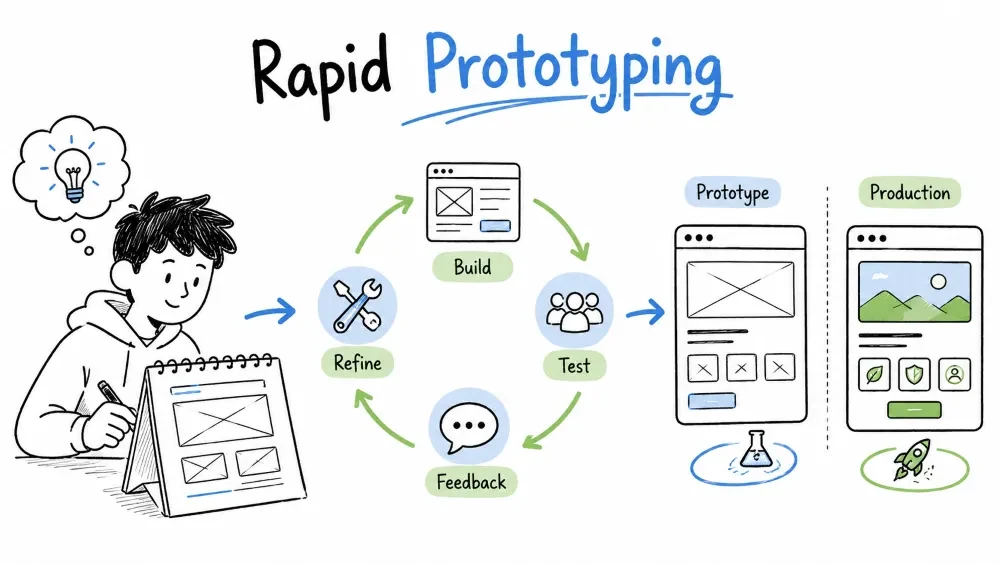
Rapid prototyping is the discipline of turning an idea into something testable in hours or days instead of months. The whole point is learning before building: a cheap, throwaway version of a product that answers one question at a time. This tutorial builds the mental model — what rapid prototyping actually is, why it exists, and how to think about the difference between a prototype and real production software.
Rapid prototyping is building a small, working, intentionally rough version of a product to learn something specific, quickly. You're not trying to finish — you're trying to answer: does this solve the problem? does the customer want it? does it technically work?
Every earlier tutorial in this course built skills (APIs, AI, data). Prototyping is where you spend them. Instead of planning for months, you pick the smallest useful piece, build it today, and show it to a human by the end of the week.
Note: "rapid" means the time to learning, not "sloppy on purpose." Fast to build, fast to test, fast to throw away.
The engine behind prototyping is one idea: it's cheaper to fail in a day with a fake product than to fail in a year with the real one.
| Cost of learning | Time to learn | Example |
|---|---|---|
| Very low | Hours | Clickable mock of a dashboard screen |
| Low | Days | Auto on real data, brittle and manual |
| High | Months | Full production build with auth, tests, scaling |
If you can afford to learn the hard lessons with a cheap version, you should. The prototype trades beauty and reliability for existence — because a working rough version teaches more than a polished plan.
Every prototype — big or small — runs the same loop, and usually more than once:
1. Hypothesize → "I think the customer needs X"
2. Build       → smallest convincing version of X
3. Test        → put it in front of a real user
4. Learn       → what worked, what fell apart
5. Iterate     → change the next version accordingly
Building is only one of the five steps. The whole point is learning on steps 3 and 4. If you never show it to a customer, you are not prototyping — you are just going to war with product planning.
Early on, literally none of the "important" parts have been validated. You do not know if the dashboard metric matters, if the chatbot answer is useful, or if anyone will use the tool at all.
So speed is a strategy, not a virtue:
The killer error is optimizing the wrong direction: weeks spent on font spacing for a tool nobody has confirmed they need.
A prototype is not the final product, a bill of materials, a plan you must honor, or your reputation on the line. It is a question dressed as a product.
This is worth saying bluntly because it changes your whole behavior: the prototype is throwaway. You build for insight, not lasting value. If the test fails, celebrate — you learned something at low cost. If it succeeds, you rebuild it properly with everything you learned.
When to stop prototyping and start producing — maybe to start developing — is the moment of transition (Tutorial 8). But the distinction should always shape how you build:
| Dimension | Prototype | Production |
|---|---|---|
| Purpose | Answer a question | Deliver on a promise |
| Lifetime | Days to weeks | Years |
| Users | A handful of testers | Real, unknown, many |
| Data | Mock, fake, hard-coded | Real, sensitive, live |
| Errors | Acceptable; learn from them | Unacceptable; fail safely |
| Security | Skip or minimal | Mandatory, harsh |
| Speed | Favor velocity | Favor correctness |
The same idea from another angle: a digital agency's sketch costs hours and gets ripped up. The final release costs months and is paid for in years of real users. Different purposes, different budgets — and you cannot hold the sketch to the release's standard.
Prototype and production exist to do different jobs, so the bar differs in every dimension:
This is why you must never ship a prototype and call it production (Tutorial 8 covers the painful reality). A quick build that "works on my machine" with mock data is not a platform of record.
When you are unsure which mode you are in, ask a decisive question:
"If this broke tomorrow, would a real user be harmed / lose trust?"
Another test: is the data real or mocked? Live banking data in production demands encryption and audit; a hard-coded array of fake accounts demands nothing.
Prototype first. Always. Because:
Cross it over to production only when the hypothesis is proven: the user genuinely wants it, you understand the failure modes, and you're ready to honor reliability, security, and data.
Best Practice: force the question each iteration. "Is our purpose to test an idea (prototype) or run a reality (production)?" The answer decides how much of every step — code, DB, tests, security — you actually need.
Save your progress and earn XP for completing tutorials.
4 questions · Pass with 70%+
1What is the primary goal of rapid prototyping?
2Which step of the prototyping loop matters most?
3A customer tool "works on your machine" with mock data but breaks for a real user. What are you in?
4Which best describes a prototype?
Technology
Forward Deployed Engineer
Lesson group
Rapid Prototyping
Progress
13% complete