Preparing your learning space...
100% through Object-Oriented Programming tutorials
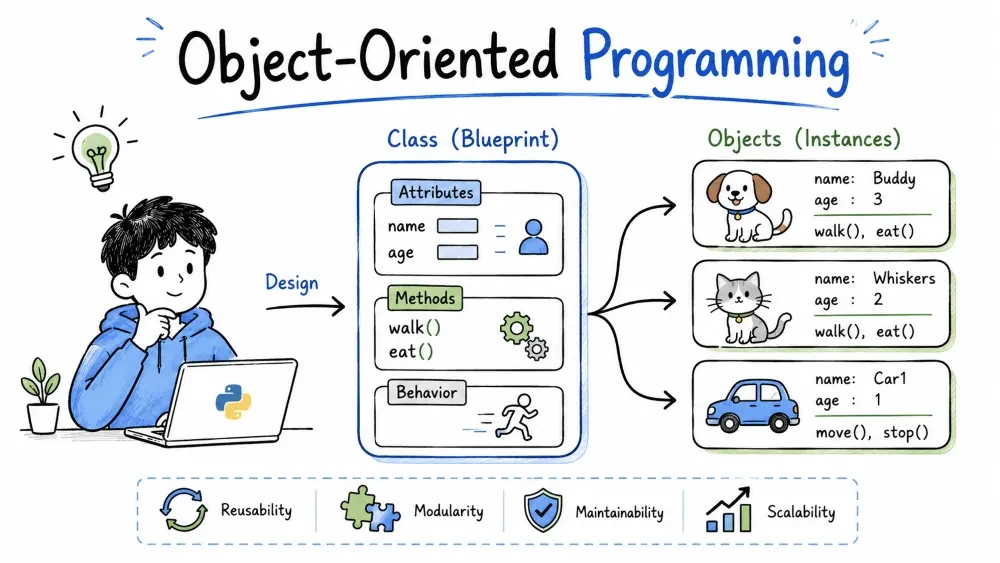
A practical guide to writing cleaner, reusable code with classes and objects. You'll learn the core concepts by building real examples.
Object-Oriented Programming is a way of writing code that groups related data and behavior into objects. Instead of passing data around separate functions, you bundle the data and the functions that work on it together.
Procedural approach — data and functions are separate:
name = "Alice"
balance = 100

def deposit(amount):
    global balance
    balance += amount
OOP approach — data and functions live together:
class BankAccount:
    def __init__(self, name, balance):
        self.name = name
        self.balance = balance

    def deposit(self, amount):
        self.balance += amount
OOP helps you model real-world things (users, products, orders) as code, keeps related code organized, and makes reuse easier.
A class is a blueprint. An object is an actual thing built from that blueprint.
class Car:
    pass

my_car = Car()      # my_car is an object (instance) of the Car class
your_car = Car()    # separate object, same blueprint
You can create as many objects from one class as you need. Each one is independent — changing my_car does not affect your_car.
Attributes store data about an object. Methods are functions that belong to an object.
class Dog:
    def __init__(self, name, breed):
        self.name = name          # attribute
        self.breed = breed        # attribute

    def bark(self):               # method
        return f"{self.name} says Woof!"

    def describe(self):           # method
        return f"{self.name} is a {self.breed}"

dog1 = Dog("Max", "Golden Retriever")
print(dog1.name)                  # Max
print(dog1.bark())                # Max says Woof!
print(dog1.describe())            # Max is a Golden Retriever
Attributes hold the state. Methods define what the object can do.
The constructor (__init__) runs automatically when you create an object. It sets up the initial state of the object.
class Student:
    def __init__(self, name, grade, student_id):
        self.name = name
        self.grade = grade
        self.student_id = student_id
        self.attendance = 0         # default value, not passed in

    def mark_present(self):
        self.attendance += 1

s1 = Student("Emma", "A", "STU001")
s2 = Student("Liam", "B", "STU002")

print(s1.name, s1.grade)           # Emma A
print(s2.name, s2.grade)           # Liam B
The self parameter refers to the current object instance. Every method needs self as its first parameter.
Encapsulation means keeping internal data private and only exposing what's necessary. In Python, prefixing an attribute with _ (protected) or __ (private) signals that it shouldn't be accessed directly.
Use getters and setters (or properties) to control access.
class BankAccount:
    def __init__(self, owner, balance=0):
        self.owner = owner
        self.__balance = balance      # private attribute

    def deposit(self, amount):
        if amount > 0:
            self.__balance += amount

    def withdraw(self, amount):
        if 0 < amount <= self.__balance:
            self.__balance -= amount
        else:
            print("Insufficient funds")

    def get_balance(self):            # controlled read access
        return self.__balance

acc = BankAccount("Alice", 1000)
acc.deposit(500)
acc.withdraw(200)
print(acc.get_balance())              # 1300
# print(acc.__balance)                # AttributeError — private
Why encapsulate? It prevents external code from putting your object into an invalid state (e.g., a negative bank balance).
Inheritance lets one class reuse the attributes and methods of another class. The child class gets everything from the parent class and can add or override what it needs.
class Animal:
    def __init__(self, name):
        self.name = name

    def speak(self):
        return f"{self.name} makes a sound"

    def move(self):
        return f"{self.name} moves"

class Cat(Animal):          # Cat inherits from Animal
    def speak(self):        # override the parent method
        return f"{self.name} says Meow!"

class Bird(Animal):
    def __init__(self, name, wingspan):
        super().__init__(name)      # call parent constructor
        self.wingspan = wingspan

    def speak(self):
        return f"{self.name} says Chirp!"

    def fly(self):          # new method, not in parent
        return f"{self.name} flies with {self.wingspan}cm wings"

cat = Cat("Whiskers")
bird = Bird("Tweety", 25)

print(cat.speak())          # Whiskers says Meow!
print(cat.move())           # Whiskers moves (inherited)
print(bird.speak())         # Tweety says Chirp!
print(bird.fly())           # Tweety flies with 25cm wings
Use super() to call the parent class's methods. This avoids duplicating parent initialization code.
Polymorphism means different classes can use the same method name but behave differently. The calling code doesn't need to know which specific class it's working with.
class Rectangle:
    def __init__(self, width, height):
        self.width = width
        self.height = height

    def area(self):
        return self.width * self.height

class Circle:
    def __init__(self, radius):
        self.radius = radius

    def area(self):
        return 3.14159 * self.radius ** 2

class Triangle:
    def __init__(self, base, height):
        self.base = base
        self.height = height

    def area(self):
        return 0.5 * self.base * self.height

# Polymorphic function — works with any shape that has .area()
def print_area(shapes):
    for shape in shapes:
        print(f"Area: {shape.area()}")

shapes = [
    Rectangle(5, 10),
    Circle(7),
    Triangle(4, 6)
]

print_area(shapes)
# Area: 50
# Area: 153.938...
# Area: 12.0
The print_area function doesn't care what type each shape is. It only cares that the object has an area() method. This lets you add new shape types without changing existing code.
Abstraction means hiding complex implementation details and only showing the essential features. In Python, you can use the abc module to create abstract base classes that define what methods a child class must implement.
from abc import ABC, abstractmethod

class PaymentProcessor(ABC):
    @abstractmethod
    def pay(self, amount):
        """Process a payment — must be implemented by subclasses"""
        pass

    def receipt(self, amount):      # concrete method, shared by all
        return f"Payment of ${amount:.2f} completed"

class CreditCard(PaymentProcessor):
    def pay(self, amount):
        return f"Charging ${amount:.2f} to credit card"

class PayPal(PaymentProcessor):
    def pay(self, amount):
        return f"Redirecting to PayPal for ${amount:.2f}"

class Crypto(PaymentProcessor):
    def pay(self, amount):
        return f"Sending {amount * 0.000042} BTC"

# payment = PaymentProcessor()      # TypeError — can't instantiate abstract class

cards = [CreditCard(), PayPal(), Crypto()]
for card in cards:
    print(card.pay(50.00))
    print(card.receipt(50.00))
The abstract class guarantees every payment method has a pay() function. You can add new payment types later without changing the code that uses them.
OOP is a tool, not a rule. Use classes when you're modeling things with related data and behavior, or when code reuse across similar types makes sense. For simple scripts, functions are often enough.
Save your progress and earn XP for completing tutorials.
Technology
Python
Lesson group
Object-Oriented Programming
Progress
100% complete