

AI Data Privacy — Protecting Personal Information in the Age of AI
Learn how to protect personal and sensitive information when using AI tools and services.
Preparing your learning space...
33% through AI Ethics & safty tutorials
Learn how to protect personal and sensitive information when using AI tools and services.
In this tutorial, you will learn:
Data Privacy is the practice of protecting personal and sensitive information from unauthorized access, misuse, or sharing.
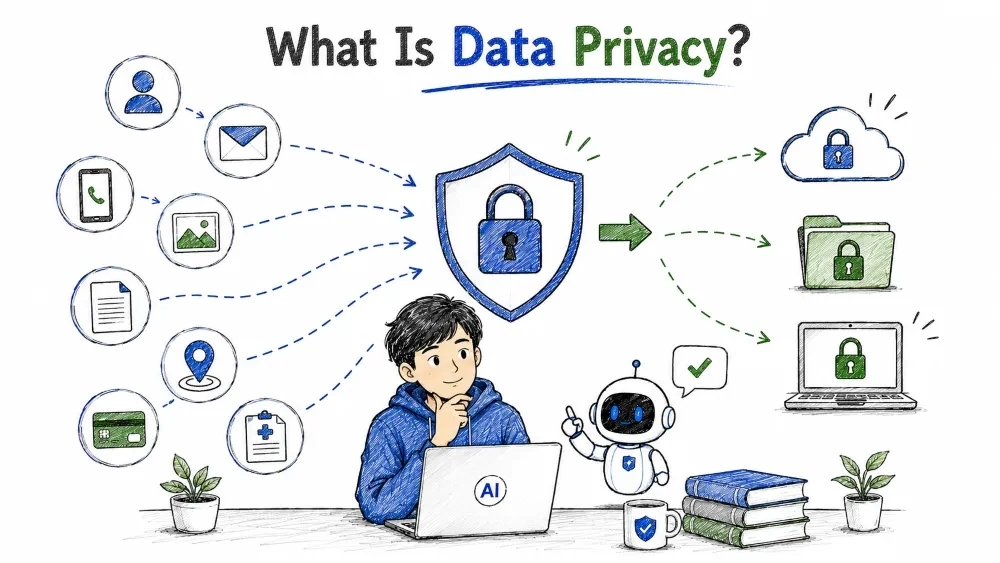
Data Privacy is the practice of protecting personal and sensitive information from unauthorized access, misuse, or sharing.
When using AI, you may provide information such as:
Data privacy ensures this information is handled safely and responsibly.
AI systems often need data to provide services — without proper privacy protection, personal information could be misused or exposed.
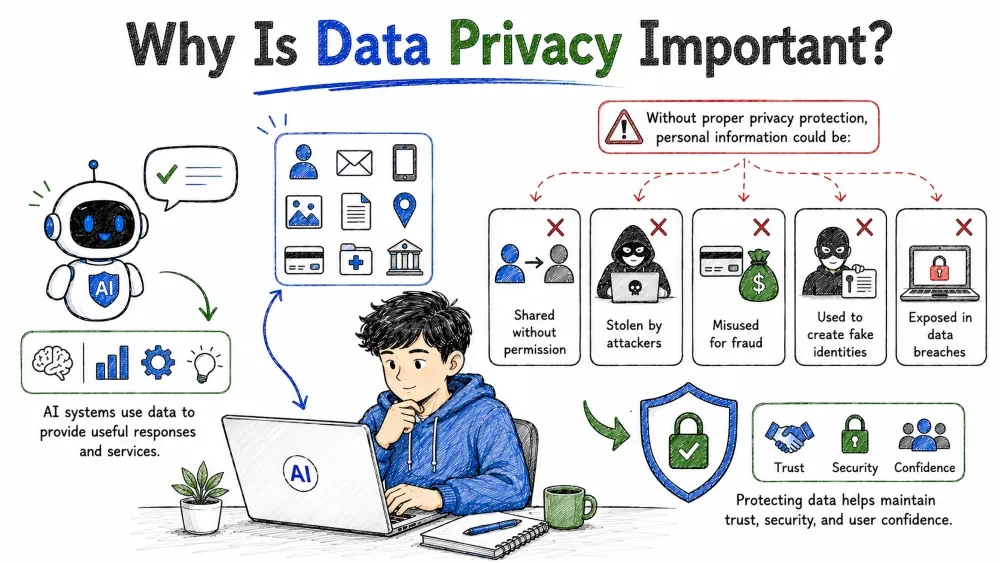
AI systems often need data to provide useful responses and services.
Without proper privacy protection, personal information could be:
Protecting data helps maintain trust, security, and user confidence.
A practical story showing how a teacher (Ms. Anita Kapoor) protected student data while using AI tools in her classroom.
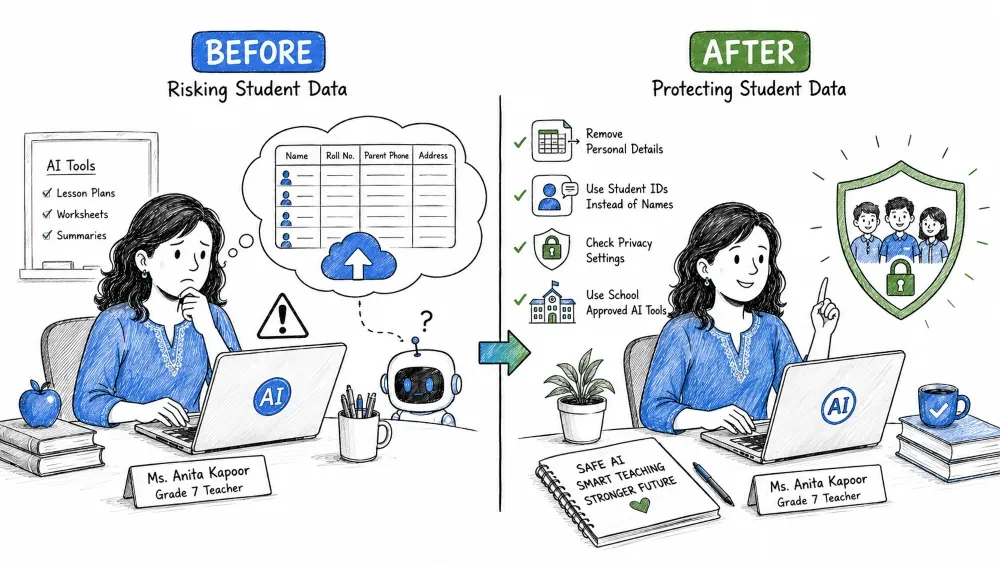
Ms. Anita Kapoor is a Grade 7 teacher who recently started using AI tools to:
One day, she uploaded a class spreadsheet to an AI tool to help organize student grades. The spreadsheet contained:
Later, she realized the AI tool might store or share that data. She immediately deleted the file from the platform.
The Problem:
Ms. Kapoor had accidentally shared sensitive student information with an AI tool without checking its privacy policy.
Solution:
Result:
Ms. Kapoor now uses AI safely — she gets the help she needs without putting student data at risk.
AI may use data to understand requests, personalize recommendations, and improve accuracy — but it should collect only what is needed.
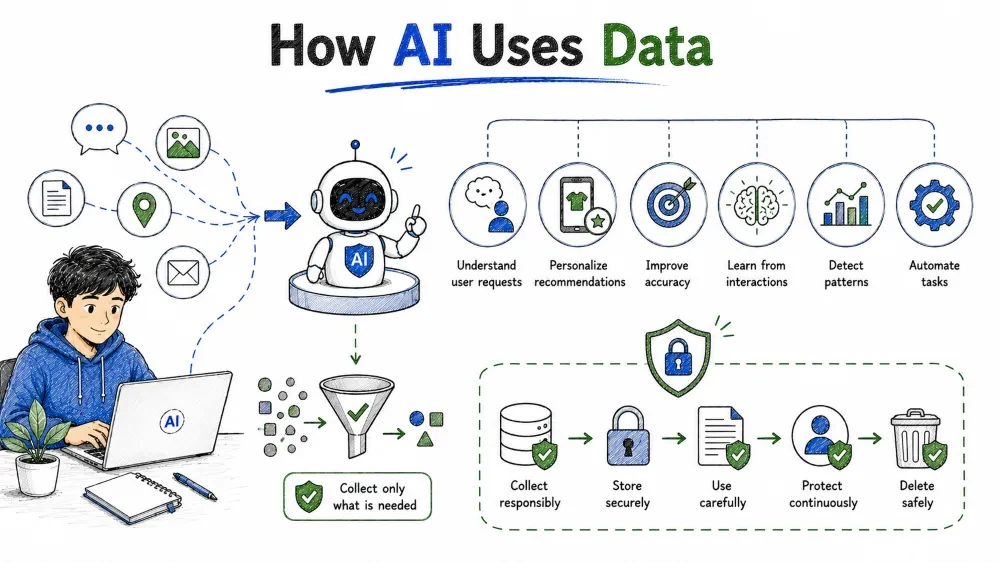
AI may use data to:
Responsible AI systems collect only the data they need and protect it throughout its lifecycle.
AI may process different types of information — from basic personal details to sensitive health and financial records.
AI may process different types of information.
A simple example showing how a privacy-focused AI should handle sensitive documents like medical reports.
Imagine you ask an AI assistant:
"Summarize my medical report."
The AI processes your uploaded document.
A privacy-focused AI should:
Sensitive information should always be handled with care.
A comparison showing the difference between data privacy (user rights) and data security (technical protection).
| Data Privacy | Data Security |
|---|---|
| Controls how data is collected and used | Protects data from theft and attacks |
| Focuses on user rights | Focuses on technical protection |
| Requires user permission | Uses encryption and security measures |
| Defines who can access data | Prevents unauthorized access |
Both are essential for responsible AI.
AI users should be aware of several privacy risks — from oversharing to data breaches and identity theft.
AI users should be aware of several privacy risks.
Providing unnecessary personal details.
Example:
Sharing your full address when it isn't needed.
Hackers may gain access to stored information.
Personal data may be used to impersonate someone.
Data could be shared without the user's knowledge.
Scammers may use AI-generated messages to steal information.
Personal photos or voice recordings may be misused to create fake media.
Follow these habits whenever using AI — small changes can greatly improve your privacy.
Follow these habits whenever using AI.
Small habits can greatly improve your privacy.
Some information should never be shared with AI unless absolutely necessary and you trust the service.
Do not share the following unless absolutely necessary and you trust the service.
Always think before sharing sensitive information.
Instead of sharing sensitive details, learn how to ask AI for help while protecting your private information.
Instead of writing:
"My bank account number is 123456789. Help me check my balance."
Write:
"How can I understand a bank statement?"
The second question protects your private information while still getting useful help.
Consent means giving permission before your data is collected or used — responsible AI systems should always ask.
Consent means giving permission before your data is collected or used.
Responsible AI systems should:
Users should understand how their information is being used.
Organizations use encryption, secure servers, access controls, and other methods to protect user information.
Organizations use various methods to protect user information.
Common protections include:
These measures reduce the risk of unauthorized access.
Privacy should be considered from the beginning when creating AI systems — collect only what is necessary.
Privacy should be considered from the beginning when creating AI systems.
Developers should:
This approach is called Privacy by Design.
Data privacy matters when using AI chatbots, voice assistants, smart devices, and many other everyday tools.
Data privacy matters when using:
Privacy should be considered in every AI-powered service.
Common privacy mistakes to avoid when using AI tools and services.
❌ Sharing passwords with AI
❌ Uploading confidential documents unnecessarily
❌ Ignoring privacy settings
❌ Using weak passwords
❌ Reusing the same password everywhere
❌ Clicking suspicious AI-generated links
Before sharing information with an AI tool, ask yourself these questions to protect your privacy.
Before sharing information with an AI tool, ask yourself:
If you're unsure, avoid sharing it.
A hands-on exercise to practice identifying privacy risks when using AI to summarize a business document.
Scenario: Imagine you are using an AI assistant to summarize a business document.
| # | Question | Your Answer |
|---|---|---|
| 1 | Which information should be removed before uploading? | |
| 2 | Why is data privacy important in this situation? | |
| 3 | What security measures could protect the document? | |
| 4 | Should confidential customer information be shared? | |
| 5 | How can you reduce privacy risks? |
Review your own AI usage habits for one week and identify ways to improve your data privacy.
Goal: Choose one AI tool you use regularly and review your privacy habits.
| Day | AI Tool Used | Info Shared | Sensitive? | Privacy Settings Checked? |
|---|---|---|---|---|
| Day 1 | Yes / No | Yes / No | ||
| Day 2 | Yes / No | Yes / No | ||
| Day 3 | Yes / No | Yes / No | ||
| Day 4 | Yes / No | Yes / No | ||
| Day 5 | Yes / No | Yes / No | ||
| Day 6 | Yes / No | Yes / No | ||
| Day 7 | Yes / No | Yes / No |
The most important lessons to remember about data privacy and responsible AI use.
Data privacy is a fundamental part of responsible AI — understand what to share, recognize risks, and follow safe practices.
Data privacy is a fundamental part of responsible AI. By understanding what information should be shared, recognizing privacy risks, and following safe practices, users can confidently use AI while protecting their personal information. Responsible AI systems prioritize transparency, security, and user control over data.
Save your progress and earn XP for completing tutorials.
Technology
AI for everyone
Lesson group
AI Ethics & safty
Progress
33% complete