

AI Bias Mitigation — Make AI Fair, Accurate, and Inclusive
Learn how to identify, reduce, and prevent unfair bias in AI systems to make them fairer and more trustworthy.
Preparing your learning space...
67% through AI Ethics & safty tutorials
Learn how to identify, reduce, and prevent unfair bias in AI systems to make them fairer and more trustworthy.
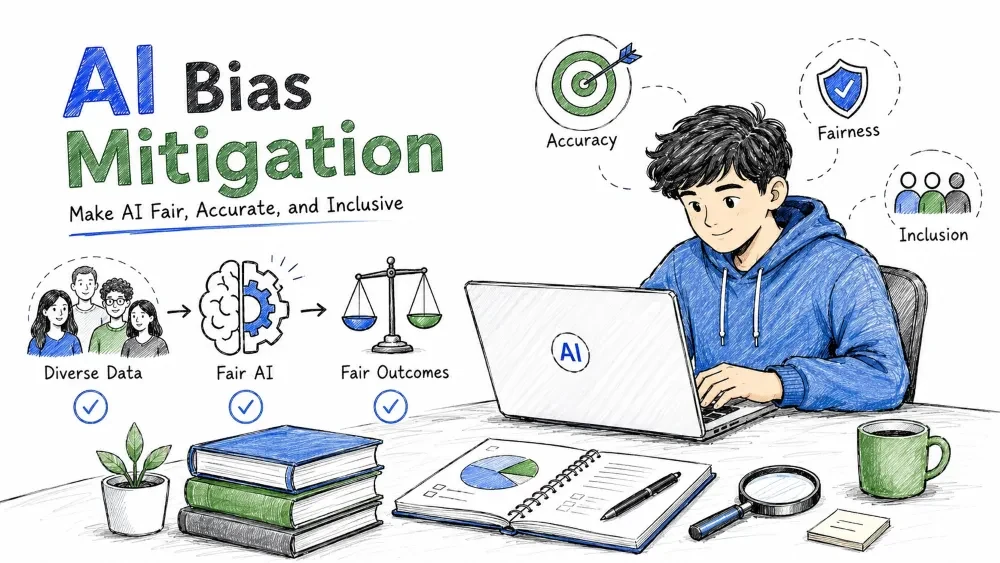
In this tutorial, you will learn:
Bias Mitigation is the process of identifying, reducing, and preventing unfair bias in AI systems.
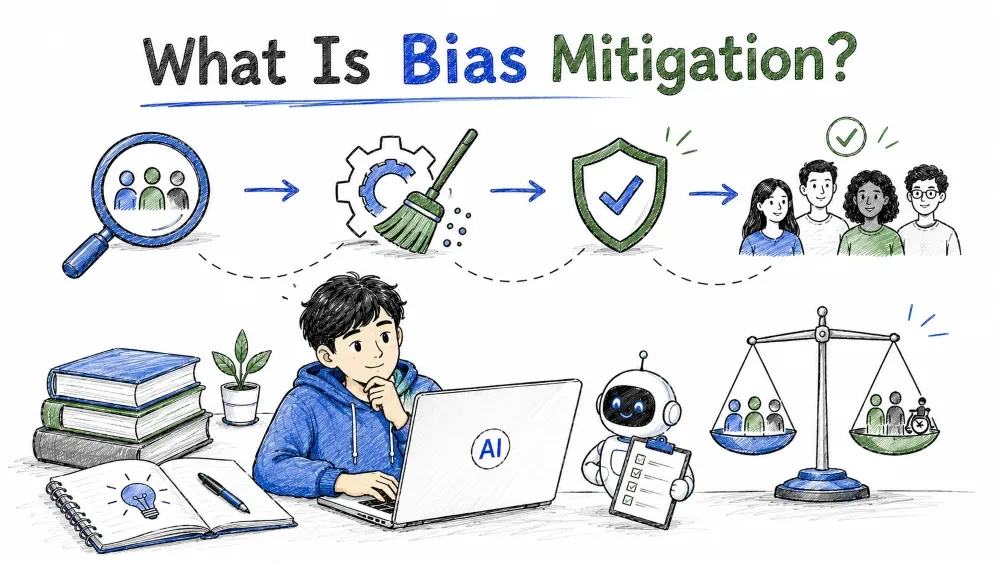
Bias Mitigation is the process of identifying, reducing, and preventing unfair bias in AI systems.
AI learns from data. If the training data contains unfair patterns or stereotypes, the AI may produce biased or unfair results.
Bias mitigation helps make AI:
AI learns from data. If the training data contains unfair patterns or stereotypes, the AI may produce biased or unfair results.
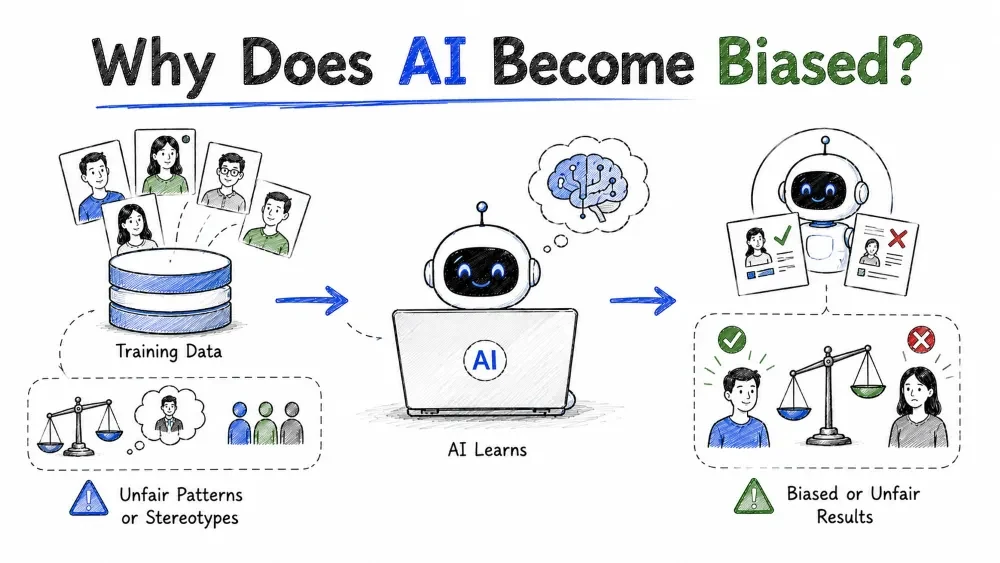
AI does not have personal opinions.
Instead, it learns from:
If these sources contain bias, AI may learn those patterns.
Example:
If an AI hiring system is trained mostly on resumes from one group of people, it may unfairly prefer similar applicants.
A practical story showing how bias in an AI system affected real students and how the problem was identified and fixed.
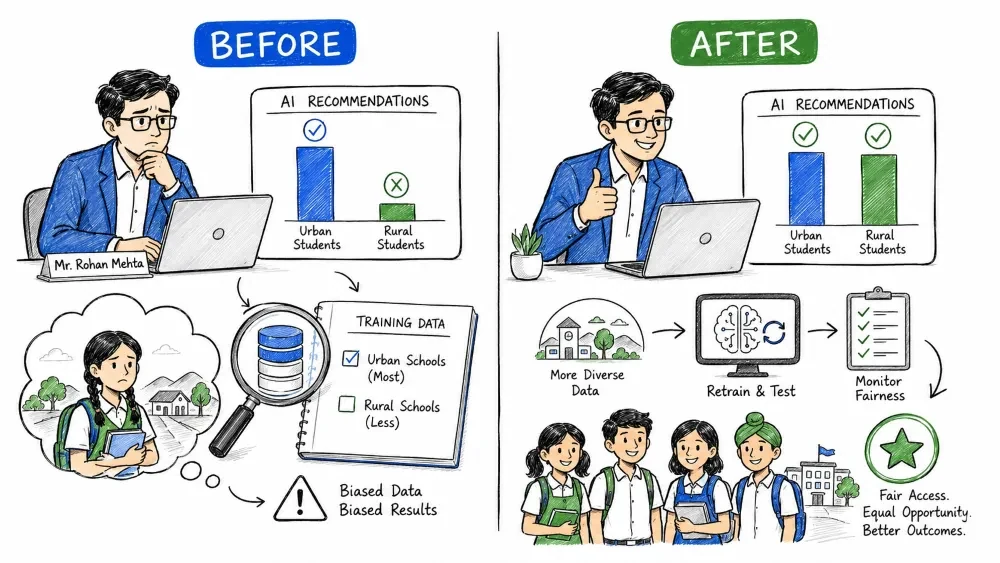
Mr. Rohan Mehta is a school administrator at a large high school. The school started using an AI tool to help:
After a few months, teachers noticed something unusual.
The Problem:
The AI was consistently recommending fewer students from rural backgrounds for advanced programs — even when their grades were similar to urban students.
Investigation:
Mr. Mehta and the teachers reviewed the AI's training data and found:
Solution:
Result:
After fixing the bias, the AI started recommending qualified students from all backgrounds fairly. More rural students gained access to advanced programs.
Imagine an AI hiring assistant.
Training Data:
The AI may incorrectly assume male candidates are better simply because it has seen more examples.
This is called training data bias.
Bias mitigation helps detect and correct this problem.
Understanding the different kinds of bias that can appear in AI systems — from data bias to cultural bias.
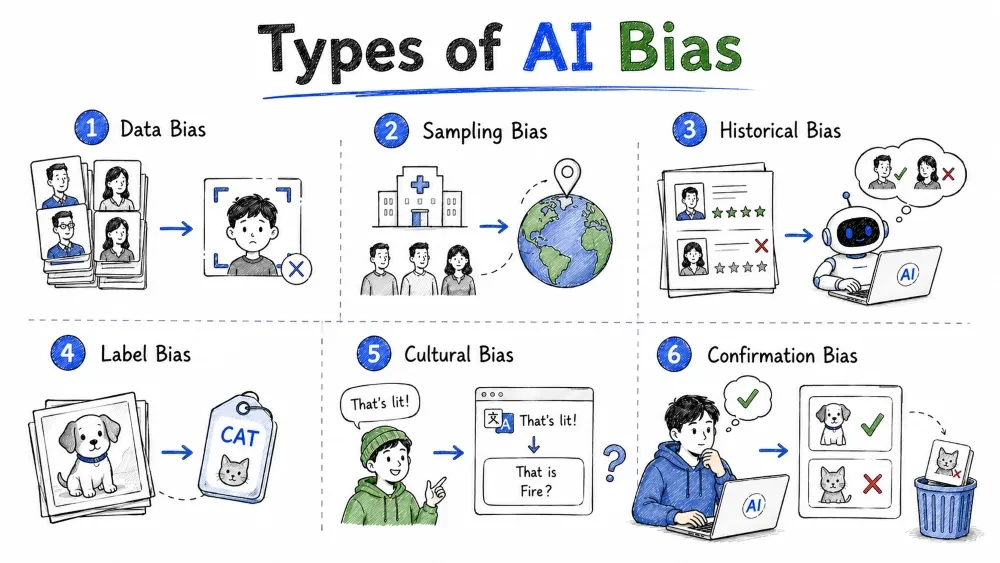
Occurs when training data is unbalanced.
Example:
A facial recognition model trained mostly on adults performs poorly for children.
Some groups are underrepresented.
Example:
A medical AI trained only using patients from one country.
Past human decisions influence AI.
Example:
Historical hiring practices that favored one gender.
Incorrect labels are used during training.
Example:
Photos labeled incorrectly during image classification.
AI assumes one culture is the standard.
Example:
Translation tools misunderstanding regional expressions.
Developers unintentionally reinforce expected outcomes.
Example:
Ignoring incorrect predictions because they match expectations.
Biased AI can reject qualified applicants, give unfair approvals, produce offensive content, and reduce trust in AI.
Biased AI can:
Even small bias can affect millions of users.
Watch for situations where AI gives different answers for similar users, produces stereotypes, or ignores minority groups.
Watch for situations where AI:
Bias mitigation happens in four stages — collect diverse data, detect bias, reduce bias, and continuously monitor.
Bias mitigation usually happens in four stages:
The best way to reduce bias is using balanced training data that represents all groups fairly.
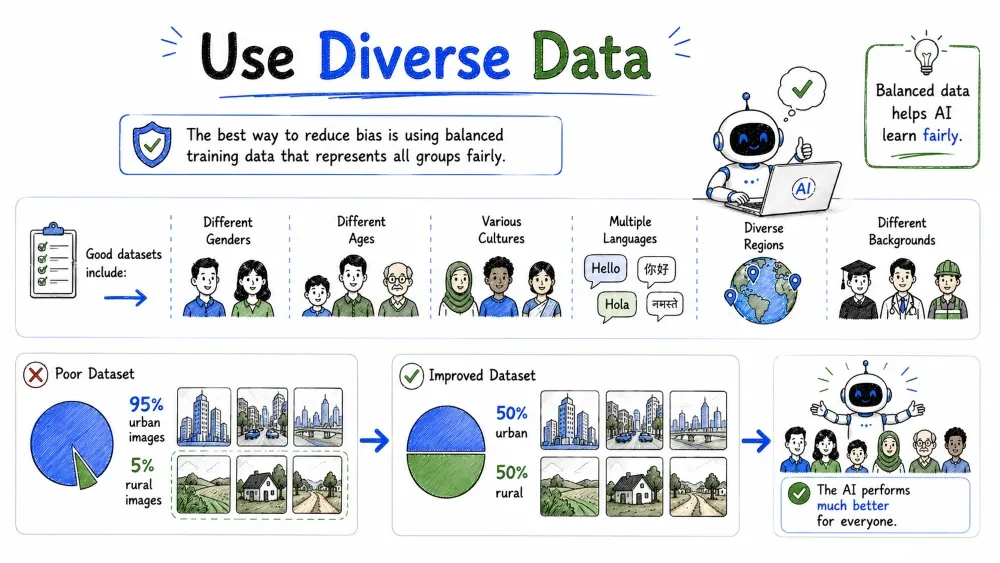
The best way to reduce bias is using balanced training data.
Good datasets include:
Balanced data helps AI learn fairly.
Poor Dataset
Improved Dataset
The AI performs much better for everyone.
Before deploying AI, developers test it carefully to ensure it treats all groups equally.
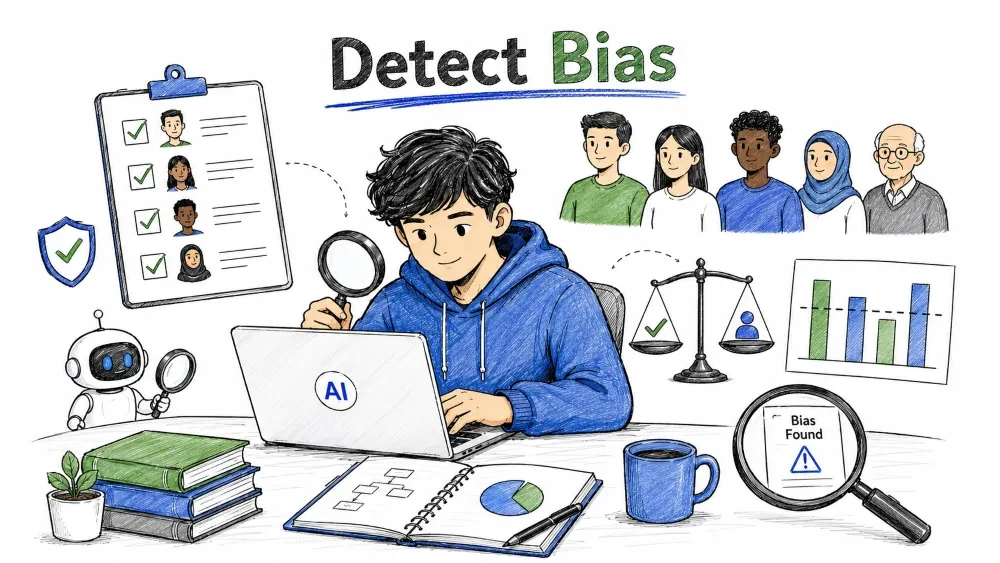
Before deploying AI, developers test it carefully.
Questions include:
Testing reveals hidden bias.
Developers can reduce bias by adding missing data, removing biased examples, and fine-tuning AI models.
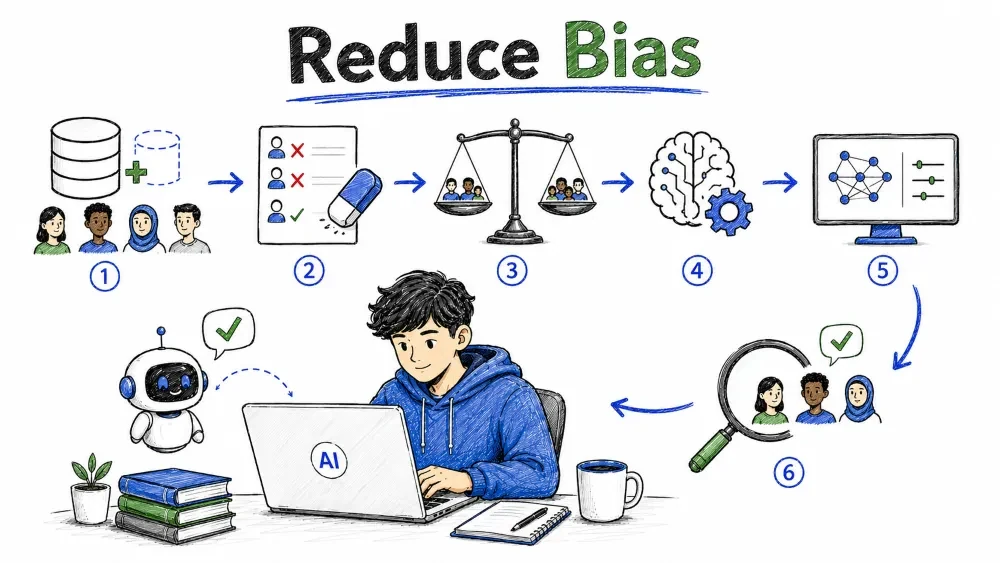
Developers can reduce bias by:
Bias can appear over time — developers should regularly review AI, collect feedback, and update datasets.
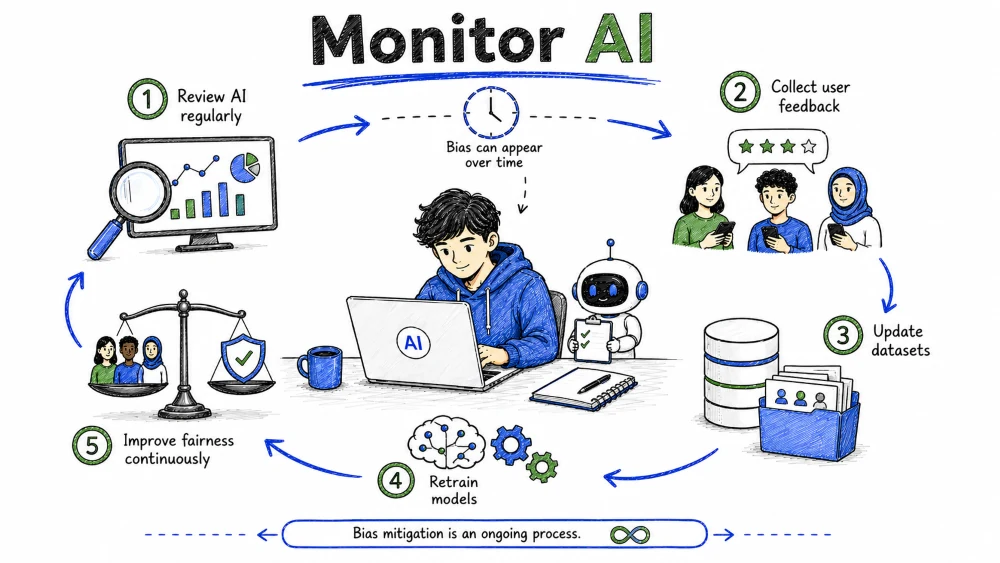
Bias can appear over time.
Developers should:
Bias mitigation is an ongoing process.
A university uses AI to review scholarship applications — but discovers bias against rural students and fixes it.
A university uses AI to review scholarship applications.
Problem:
Students from rural schools receive lower scores.
Investigation finds:
Training data mostly contained applications from urban schools.
Solution:
The AI becomes more balanced.
Bias can appear in search engines, chatbots, image generators, recommendation systems, and many other AI tools.
Bias can appear in:
A comparison between human bias (personal, emotional) and AI bias (data-driven, scalable).
| Human Bias | AI Bias |
|---|---|
| Comes from personal beliefs | Comes from training data |
| Emotional | Data-driven |
| Individual | Can affect millions |
| Hard to measure | Can often be tested |
| Personal decisions | Automated decisions |
Key strategies to ensure AI systems remain fair, transparent, and inclusive throughout their lifecycle.
Before using AI, ask these questions to ensure it is fair, transparent, and accountable.
Before using AI, ask:
If the answer is "Yes" to all, the AI is more likely to be responsible.
A hands-on exercise to think about bias in an AI movie recommendation system.
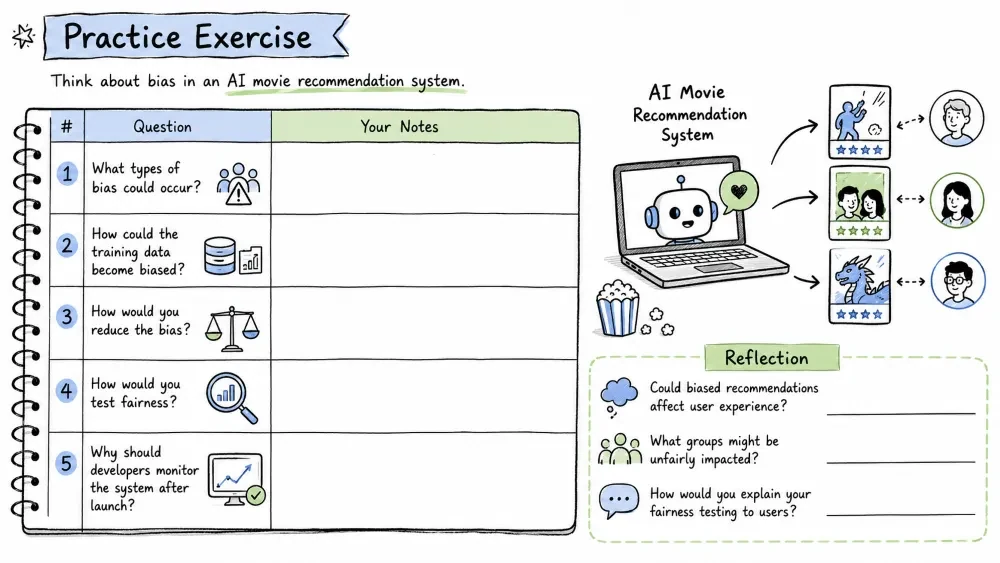
Scenario: Think about an AI movie recommendation system.
| # | Question | Your Notes |
|---|---|---|
| 1 | What types of bias could occur? | |
| 2 | How could the training data become biased? | |
| 3 | How would you reduce the bias? | |
| 4 | How would you test fairness? | |
| 5 | Why should developers monitor the system after launch? |
Choose any AI tool you use regularly and observe its responses for signs of bias over one week.
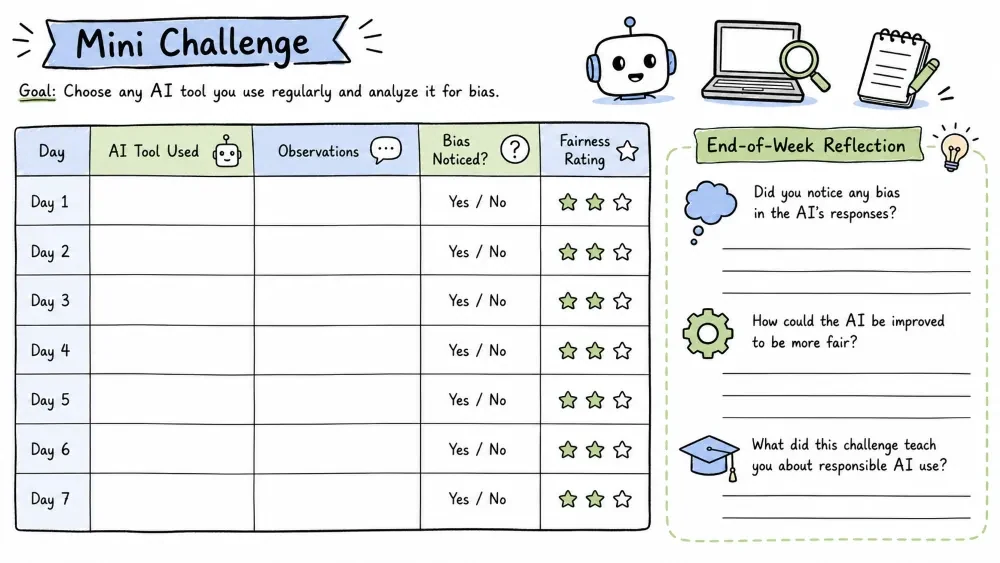
Goal: Choose any AI tool you use regularly and analyze it for bias.
| Day | AI Tool Used | Observations | Bias Noticed? | Fairness Rating |
|---|---|---|---|---|
| Day 1 | Yes / No | ⭐⭐___ | ||
| Day 2 | Yes / No | ⭐⭐___ | ||
| Day 3 | Yes / No | ⭐⭐___ | ||
| Day 4 | Yes / No | ⭐⭐___ | ||
| Day 5 | Yes / No | ⭐⭐___ | ||
| Day 6 | Yes / No | ⭐⭐___ | ||
| Day 7 | Yes / No | ⭐⭐___ |
Save your progress and earn XP for completing tutorials.
Technology
AI for everyone
Lesson group
AI Ethics & safty
Progress
67% complete