Preparing your learning space...
100% through AI Ethics & safty tutorials
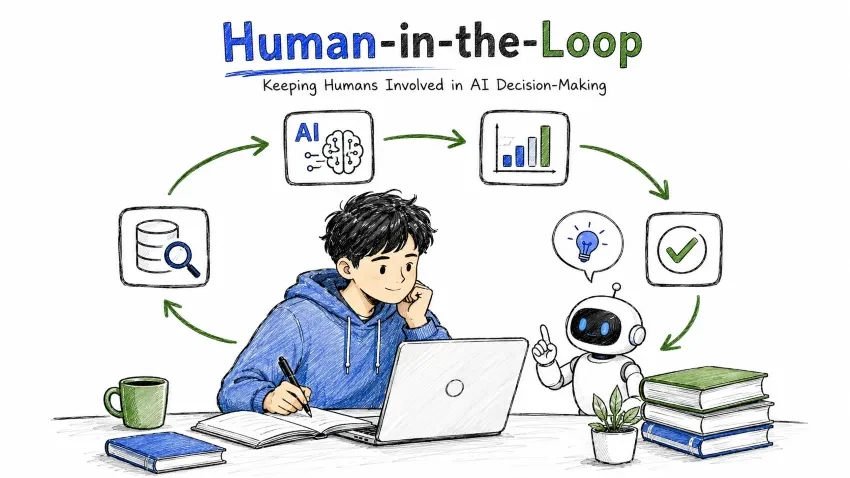
Learn why human oversight is essential in AI systems and how to combine AI efficiency with human judgment.
In this tutorial, you will learn:
Human-in-the-Loop is an approach where humans actively participate in the AI decision-making process to ensure accuracy and fairness.
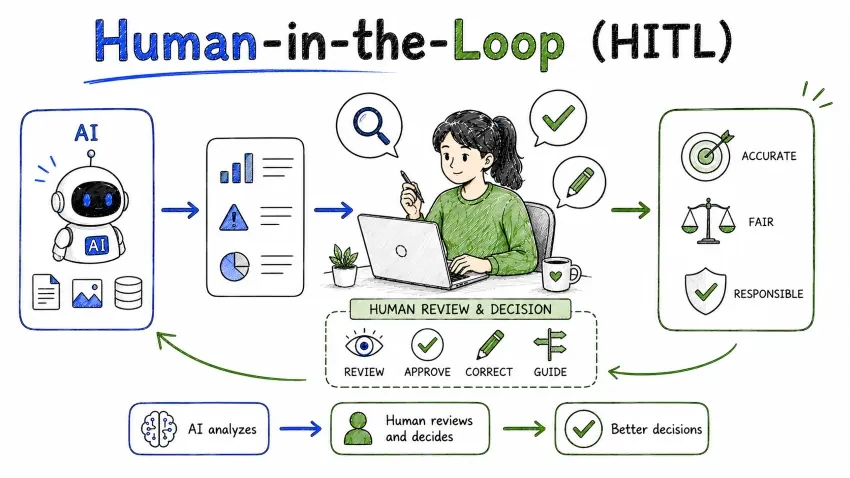
Human-in-the-Loop (HITL) is an approach where humans actively participate in the AI decision-making process.
Instead of allowing AI to make every decision on its own, a person reviews, approves, corrects, or guides the AI when necessary.
This helps ensure that important decisions remain accurate, fair, and responsible.
AI is powerful but not perfect — it can make mistakes, misunderstand context, and show bias. Human involvement helps catch these issues.
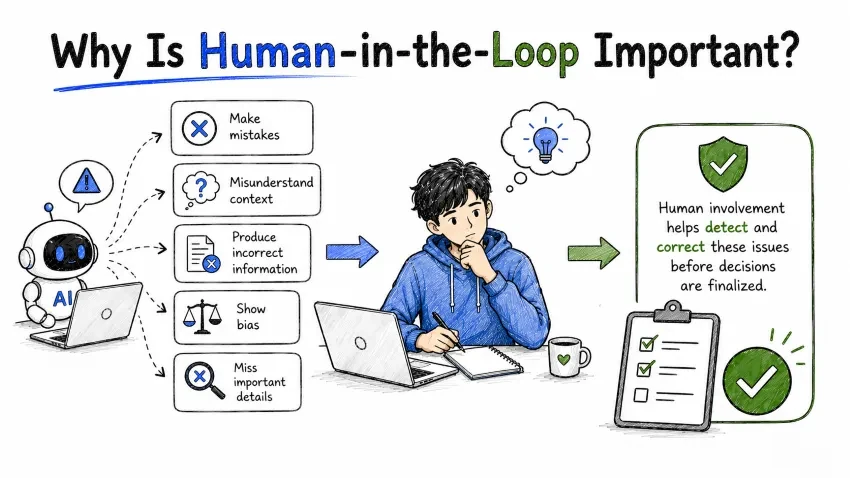
AI is powerful, but it is not perfect.
It can:
Human involvement helps detect and correct these issues before decisions are finalized.
A practical story showing how a school principal (Mr. Arjun Mehta) used HITL to ensure fair student placements with AI assistance.
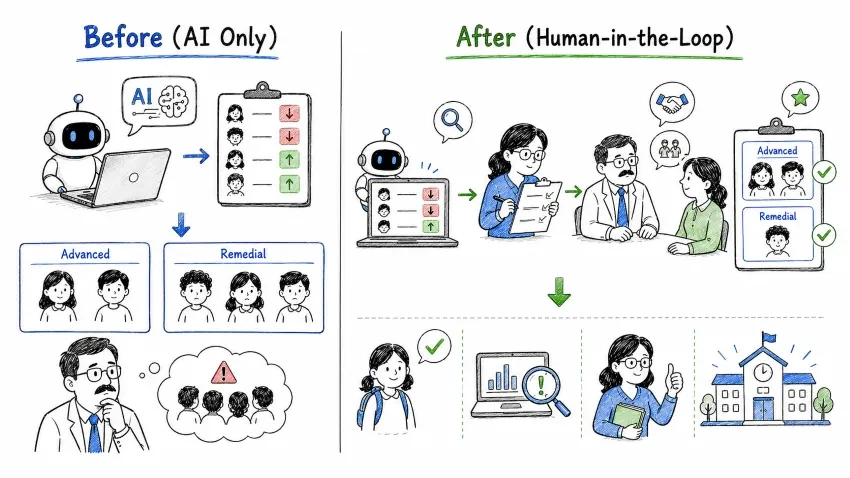
Mr. Arjun Mehta is a school principal managing student placements for the new academic year. His school started using an AI tool to:
The AI quickly processed hundreds of student records and generated recommendations.
The Problem:
The AI recommended that several students from a particular background be placed in remedial sections — even though their test scores were average. The AI had learned patterns from previous years' data that contained human bias.
The HITL Solution:
Instead of accepting the AI's recommendations automatically, Mr. Mehta followed a Human-in-the-Loop approach:
Result:
A typical HITL workflow: user provides input → AI analyzes → human reviews → final decision is made.
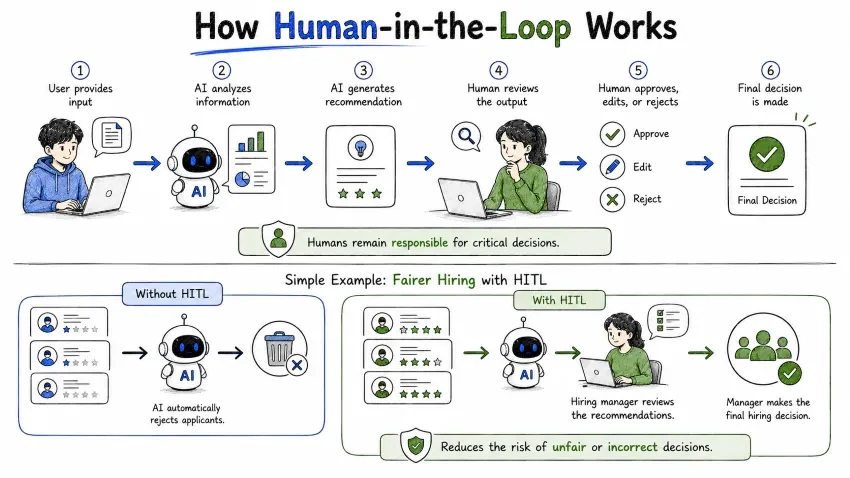
A typical HITL workflow follows these steps:
Humans remain responsible for critical decisions.
An example showing how HITL prevents unfair hiring decisions by keeping a human reviewer in the loop.
Imagine an AI that reviews job applications.
Without HITL:
With HITL:
This reduces the risk of unfair or incorrect decisions.
Many industries use HITL to improve reliability — from healthcare and education to banking and government services.
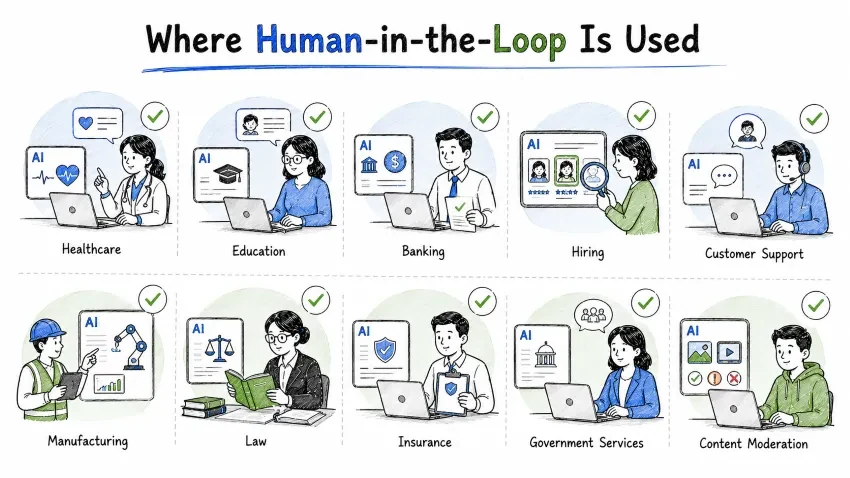
Many industries use HITL to improve reliability.
Examples include:
An AI system analyzes an X-ray and highlights suspicious areas — but a doctor makes the final diagnosis.
An AI system analyzes an X-ray and detects signs of pneumonia.
Instead of diagnosing the patient automatically:
The doctor's expertise ensures patient safety.
An AI grades student essays for grammar and structure — but the teacher reviews and adjusts the final scores.
An AI grades student essays.
Instead of assigning final grades automatically:
Teachers maintain control over student assessment.
An AI flags a suspicious transaction — but a fraud specialist reviews it before taking action.
An AI detects a suspicious credit card transaction.
Instead of blocking the card immediately:
Human review helps avoid unnecessary disruptions.
Humans can participate in different ways — as reviewers, decision makers, trainers, monitors, and auditors.
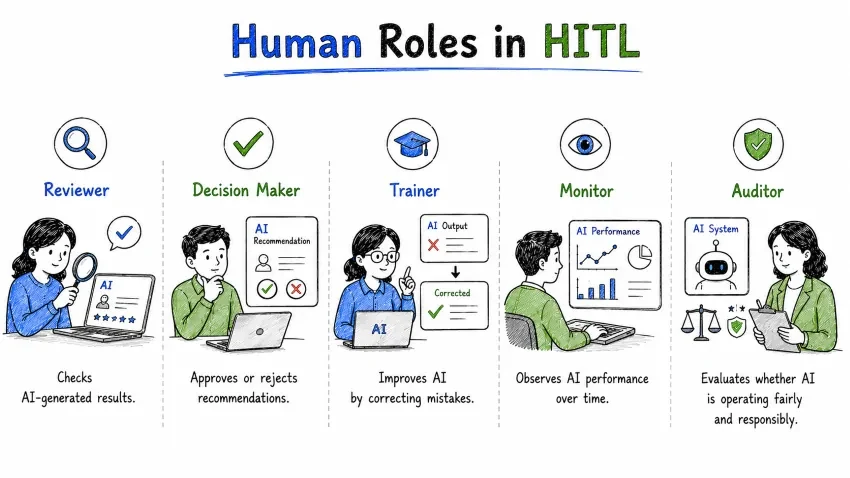
Humans can participate in different ways.
Checks AI-generated results.
Approves or rejects recommendations.
Improves AI by correcting mistakes.
Observes AI performance over time.
Evaluates whether AI is operating fairly and responsibly.
HITL improves accuracy, reduces mistakes, detects bias, and builds trust in AI systems.
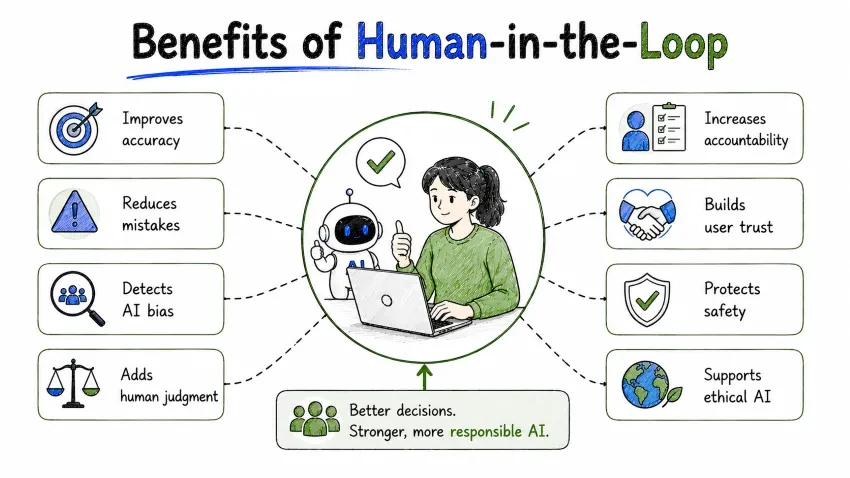
HITL provides several important advantages.
HITL requires additional time, trained reviewers, and may slow fully automated processes — but the trade-off is worth it for critical decisions.
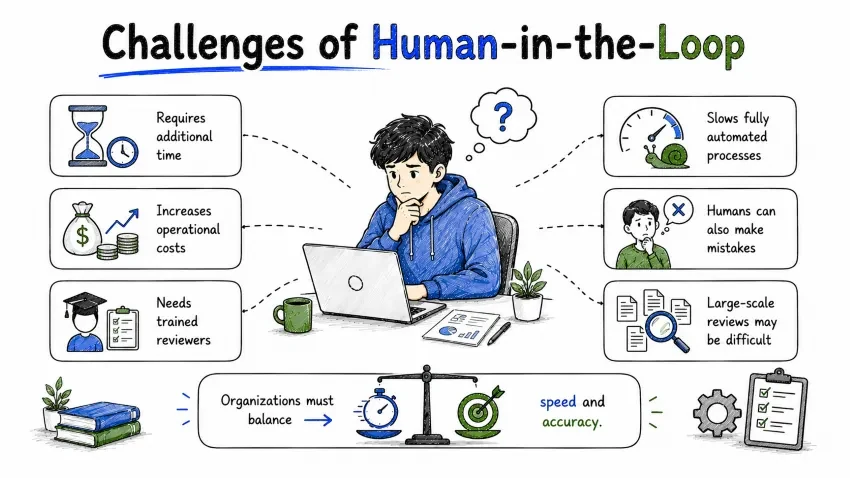
Although useful, HITL also has limitations.
Organizations must balance speed and accuracy.
A comparison showing when human review is essential versus when full automation is appropriate.
| Human-in-the-Loop | Fully Automated AI |
|---|---|
| Human reviews results | AI decides independently |
| Better for critical decisions | Better for repetitive tasks |
| Higher accuracy | Faster processing |
| More accountability | Less human oversight |
| Slower workflow | Faster workflow |
Both approaches have appropriate use cases.
Human oversight is especially important when AI decisions affect people — like medical diagnosis, hiring, and loan approvals.
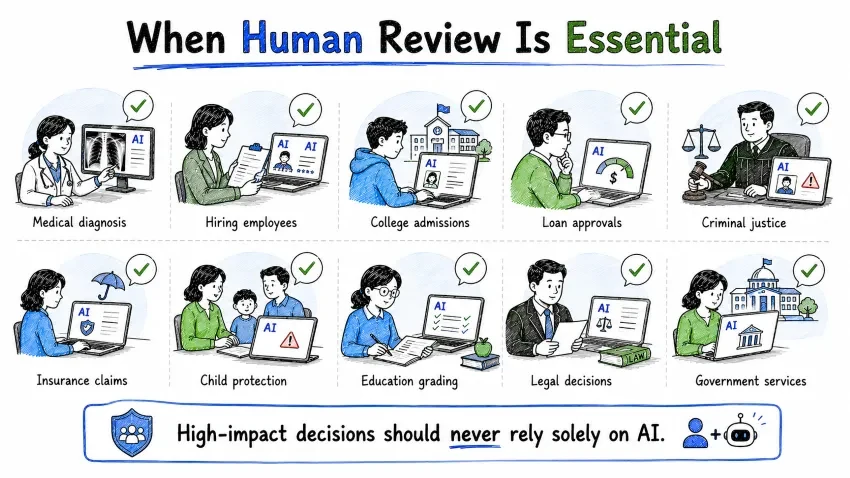
Human oversight is especially important when AI decisions affect people.
Examples include:
High-impact decisions should never rely solely on AI.
Some low-risk tasks like spell checking, email categorization, and calendar scheduling can be safely automated.
society.
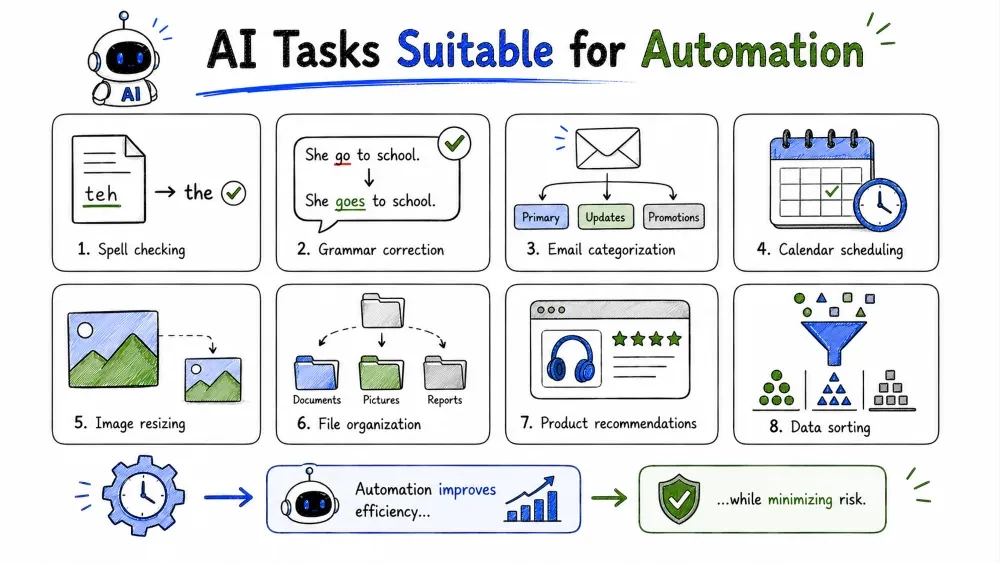
Some tasks are low-risk and can often be automated.
Examples include:
Automation improves efficiency while minimizing risk.
Organizations should keep humans involved in important decisions, train reviewers, and monitor AI performance.
Organizations should follow these guidelines.
Common pitfalls when implementing HITL — like trusting AI without verification and removing humans from critical decisions.
❌ Trusting AI without verification
❌ Removing humans from critical decisions
❌ Ignoring AI errors
❌ Assuming AI is always correct
❌ Failing to document decisions
❌ Providing little or no reviewer training
Before using AI for important decisions, ask these questions to ensure human oversight is in place.
Before using AI for important decisions, ask:
If the answer is "Yes," the AI process is more reliable and responsible.
A hands-on exercise to think about how HITL applies when a school uses AI to review scholarship applications.
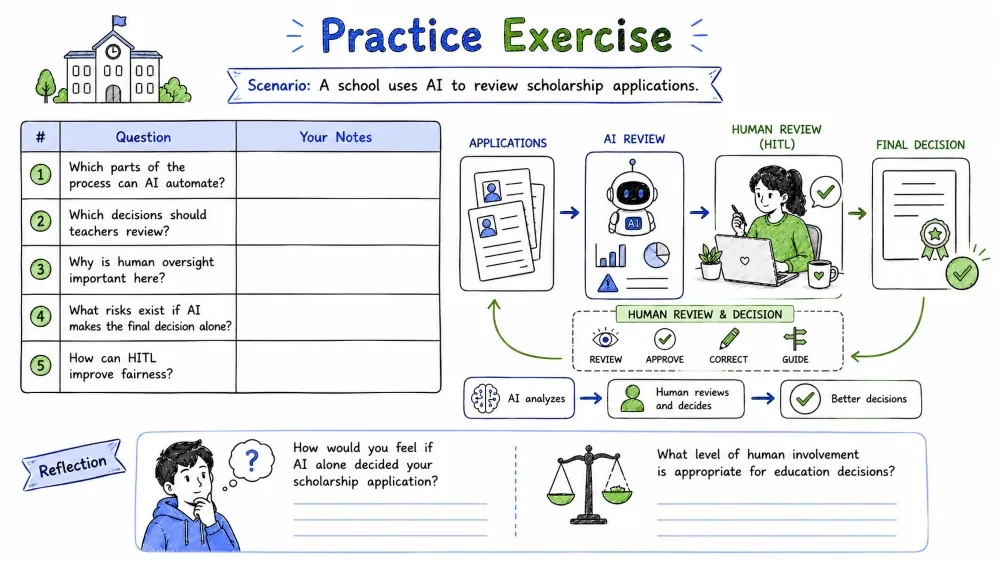
Scenario: A school uses AI to review scholarship applications.
| # | Question | Your Notes |
|---|---|---|
| 1 | Which parts of the process can AI automate? | |
| 2 | Which decisions should teachers review? | |
| 3 | Why is human oversight important here? | |
| 4 | What risks exist if AI makes the final decision alone? | |
| 5 | How can HITL improve fairness? |
Choose an AI tool you use regularly and analyze which tasks need human review and which can be automated.
Goal: Choose an AI tool you use regularly and analyze its tasks for HITL.
| Day | AI Tool Used | Tasks AI Can Do Alone | Tasks Needing Human Review | Mistakes AI Could Make |
|---|---|---|---|---|
| Day 1 | ||||
| Day 2 | ||||
| Day 3 | ||||
| Day 4 | ||||
| Day 5 | ||||
| Day 6 | ||||
| Day 7 |
Save your progress and earn XP for completing tutorials.
Technology
AI for everyone
Lesson group
AI Ethics & safty
Progress
100% complete

