Preparing your learning space...
17% through Cyber Security Basics tutorials
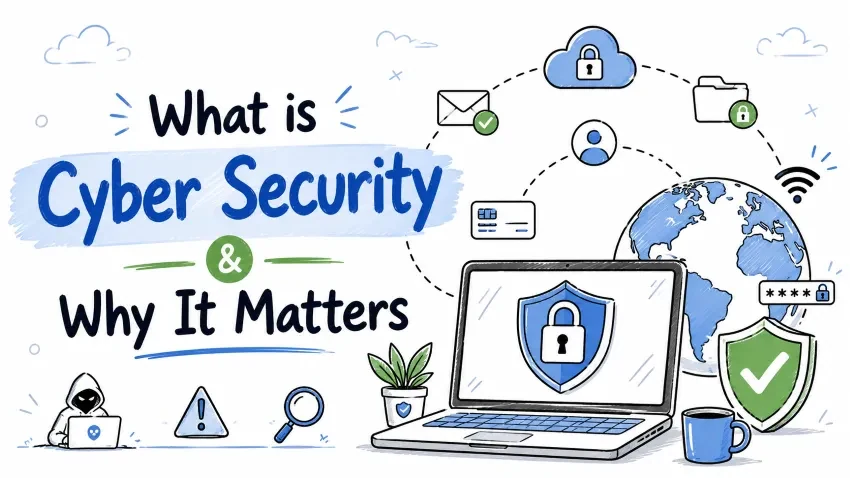
Cyber Security (also called Computer Security or IT Security) is the practice of protecting computer systems, networks, devices, and data from unauthorized access, theft, damage, or disruption.
In simple words — it's about keeping your digital world safe from bad guys on the internet.
Let's understand each part:
| Term | Meaning |
|---|---|
| Computer Systems | Laptops, desktops, servers, smartphones, tablets |
| Networks | Internet connections, WiFi, LAN, corporate networks |
| Devices | IoT devices, cameras, printers, smart home gadgets |
| Data | Personal info, photos, documents, financial records |
| Unauthorized Access | Someone accessing without permission |
| Disruption | Making systems unusable (like ransomware) |
Cyber security aims to ensure three things (known as the CIA Triad — more on this in Tutorial 3):
| Goal | Meaning | Simple Example |
|---|---|---|
| Confidentiality | Only authorized people can see the data | Your WhatsApp messages are private |
| Integrity | Data is accurate and hasn't been tampered with | Your bank balance shows the correct amount |
| Availability | Systems and data are accessible when needed | You can check your email anytime |
| What | Examples | Why It's Important |
|---|---|---|
| Personal Data | Passwords, bank details, health records, photos | Identity theft, financial loss |
| Business Data | Customer info, trade secrets, financial records | Company reputation, legal compliance |
| Devices | Laptops, smartphones, tablets, servers | Entry points for hackers |
| Networks | Internet connections, WiFi, corporate networks | Data in transit can be intercepted |
| Critical Infrastructure | Power grids, hospitals, water systems | Public safety, national security |
The answer: EVERYONE.
Think of cyber security like securing your physical home:
| Physical Home | Digital World |
|---|---|
| Front door lock | Strong password |
| Security camera | Antivirus software |
| Alarm system | Intrusion Detection System (IDS) |
| Fence | Firewall |
| Guard dog | AI-based threat detection |
| Locking valuables in safe | Encryption |
| Spare key with neighbor | Backup & recovery plan |
| Neighborhood watch | Security community monitoring |
| Not opening door to strangers | Not clicking suspicious links |
| Checking who's at peephole | Verifying sender before opening emails |
Just like you wouldn't leave your front door unlocked, you shouldn't leave your digital devices unprotected!
| Body | Cyber Security |
|---|---|
| Skin | Firewall (first line of defense) |
| White blood cells | Antivirus software |
| Immune memory | Security updates & patches |
| Healing after cut | Incident response & recovery |
| Vaccination | Security awareness training |
Understanding how cyber security evolved helps us appreciate why it's so important today:
| Era | Event | Significance |
|---|---|---|
| 1940s | First computers developed | No security concerns — computers were room-sized and isolated |
| 1970s | ARPANET (early internet) | First network connections created new risks |
| 1988 | Morris Worm | First major internet worm — affected 10% of all internet-connected computers |
| 1990s | Rise of commercial internet | E-commerce created need for online payment security |
| 2000s | Widespread malware | Viruses, worms, and Trojans became common |
| 2010s | Advanced persistent threats | State-sponsored hacking, massive data breaches |
| 2020s | AI-powered attacks | Ransomware-as-a-Service, deepfakes, sophisticated phishing |
| 2024+ | Quantum computing threats | New encryption challenges emerging |
Cyber security has evolved from a niche technical concern to a global necessity affecting every internet user.
Cyber security is built on three pillars that work together like a three-legged stool — if any leg is missing, security fails:
The human element — often the weakest link, but also the first line of defense.
What it includes:
The Problem: 95% of cyber security breaches are caused by human error (IBM report).
Solution: Continuous education and creating a security-first culture.
The rules and procedures that govern security.
What it includes:
Example: A company has a policy that all passwords must be changed every 90 days, and any security incident must be reported within 1 hour.
The tools and systems that enforce security.
What it includes:
Important Note: Technology alone is NOT enough. Even the best security tools fail if people don't use them correctly or if processes are not followed!
             SECURITY
                │
    ┌───────────┼───────────┐
    │           │           │
  PEOPLE     PROCESS    TECHNOLOGY
    │           │           │
  Training    Policies    Firewalls
  Awareness   Procedures  Antivirus
  Behavior    Audits      Encryption
You might not realize it, but you use cyber security every single day:
| Activity | Security In Action |
|---|---|
| Unlocking your phone | Authentication (PIN/fingerprint) |
| Checking email | Spam filters block phishing emails |
| Logging into social media | Password + MFA verification |
| Using WhatsApp | End-to-end encryption |
| Activity | Security In Action |
|---|---|
| Logging into company system | Authentication + Authorization |
| Accessing shared files | Access control permissions |
| Video conferencing | Encrypted communication |
| Printing documents | Secure release printing |
| Activity | Security In Action |
|---|---|
| Online shopping | HTTPS encryption protects credit card info |
| Netflix streaming | Account security prevents unauthorized use |
| Online banking | MFA + fraud detection systems |
| Smart home devices | Network security protects IoT devices |
The digital world is expanding rapidly, and so are cyber threats:
| Statistic | Number | Context |
|---|---|---|
| Annual cost of cyber crime | $10+ trillion | More than the GDP of most countries |
| Households affected | 1 in 3 | Almost every family knows someone affected |
| Daily attacks | 2,200+ | That's 1.5 attacks every minute |
| Attack frequency | Every 39 seconds | By the time you read this paragraph, another attack occurred |
| Data breach cost (average) | $4.45 million | Per breach in 2024 |
| Small business impact | 60% go out of business within 6 months of a cyber attack |
| Risk | What Happens | How It Feels |
|---|---|---|
| Identity Theft | Hackers steal your personal info and pretend to be you | Someone opens credit cards in your name |
| Financial Loss | Unauthorized transactions empty your bank account | Your life savings disappear overnight |
| Privacy Violation | Private photos, messages, and data get exposed | Personal moments shared without consent |
| Account Hijacking | Social media, email, or gaming accounts get stolen | Lose access to years of memories and contacts |
| Ransomware | Your files get locked and you have to pay to unlock them | Family photos and important documents held hostage |
| Doxing | Your personal address, phone number published online | Fear for physical safety |
| Consequence | Impact | Real Example |
|---|---|---|
| Revenue Loss | Downtime can cost thousands per minute | Colonial Pipeline lost $4.4M in ransom + millions in downtime |
| Reputation Damage | Customers lose trust after a breach | Target's stock dropped 46% after 2013 breach |
| Legal Penalties | Fines for failing to protect customer data | British Airways fined $230M under GDPR |
| Operational Disruption | Critical systems become unavailable | Hospitals unable to treat patients |
| Intellectual Property Theft | Trade secrets and patents stolen | Years of R&D stolen in minutes |
| Customer Loss | 87% of consumers will take business elsewhere after a breach | Long-term brand damage |
| Threat | Potential Impact |
|---|---|
| Power grid attack | Millions without electricity in winter |
| Hospital ransomware | Patients cannot receive treatment, records locked |
| Government breach | Classified information exposed, national security risk |
| Election interference | Undermining democracy and public trust |
| Water supply attack | Contamination or shutdown of water systems |
| Transportation attack | Air traffic control, trains, or shipping disrupted |
| Financial system attack | Stock market manipulation, bank failures |
Year    Estimated Cost
2020    $3 Trillion
2021    $6 Trillion
2022    $8.4 Trillion
2023    $9.5 Trillion
2024    $10.5 Trillion
2025    $12+ Trillion (projected)
| Group | Why It Matters | Specific Risks |
|---|---|---|
| Students | Protect schoolwork, personal data, avoid cyberbullying | Academic records tampered, scholarship fraud |
| Professionals | Secure company data, client info, career reputation | Professional reputation ruined by hacked accounts |
| Parents | Keep children safe online, protect family devices | Children exposed to predators, family financial info stolen |
| Business Owners | Protect customer data, business operations, finances | Business closure after ransomware attack |
| Seniors | Avoid scams, protect retirement savings, stay connected safely | Most targeted group for financial scams |
| Gamers | Protect gaming accounts, in-game purchases, personal info | Rare skins and items stolen, account bans from being hacked |
| Remote Workers | Secure home network, work devices, company data | Company data leaked through unsecured home WiFi |
| Myth | Fact |
|---|---|
| "I'm not important enough to be hacked" | Automated bots scan everyone — you don't need to be a target |
| "Antivirus is enough" | Antivirus catches only known threats; modern attacks need multiple layers |
| "Strong passwords are unbreakable" | Even strong passwords can be stolen via phishing or data breaches |
| "Cyber security is just IT's job" | Every employee and individual plays a crucial role |
| "Macs can't get viruses" | Macs are less targeted but still vulnerable to malware |
| "I have nothing to hide" | It's not about hiding — it's about control over your own data |
| "Cyber security is too expensive" | The cost of prevention is much less than the cost of a breach |
| "Incognito mode makes me anonymous" | Incognito only hides browsing from local users, not from websites or ISPs |
What Happened:
Impact:
Lesson Learned: Always keep your software updated! The patch was available BEFORE the attack.
What Happened:
Impact:
Lesson Learned: Third-party vendors can be a weak link — vet all partners' security.
What Happened:
Impact:
Lesson Learned: Critical infrastructure needs robust backup and response plans.
What Happened:
Impact:
Lesson Learned: Trust but verify — even legitimate software updates can be compromised.
Many attacks happen silently — hackers may lurk in systems for months before revealing themselves.
Basic security practices (strong passwords, updates, caution with emails) don't require technical skills.
Passwords can be stolen. MFA adds an essential extra layer.
Attackers also target data, intellectual property, and can disrupt operations for political reasons.
Antivirus is ONE layer. Modern security needs multiple layers (firewall, updates, backups, awareness).
| Step | Action | Time Needed |
|---|---|---|
| 1 | Use strong, unique passwords for each account | 30 min |
| 2 | Enable MFA on all important accounts | 15 min |
| 3 | Update your OS and apps | 20 min |
| 4 | Install antivirus (Windows Defender is good) | 10 min |
| 5 | Set up regular backups | 30 min |
| 6 | Learn to spot phishing emails | 20 min |
| 7 | Use a password manager | 30 min |
| 8 | Secure your home WiFi | 15 min |
Save your progress and earn XP for completing tutorials.
4 questions · Pass with 70%+
1Cyber Security is best defined as:
2Why is cyber security important for individuals?
3Which is a common consequence of a cyber attack on a business?
4Cyber attacks are typically carried out by:
Technology
Cyber Security & Networking
Lesson group
Cyber Security Basics
Progress
17% complete