Preparing your learning space...
90% through AI Engineering for FDEs tutorials
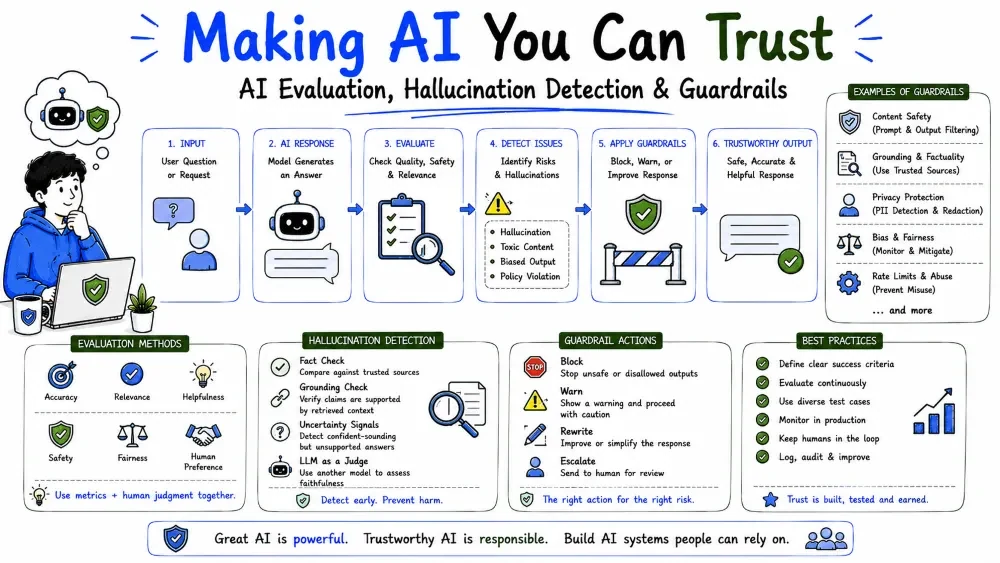
A model that's fluent but wrong is dangerous in production. Before you ship, you need to measure how good it is (evaluation), catch when it's making things up (hallucination detection), and constrain what it's allowed to do (guardrails). This tutorial covers all three as one discipline: trust.
An AI system that answers confidently but wrong erodes user trust fast, and once trust is gone, adoption dies. Evaluation, hallucination detection, and guardrails are how you make a probabilistic model trustworthy enough to ship. They're not nice-to-haves — they're what turn a demo into a product.
Evaluation is measuring how well your AI system performs on a known set of cases. You run the system against a test set of inputs with expected outcomes, then score the results.
Why it matters: without measurement, "it seems good" is a guess. With evaluation, you can prove a change helped, catch regressions, and compare prompts or models objectively.
Test set: 100 questions with expected answers
Run system on each  ->  compare to expected  ->  compute a score (e.g. accuracy)
Choose metrics that match the task. Different tasks need different scores:
| Task | Metric | What it measures |
|---|---|---|
| Classification | Accuracy | Fraction correct overall |
| Classification (imbalanced) | Precision / Recall / F1 | Avoids being fooled by the common class |
| Extraction | Exact match | Output matches the expected field |
| Summarization / Q&A | Faithfulness | Answer stays true to the source |
| Retrieval | Recall@k | Retrieved the right document in top k |
# Accuracy: the simplest score
correct = sum(actual == expected for actual, expected in zip(outputs, expecteds))
accuracy = correct / len(outputs)
Explanation: accuracy counts how many outputs match expected. But watch out — if 95% of cases are "low priority," a system that always says "low" scores 95% yet is useless. That's why imbalanced tasks use precision/recall.
Best Practice: Build a permanent test set of real, hard cases and rerun it on every prompt or model change. That's your regression safety net.
Two ways to score outputs:
# Model-based check: is the answer grounded in the source?
resp = client.messages.create(
    model="claude-sonnet-5",
    max_tokens=50,
    system="Return 'GROUNDED' if the answer is fully supported by the "
           "source text, otherwise 'NOT_GROUNDED'.",
    messages=[{"role": "user", "content": f"SOURCE:\n{source}\n\nANSWER:\n{answer}"}],
)
grounded = resp.content[0].text == "GROUNDED"
Explanation: a judge model compares the answer against the source text and flags whether the answer is supported. This is a fast, scalable way to catch unfaithful outputs across thousands of cases.
Best Practice: Use cheap/fast checks at scale and spend human review only on the outputs that matter most or that automated checks flag.
A hallucination is a confident statement the model makes up — facts, names, citations, numbers — that aren't true or aren't in the source. It happens because the model predicts plausible text, not truth. It's especially dangerous in customer-facing or high-stakes answers.
Why it matters for FDEs: your solution sits inside a real business. A hallucinated order status or invented policy has real consequences, so you build detection around it.
Detection means catching fabricated content before it reaches the user. Three practical approaches:
# Ask twice with a different phrasing; disagreement is a warning sign
a = ask("Who is the CFO of Acme?")
b = ask("Acme's chief financial officer is?")
if normalize(a) != normalize(b):
    flag_for_review(a)   # likely hallucination or uncertainty
Explanation: a real fact tends to reproduce consistently; a fabrication drifts. When the two answers disagree, don't trust it — escalate or re-prompt.
Best Practice: Never ask the model to just "be careful." Verify against a source (grounding) or cross-check answers. That's what catches hallucination.
Guardrails are the constraints and controls you put around the model to keep its behavior inside acceptable bounds. They don't rely on the model behaving well — they enforce limits from outside.
Why they're needed: prompts reduce errors but can't eliminate them. Guardrails are the safety net that catches what the prompt missed: jailbreaks, off-topic output, harmful content, or risky actions.
Guardrails come in layers:
def safe_reply(user_input):
    if is_blocked_input(user_input):        # input filter
        return "I can't help with that."
    reply = generate(user_input)
    if violates_policy(reply):              # output filter
        return "I can't provide that."
    return reply
Explanation: the request and the reply each pass through a filter before and after the model. Even if the model tries something off-limits, the filter catches it before the user — or your systems — sees it.
Best Practice: Treat guardrails as a security layer you can't skip, not an optional add-on. Assume the model will be tested by users and design the guardrails to hold regardless.
Save your progress and earn XP for completing tutorials.
4 questions · Pass with 70%+
1On imbalanced data (95% "low priority"), why can accuracy lie?
2What is a hallucination?
3Which approach actually detects hallucination?
4What is a guardrail?
Technology
Forward Deployed Engineer
Lesson group
AI Engineering for FDEs
Progress
90% complete