Preparing your learning space...
10% through AI Engineering for FDEs tutorials
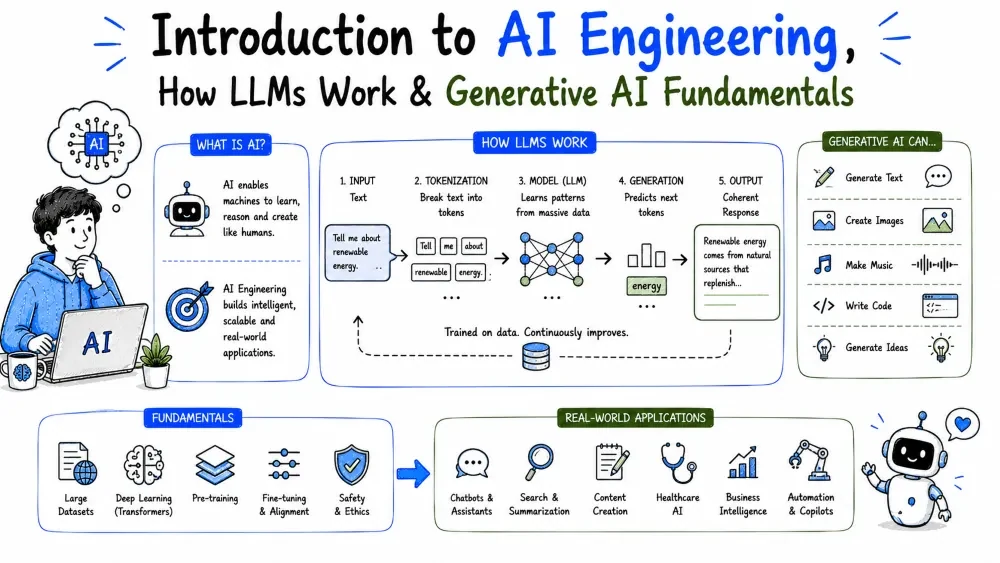
AI engineering is the craft of building working software on top of large language models (LLMs) and other generative AI systems. This tutorial gives you the mental model an FDE needs: what the field is, what actually happens inside an LLM, and the core ideas behind generative AI.
AI engineering is the discipline of designing, building, and shipping applications where an LLM or other AI model does real work inside the system — answering questions, writing code, summarizing documents, or triggering actions.
It is not the same as training models. Most FDEs never train a model from scratch; they compose existing models with prompts, tools, data, and guardrails to solve a customer's problem. The skill is knowing how to make a model reliable enough to put in front of a real user.
An FDE already knows programming, APIs, and customer discovery. AI engineering plugs into that toolkit rather than replacing it.
| FDE skill | How AI engineering uses it |
|---|---|
| Programming | Orchestrate model calls, parse outputs, wire up tools |
| APIs | Call model APIs and the customer's own systems |
| Discovery | Decide where an LLM helps and where it hurts |
| Solution design | Choose RAG, agents, or plain automation — the right pattern |
The trap is using AI where a if statement would do. AI engineering is for fuzzy, language-heavy problems — not for arithmetic or rigid rules.
Generative AI is a branch of AI that creates new content — text, images, code, audio — instead of just classifying or predicting a single label. An LLM generating an email is generative; a spam filter labeling an email as "spam" is not.
Why useful: generative models turn a natural-language request into a finished artifact, which is exactly what customers want — "draft the reply," "summarize the ticket," "write the migration script."
The two families an FDE meets most:
Note: "Generative" says what the model produces. It does not mean the output is correct — that gap is the entire subject of evaluation and guardrails (see Tutorial 9).
A Large Language Model is a giant statistical function trained on huge amounts of text. Feed it some text, and it returns the most likely text that should follow.
It has no database, no beliefs, and no memory between calls. Everything it "knows" lives in the numerical weights it learned during training. When you chat with it, you are prompting that function — not querying a brain.
LLMs work by predicting one token at a time. A token is a chunk of text — roughly 4 characters or ¾ of a word in English. "Learning" is 1 token; "unbelievable" might be 2.
The model does this:
Input:  "The capital of France is"
Model predicts next token:  " Paris"
Now input becomes: "The capital of France is Paris"
Model predicts next: "."  ... and so on.
Explanation: this is next-token prediction, run in a loop. The model never "decides the full sentence up front" — it commits to one token, then re-reads everything including that token to pick the next.
Best Practice: Remember the model predicts, it doesn't retrieve. If you need facts it wasn't trained on, you must supply them (that's what RAG does — Tutorial 6).
Two phases, often confused:
Training:  read billions of documents  ->  produce model weights
Inference: prompt + weights           ->  generated text (what you pay per call)
Common Mistake: Assuming the model "remembers" what you told it last week. It doesn't — each API call is independent unless you send the history back in.
Two numbers you'll see on every model card:
Model: "Sonnet" Context: 200,000 tokens Used: prompt(1,200) + reply(300) = 1,500 tokens billed
Note: Bigger context is not free memory. The model still predicts token-by-token; a huge context just means more text to read each step, which costs time and money.
Save your progress and earn XP for completing tutorials.
4 questions · Pass with 70%+
1What does an LLM actually do when generating text?
2Your model gives a confident but wrong answer. Why?
3Which is true about a model's memory between API calls?
4When should you avoid reaching for an LLM?
Technology
Forward Deployed Engineer
Lesson group
AI Engineering for FDEs
Progress
10% complete