Preparing your learning space...
17% through Customer Problem Discovery tutorials
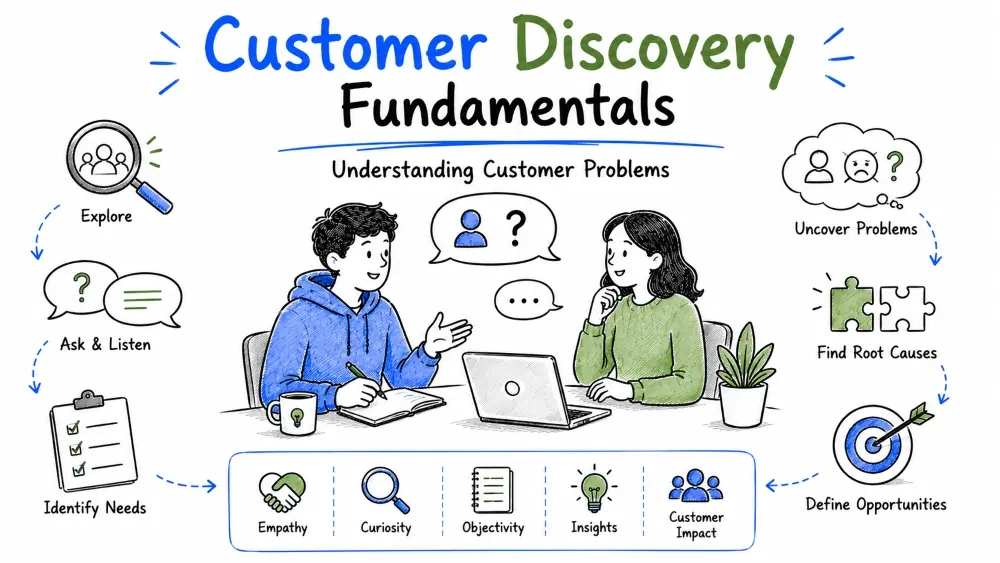
Before an FDE writes a single line of code, they have to know what problem they're actually solving. This tutorial lays the foundation: what customer problem discovery is, why it beats guessing, and the mindset that keeps discovery honest.
A customer problem is rarely what the customer asks for. The request on the surface — "we need a dashboard," "we want a chatbot" — usually sits on top of a deeper problem that a better solution might not even need to look like the request.
The job of an FDE is to dig past the stated request and find the problem underneath: what is the customer trying to accomplish, what's standing in their way, and what does it cost them.
A quick example: a customer says "we need a dashboard for our managers." The real problem turns out to be "managers spend three hours every Monday pulling numbers from spreadsheets into a summary." A dashboard would help, but a one-click weekly summary email might solve the underlying problem for a tenth of the effort. You only learn that by understanding the problem, not the request.
Customer discovery is the process of talking to real customers, asking careful questions, and learning how they actually do their work — before you build anything. It comes from startup methodology (specifically the Lean Startup), but it's exactly what FDEs do every time they engage with a customer.
The guiding idea is simple: you interview to learn, not to pitch. During discovery your job is to collect evidence about what's true in the customer's world, then let that evidence reshape your plan.
Note: discovery never really ends. The first round shapes the first build; every conversation after it keeps refining your picture of the problem. Good FDEs treat the whole engagement as a series of small discoveries.
Most projects fail because of misunderstanding, not bad code. Discovery is cheap when you do it early and brutally expensive when you skip it: a wrong assumption caught in week one costs a conversation; the same wrong assumption caught in week eight costs a rewrite, a re-demo, and a customer's lost trust.
Everything downstream inherits your understanding of the problem — requirements, architecture, code, testing. Get the problem wrong at the top and every layer below carries the mistake.
A handful of habits separate real discovery from a pleasant chat. These are the fundamentals:
These contrast nicely with a few dead-end approaches:
| Defensive habit | Outcome |
|---|---|
| Ask "would you use a dashboard?" | People say yes to be polite — learns nothing |
| Ask "what features do you need?" | You get a wish list, not the problem |
| Ask "is that painful?" | They usually say some version of "sure" |
| Ask "walk me through your Monday morning" | You get their real workflow, friction and all |
The pattern: open questions aimed at real, concrete instances beat opinion questions every time.
Discovery and selling are easy to confuse because both are conversations with customers. But the goals are opposite:
| Discovery | Selling | |
|---|---|---|
| Who talks most | The customer | You |
| Your goal | Learn and revise your understanding | Persuade and close |
| Best reaction | Surprise, changing your plan | Agreement, moving forward |
| End of conversation | A sharper problem statement | A signed deal |
A useful self-check: if you're talking more than a third of the time, you're selling, not discovering.
Common Mistake: performing for the customer — nodding along, never pushing back, agreeing with everything so they'll like you. Discovery requires gently challenging answers. "You said this takes two hours — what happens if it slips to four?" real questions like that build more trust than politeness ever will.
Discovery is a loop, not a one-off meeting:
The loop is what separates discovery from a tour of the building. Tours collect impressions; loops collect evidence that visibly changes direction.
Best Practice: within an hour of any customer conversation, write down three things: what you learned, what surprised you, and what you were wrong about. The surprise and the "wrong about" are the whole point — they're the new information that pays for the meeting. If you have nothing for those two, the conversation was warm but wasted.
Save your progress and earn XP for completing tutorials.
4 questions · Pass with 70%+
1A customer asks for "a dashboard for our managers." What is the FDE's real job?
2During discovery, who should be talking most?
3Why should you interview the user, not just the buyer?
4Which list belongs in the Discovery Loop, in order?
Technology
Forward Deployed Engineer
Lesson group
Customer Problem Discovery
Progress
17% complete