Preparing your learning space...
33% through Customer Problem Discovery tutorials
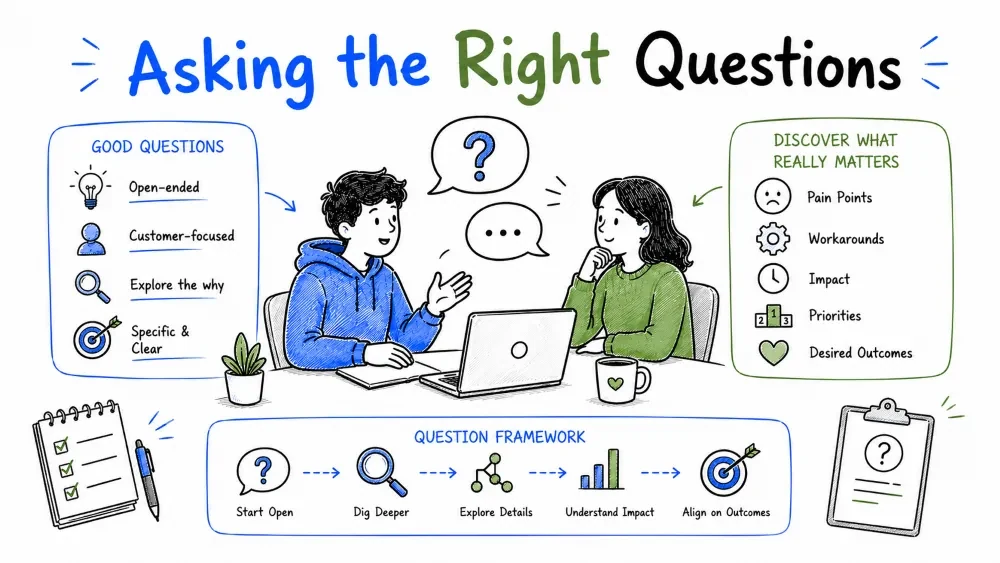
Discovery happens in interviews, and interviews are only as good as the questions you ask. This tutorial covers the whole arc: how to ask questions that reveal real problems, how to run a 45-minute conversation worth having, and how to turn what you hear into sharp, quantified pain points.
Asking the right question means choosing a question that makes the customer describe what actually happens, rather than their polished opinion of themselves, their company, or you. People are terrible at predicting their own behavior and excellent at describing past events — great questions exploit that gap.
Rule of thumb: people can't fabricate concrete memories as easily as they can fabricate opinions. Ask about specific past moments, and you'll get truthful, usable answers.
During discovery you want to lean heavily open:
| Closed (weak for discovery) | Open (strong for discovery) |
|---|---|
| "Do you use email a lot?" | "Walk me through your morning with emails." |
| "Is tracking orders painful?" | "Tell me about the last order that went wrong." |
| "Would you pay for a tool like this?" | "What do you do today, manually, when this happens?" |
| "Is that report a problem?" | "Describe the last time that report was late." |
Why the open ones work: they force the customer to reconstruct an actual event. That event — the steps, the tools, the emotions, the time lost — is the raw material of discovery. The closed ones only get you their self-reported verdict, which is worth little.
Most good discovery questions fall into a few repeatable categories. Mix them in any interview:
| Category | Question examples | What it gives you |
|---|---|---|
| Context | "Who's involved here? What software do you touch daily?" | The cast and the landscape |
| Workflow | "What exact steps take you from an order to a shipped product?" | The process to map |
| Pain | "Where do you waste the most time?" | Candidate pain points |
| Last instance | "Walk me through the last time this went wrong." | A concrete, honest story |
| Quantification | "How often? How long does that take? What's it worth to you?" | Numbers to anchor the problem |
| Referral | "Who else should I be talking to?" | More users to find more pain |
The "last time" question deserves special attention. It's the strongest probe in the toolkit: "Walk me through the last time you had to assemble that report." Nobody can smoothly fake a detailed account of a recent event, so their response is almost always grounded in reality — warts and workarounds included.
Common Mistake: asking "would you use / like / buy X?" People say yes to be agreeable, then never use it. It's the question that separates junior interviewers from experienced ones — drop it entirely.
Best Practice: write your question guide in advance, but treat it as a safety net, not a script. Before you enter, set one clear goal ("I want to learn how refunds actually flow"). Within the interview, follow what's interesting. The best questions are follow-ups you couldn't have planned.
An interview is a short, structured conversation with one goal: test your assumptions and collect evidence about the customer's problem. It has a shape — prepare, open, explore, close, follow up — and each phase has a job.
Keep it to one person at a time. Group interviews sound efficient but the loudest personality hijacks them, and people won't admit real pain in front of colleagues. A single good interview beats a room of mediocre ones.
Preparation should take about fifteen minutes, not three hours:
Then hold to a rough structure:
| Phase | Time | Goal |
|---|---|---|
| Warm-up | 5 min | Comfort; confirm their role |
| Context | 5 min | How their team and tools fit together |
| Main discovery | 25 min | Walk through real instances; collect pains |
| Open end | 5 min | "Is there anything we haven't touched?" |
| Wrap | 5 min | Thanks; who else should I talk to? |
Always ask permission to record, and take notes even if they say yes — recordings fail, and hand notes force you to decide what matters on the spot.
Listening is a skill, and in discovery it's the whole job. Three habits:
Useful probing phrases:
Common Mistake: interrupting with your solution. The minute you say "oh, we could fix that with a script," the story stops and the customer turns into an evaluator of your idea instead of a source of truth. Write the idea down on the pad, then go back to listening.
Best Practice: capture verbatim quotes in your notes, marked with quotation marks. "We reconcile these two spreadsheets by hand every Friday" is the sentence your problem statement will later hang from.
A pain point is a specific, repeated, costly difficulty in the customer's work — the problem your solution will target. Interviews give you the raw material; you extract the pains by listening for signals.
Once the meeting is over, scan your notes for three kinds of evidence:
| Signal | What it sounds like |
|---|---|
| Frequency words | "every day," "every single time," "always" |
| Cost words | "hours," "manual," "redo," "we fix errors" |
| Emotion words | "hate," "dread," "terrified of" |
Anything with a frequency or cost word attached is a candidate. Anything a workaround surrounds (a homemade spreadsheet, a sticky note, a shadow process) is almost certainly a real pain — people don't build workarounds for problems that don't hurt.
Note: a pain is only real once you can attach a cost or frequency. "It's kind of annoying" is a feeling. "It eats two hours every Monday and we've shipped late twice because of it" is a pain point. The second is what you can build against.
You'll surface more pains than you can solve. Rank them with three factors:
| Factor | Question it answers |
|---|---|
| Frequency | How often does it happen? |
| Severity | How badly does it hurt the business? |
| Spread | How many people, teams, or customers feel it? |
Small example from a discovery session:
| Candidate pain | Frequency | Severity | Spread | Verdict |
|---|---|---|---|---|
| Manual invoice reconciliation | Daily | High | 3 teams | Solve first |
| Occasional duplicate customer records | Monthly | Low | 1 person | Skip for now |
| Slow report loading | Daily | Medium | Everyone | Maybe |
The daily, high-severity, multi-team pain wins. It's the one with the clearest business case and the broadest buy-in.
Best Practice: before you leave, play your pains back to the customer. "Let me make sure I've got this right — you're spending two hours every Monday on invoices, and it's usually you who does it?" Confirmation catches misunderstandings at the cheapest possible moment and signals to the customer that you were actually listening.
Save your progress and earn XP for completing tutorials.
4 questions · Pass with 70%+
1Which question is strongest for discovery?
2Why keep interviews to one person at a time?
3Which is the strongest probing follow-up after a customer describes a problem?
4A pain point is only real once you can attach a ____?
Technology
Forward Deployed Engineer
Lesson group
Customer Problem Discovery
Progress
33% complete