Preparing your learning space...
50% through Customer Problem Discovery tutorials
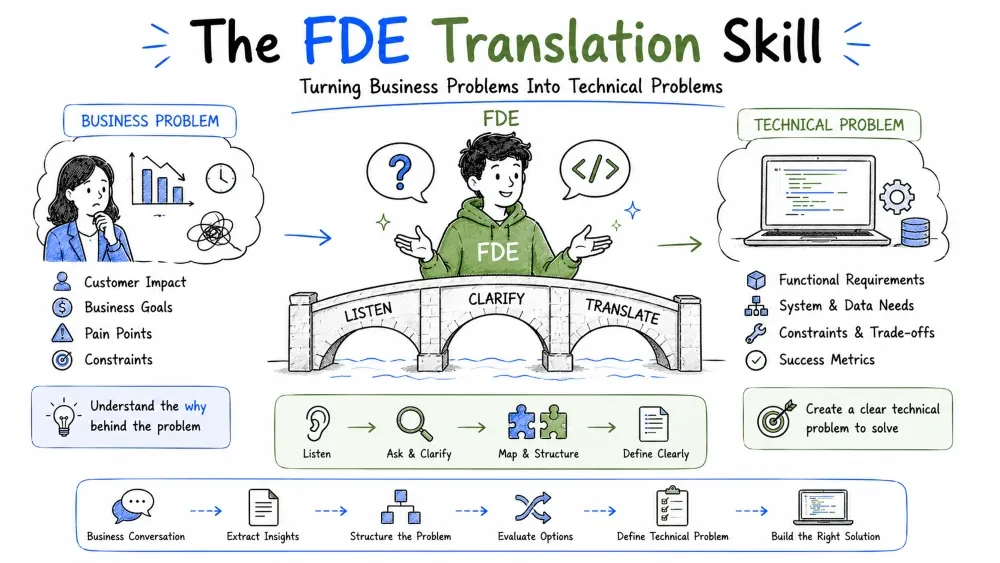
Customers describe their world in business language ("we keep losing deals to slow proposals"); engineers build in technical language ("the proposal pipeline has four manual handoffs and no audit trail"). The FDE's most valuable skill is translating between the two until one statement covers both. That translation is this tutorial.
A business problem is stated in outcomes: money, time, risk, customers. It talks about impact without saying how the impact happens. Typical business problems are things like "we're losing deals because proposals take a week to prepare" or "customers are churning after bad support."
The business statement is your starting point — it's what the customer cares about and what they'll use to judge success. But on its own it doesn't tell you what to build.
A technical problem is stated in systems and data: inputs, steps, outputs, failures. It describes the mechanism behind the impact. The same proposal problem becomes "proposal data lives in four separate systems, and assembling it requires a senior analyst to copy-paste for about eight hours with no validation."
The two are the same pain in two languages. The rule that ties them together: every real technical problem must trace back to a business problem, and every real business problem has technical causes that code can act on. If either half is missing, you don't yet understand the problem.
Translation is a repeatable five-step walk, not a flash of insight:
A recurring shortcut is translating keywords:
| The customer says | The FDE hears |
|---|---|
| "We can't keep up" | Throughput bottleneck; queue; no automation |
| "We keep losing data" | No single source of truth; failed syncs; no backup |
| "It's too error-prone" | Manual entry; no validation; no audit trail |
| "Reporting takes forever" | Scattered data; manual ETL; slow queries |
Translation needs a number. A quantity lets the customer and you agree the problem is real and is worth fixing, and it gives you something to measure against when the fix lands.
Look at the difference:
The second version is still a business problem, but it has a number, a frequency, and a cost attached — which is exactly what you need to keep the eventual technical fix honest. Without a number, you can't know whether a change helped or hurt.
Let's run the whole process on a real-sounding case: "Our support team is drowning and customers are getting angry."
Step by step:
| Step | Finding |
|---|---|
| 1. Business statement | "Support is drowning; customers are angry" |
| 2. Measurable outcome | Median first response ≈ 2 days; 40% of tickets reopened; satisfaction falling |
| 3. Follow the work | Agents copy account data from 3 systems into a shared doc before every reply |
| 4. Technical causes | No unified view; manual data assembly; no templates; no auto-resolution; duplicated data entry |
| 5. Technical problem | "Support agents spend ~60% of handling time manually assembling customer context across 3 systems because no unified view exists and nothing is automated; 40% of tickets are reopened at least once, roughly doubling load." |
Notice what happened: the complaint ("drowning, angry") became a buildable statement. The technical version reads like a brief — it names the cause (no unified view, nothing automated), the cost (60% of time, doubled load from reopens), and both of those give you your success metrics (cut assembly time, reduce reopens).
Note: the technical problem statement is the bridge into the requirements tutorial — it's where functional requirements come from. But it also answers the business question, because you kept the business numbers attached.
A symptom is what the user feels and reports. The root cause is the mechanism underneath. FDEs skip down to the root cause, because treating a symptom makes it come back wearing different clothes.
Example peeling:
The business problem ("users abandon login at peak") becomes the technical problem ("auth has no cache and no scaling; p95 login latency is 4s during peak hours"). Each layer down gives you a more buildable target.
Save your progress and earn XP for completing tutorials.
4 questions · Pass with 70%+
1A business problem is stated in terms of…
2Every real technical problem should trace back to…
3What's the first step in translating a business problem?
4Why attach a number before translating?
Technology
Forward Deployed Engineer
Lesson group
Customer Problem Discovery
Progress
50% complete