Preparing your learning space...
100% through Customer Problem Discovery tutorials
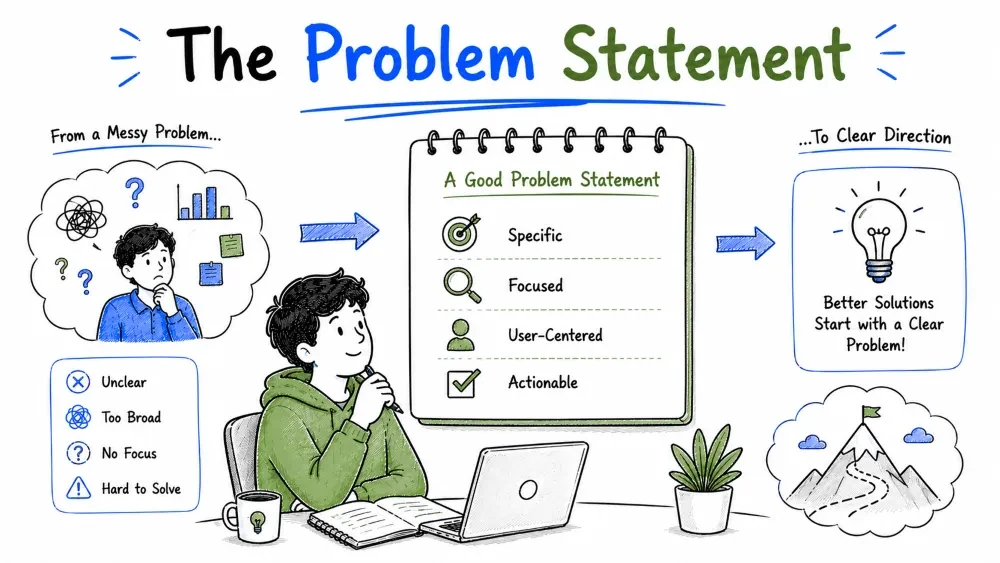
The problem statement is the single-page artifact at the center of FDE work: it says, in words everyone agrees on, who's hurting, what it costs them, and what done looks like. This capstone tutorial shows how to write one that survives contact with executives and engineers alike.
A problem statement is a short, written description of the problem you're solving: who it affects, what the measurable impact is, and what has to be true when the problem is solved. Usually five to eight sentences, or a tight template with a few blanks.
It's the output of everything in this course — the discovery, the interviews, the pain points, the business-to-technical translation, the requirements, the process map. If those earlier steps were done well, this page writes itself.
A solid statement has four parts in sequence — who, situation, cost, target:
| Part | Question it answers | Writing prompt |
|---|---|---|
| Affected group | Who feels this? | Name the actual people, not "the company" |
| Current situation | What happens today? | Concrete steps, in present tense |
| Measurable cost | Why does it matter? | Numbers: hours, money, error rate, customers |
| Target | What has to be true when fixed? | Desired future state + how we'll verify it |
That's the whole skeleton. If a statement is missing one of these, a reader will instinctively feel it's thin — and they'd be right.
Here's a worked statement that hits every part:
Support agents at Apex Electrics spend roughly 60% of each ticket manually assembling customer context — order history, warranty, and prior tickets — from three separate systems that don't sync reliably. A single reply can take 15+ minutes and involves copy-paste, about 40% of tickets are reopened at least once, and median first-response time has crept up to two working days. The fix should let an agent resolve a routine ticket without manual data assembly. Success looks like: median first response under 4 business hours and reopened tickets below 10%.
Breaking it down against the structure:
| Sentence part | Anatomy slot |
|---|---|
| "Support agents at Apex Electrics..." | Affected group — the people who feel it |
| "...three separate systems that don't sync reliably" | Current situation + a root cause |
| "60% of each ticket... 15+ minutes... 40% reopened... two working days" | Measurable cost, in numbers |
| "let an agent resolve... without manual data assembly" | Target behavior |
| "median first response under 4 hours... reopened below 10%" | How we verify done |
Notice it opens with people, keeps several concrete numbers, names a cause, and closes with two thresholds you could actually test against. That's the shape to copy.
A weak statement is worth studying so you can avoid its shape:
Customer service is slow and we need better tools. They want an AI support assistant, and it has to be done soon.
Everything's wrong with this, in an instructive way:
| Weak version says | Strong version does |
|---|---|
| "Customer service is slow" | Names the affected people and the exact activity |
| No numbers anywhere | Puts a real cost on the table (60%, 40%, 2 days) |
| "They want an AI assistant" | Solution-jumps; the strong one stays problem-shaped |
| "done soon" | Defines "done" as testable thresholds |
The strong statement fixes the weak one's every flaw by applying the anatomy above.
The statement earns its place when you get it read back and confirmed. Hand it to a stakeholder — ideally the person who gave you the best stories in the interviews — and ask: "This is my understanding of your problem. Is it right?" They'll correct a detail or two, and now you have a document both of you own.
From there it becomes the north star. Requirements trace back to it, the design serves it, the demo walks its success criteria one by one, and if someone proposes an addition, the whole process stops for the question "does this still serve the statement?" Revision stays possible — discovery never ends, and the statement should change when real learning contradicts it. The discipline is that it only changes for evidence, not for convenience.
Best Practice: keep it to one page. If you need more space, you haven't found the real problem yet. Shorter, tighter, sharper — every cut that survives makes the statement stronger.
Save your progress and earn XP for completing tutorials.
4 questions · Pass with 70%+
1The four parts of a good problem statement are…
2 A problem statement should NOT…
3What's the strongest sign a problem statement is approved?
4Why keep the "how" (solution) out of the statement?
Technology
Forward Deployed Engineer
Lesson group
Customer Problem Discovery
Progress
100% complete