Preparing your learning space...
86% through Data Engineering for FDEs tutorials
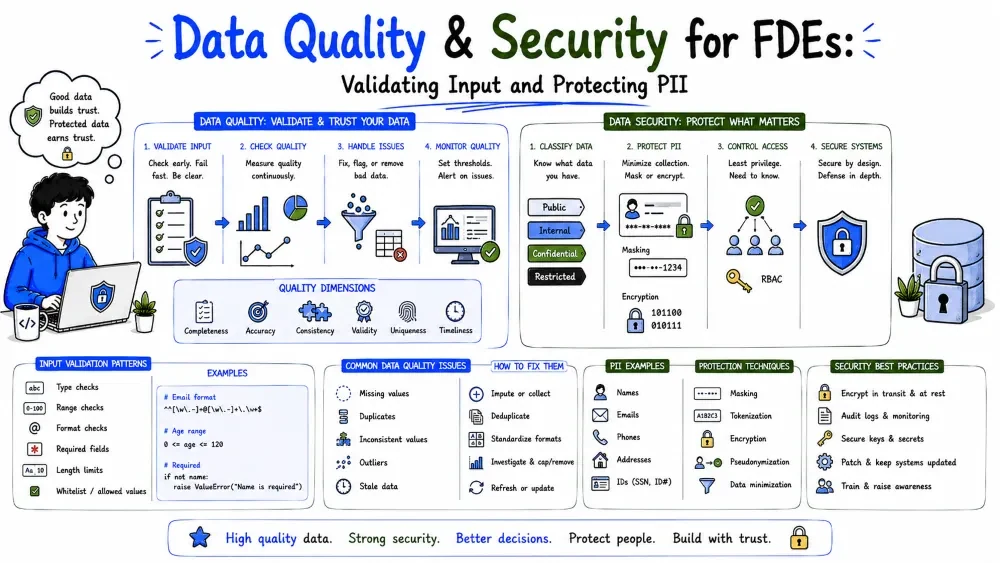
Two non-negotiables run through all data work: the data must be trustworthy and it must be protected. Validation is how you keep quality high; a handful of security habits keeps other people's data safe. This tutorial covers both — the gates that stop bad data entering, and the protection of the data you serve.
The earlier you validate, the cheaper the fix: a rule at ingest costs one function; the same bug in the monthly report costs a reconciliation project.
Validate at the boundary — the moment data enters your system (API response, file upload, row insert). That's the cheapest, most effective gate.
source ──▶ [ VALIDATE ] ──▶ transform ──▶ load ──▶ serve
              reject/quarantine bad input here
Best Practice: validate at ingest, dedupe by stable ID, compute derived fields once, audit changes (the four gates from Solution Design Tutorial 5).
pydantic declares the expected shape of a record and validates it. Perfect for API/JSON data.
from pydantic import BaseModel, field_validator
from typing import Optional

class Order(BaseModel):
    order_id: int
    customer_id: int
    amount: float
    status: str
    email: Optional[str] = None

    @field_validator("amount")
    def must_be_positive(cls, v):
        if v < 0:
            raise ValueError("amount must be >= 0")
        return v

    @field_validator("status")
    def known_status(cls, v):
        if v not in {"paid", "pending", "refunded"}:
            raise ValueError(f"unknown status: {v}")
        return v
Explanation: every field has a type; the validators enforce business rules (amount >= 0, known status). A bad record raises ValidationError instead of polluting your store.
try:
    Order(order_id=1, customer_id=2, amount=-5, status="paid")
except Exception as e:
    print("Rejected:", e)
For tabular data, assert conditions across the whole frame at ingest.
import pandas as pd

def validate(df: pd.DataFrame) -> pd.DataFrame:
    # Required columns present
    required = {"order_id", "customer_id", "amount", "status"}
    missing = required - set(df.columns)
    if missing:
        raise ValueError(f"Missing columns: {missing}")

    # Type & range checks
    assert (df["amount"] >= 0).all(), "negative amounts found"
    assert df["order_id"].notna().all(), "null order_id"
    assert df["status"].isin(["paid","pending","refunded"]).all(), "bad status"
    return df
Explanation: fail fast — if any row violates a rule, the function raises before loading. This is your ingest gate in one place.
Some rules span columns and can't be a simple type check.
# refunded orders should have amount recorded, not zeroed silently
bad = df[(df["status"] == "refunded") & (df["amount"].isna())]
assert bad.empty, f"{len(bad)} refunded orders missing amount"

# discount can't exceed amount
assert (df["discount"] <= df["amount"]).all(), "discount > amount"
Explanation: these catch logical errors a schema can't — the contradictions that quietly corrupt a report.
When a row fails, don't crash the whole run or silently drop it. Quarantine it: set it aside with a reason, load the rest.
valid = df[df.apply(row_is_valid, axis=1)]
bad   = df[~df.index.isin(valid.index)]
bad.to_csv("quarantine/orders_2026-08-19.csv", index=False)
log.warning("Quarantined %d bad rows", len(bad))
Explanation: the good rows still load; bad rows go to a quarantine file with a timestamp for later inspection. Nobody loses data, and the pipeline doesn't die on one bad record.
Quality is a number, not a feeling. Track simple metrics per load:
quality = {
    "rows": len(df),
    "null_ids": int(df["order_id"].isna().sum()),
    "dups": int(df.duplicated(subset=["order_id"]).sum()),
    "freshness_hrs": float((pd.Timestamp.utcnow() - df["updated_at"].max()).total_seconds()/3600),
}
log.info("Quality: %s", quality)
These three catch the most real-world issues:
| Dimension | Question | Check |
|---|---|---|
| Completeness | Any missing required fields? | % nulls in key columns |
| Uniqueness | Duplicate records? | count == count(distinct id) |
| Validity | Values in allowed range/set? | validator pass rate |
| Freshness | How old is the data? | now - max(updated_at) |
Best Practice: alert on deviation from baseline, not just absolute thresholds — a table that always has 5% nulls is fine; one that jumps to 40% is an incident.
You'll be handed customer databases, employee records, financials. Mishandling them isn't a bug — it's a liability. The good news: a short list of habits prevents almost every incident.
Note: when in doubt, ask the customer's security contact about their compliance needs (GDPR, HIPAA, SOC 2). Don't guess on regulated data.
API keys, DB passwords, and tokens are secrets. They belong in environment variables or a secrets manager — never in source or notebooks.
import os
DB_URL = os.getenv("DW_URL")     # read at runtime, not hardcoded
# .env (gitignored)
DW_URL=postgresql://user:pass@host/db
# .gitignore
.env
Explanation: os.getenv pulls the value at runtime; .gitignore keeps .env out of the repo. A committed secret is a leaked secret — rotate it immediately if that happens. Prefer a secrets manager (AWS Secrets Manager, Vault) over .env for production; same idea, better audit and rotation.
PII (Personally Identifiable Information) is anything that identifies a person: names, emails, phone numbers, addresses, national IDs, IP addresses, even combinations like ZIP + birthdate.
Rule of thumb: if you could find or target a specific person from a field (or a few combined), treat it as PII and protect it.
You often need data without exposing the person. Two techniques:
def mask_email(email: str) -> str:
    local, domain = email.split("@")
    return f"{local[0]}***@{domain}"      # a***@example.com

def mask_phone(phone: str) -> str:
    return "***-***-" + phone[-4:]        # ***-***-1234
Explanation: masked values keep the shape for testing/demos but can't identify anyone. Use masked copies in dev, staging, and logs.
import secrets
def tokenize(value: str, vault: dict) -> str:
    tok = secrets.token_hex(8)
    vault[tok] = value          # only the vault knows the real value
    return tok
Best Practice: work on masked/tokenized data wherever possible; keep raw PII only where the job truly needs it, and minimize who can read it.
http:// call with customer data is exposed on the wire.requests.get("https://api.example.com/data", headers=headers) # always https://
Note: encryption protects data from being read if storage is stolen. It does not control who can query it — that's access control (next).
Give every process and person the minimum access they need — no more.
orders shouldn't have write access to customers.CREATE ROLE etl_reader LOGIN PASSWORD '...';
GRANT SELECT ON orders TO etl_reader;
-- (no GRANT INSERT/UPDATE/DELETE)
Explanation: least privilege means a compromised credential or a buggy script does limited damage.
CREATE TABLE audit_log (
  id SERIAL PRIMARY KEY,
  table_name TEXT,
  row_id INTEGER,
  changed_by TEXT,
  changed_at TIMESTAMPTZ DEFAULT NOW()
);
Notebooks and logs leak secrets constantly.
# BAD — logs the secret
log.info(f"Connecting with {DB_URL}")

# GOOD — redacted
log.info("Connecting to data warehouse")
| Risk | Habit |
|---|---|
| Secret in a printed notebook | Read from env, never print it |
| PII in logs | Mask before logging |
| Notebook committed with data | Add .ipynb data exports to gitignore |
| Screenshot of a dashboard with names | Blur PII in demos |
Best Practice: before sharing any screenshot, export, or log, ask "does this contain a real person's data?" If yes, mask it.
.gitignore .env; rotate on leak. Never in code or logs.Save your progress and earn XP for completing tutorials.
4 questions · Pass with 70%+
1The cheapest, most effective place to validate data is:
2In pydantic, @field_validator("amount") is used to:
3 Which is the correct approach when a row fails validation?
4The right way to handle a database password in code is:
Technology
Forward Deployed Engineer
Lesson group
Data Engineering for FDEs
Progress
86% complete