Preparing your learning space...
71% through Deployment & Cloud tutorials
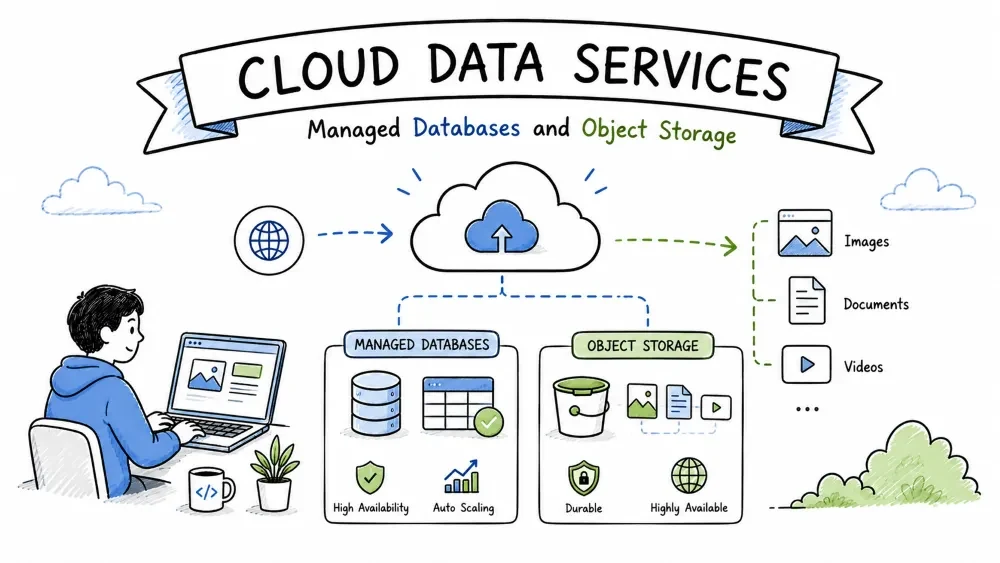
Cloud data services provide managed storage and database solutions that scale automatically. They simplify data handling for web and mobile applications.
Cloud Databases are hosted database services that offer scalability, high availability, and managed operations.
Why it is useful: They remove the need for manual provisioning, backups, and tuning, letting developers focus on code.
Example (AWS DynamoDB table creation):
aws dynamodb create-table \
  --table-name Users \
  --attribute-definitions AttributeName=UserID,AttributeType=S \
  --key-schema AttributeName=UserID,KeyType=HASH \
  --billing-mode PAY_PER_REQUEST
This command creates a scalable NoSQL table for user data. With PAY_PER_REQUEST billing, you pay only for the reads and writes you actually use rather than provisioning fixed capacity.
Note Managed relational options (like Amazon RDS or Cloud SQL) handle backups and failover for you, while NoSQL stores like DynamoDB scale horizontally with no server to manage.
Cloud Storage provides durable, scalable object storage for files and media.
Why it is useful: It offers inexpensive, reliable storage that can be accessed globally via simple APIs.
Example (uploading a file to Amazon S3):
aws s3 cp ./localfile.txt s3://my-bucket/
The command copies a local file to an S3 bucket, making it available via the web. Objects are stored with a unique key and can be made public or kept private with access policies.
Best Practices
Save your progress and earn XP for completing tutorials.
4 questions · Pass with 70%+
1PAY_PER_REQUEST billing in DynamoDB means:
2Main advantage of a managed cloud database (e.g., RDS):
3aws s3 cp ./file.txt s3://my-bucket/ does:
4A good S3 best practice is:
Technology
Forward Deployed Engineer
Lesson group
Deployment & Cloud
Progress
71% complete