Preparing your learning space...
14% through Deployment & Cloud tutorials
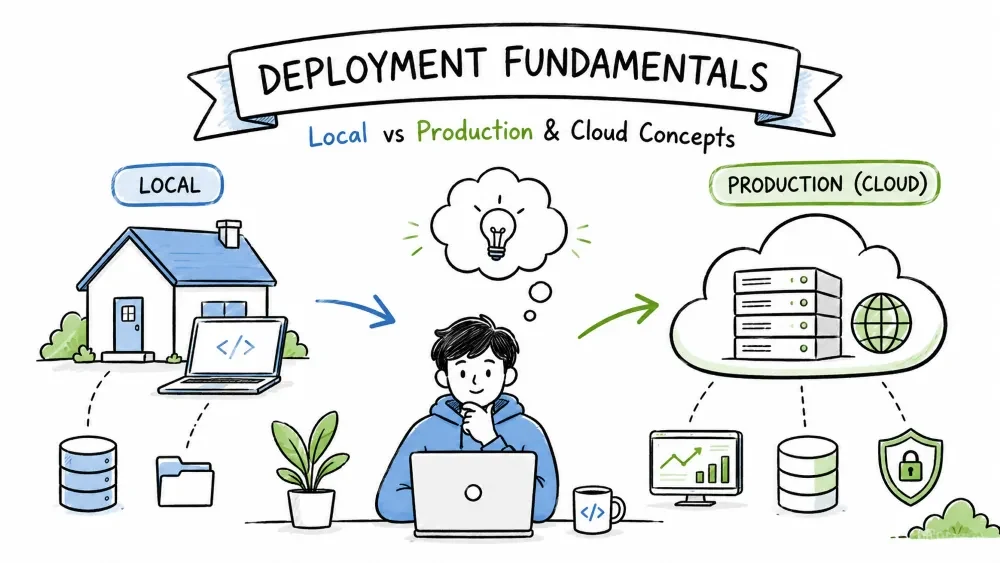
Deployment is the process of making an application available for use. Understanding the difference between local development and production environments, as well as basic cloud concepts, is essential for reliable releases.
Deployment Fundamentals cover the core concepts and practices for releasing software, including versioning, environment setup, and release strategies.
Why it is useful: Knowing how to deploy reliably ensures your users get the latest features without downtime.
Example:
# Dockerfile
FROM node:18-alpine
WORKDIR /app
COPY package*.json ./
RUN npm install
COPY . .
CMD ["node", "app.js"]
This Dockerfile builds a container that runs a Node.js app, illustrating a basic deployment step. The image bundles the code and its dependencies so the same artifact can move from a laptop to a server unchanged.
Best Practices
v1.2.0) instead of using latest for production.Local development focuses on rapid iteration with lightweight tools, while production emphasizes stability, security, and performance.
Why it is useful: Understanding these differences helps avoid environment-specific bugs and ensures smooth releases.
Example:
# .env (local development)
DB_HOST=localhost
DB_PORT=5432
DEBUG=true
Local environment variables point to a local database and enable debug mode, whereas production would use a remote host and disable debug.
Common Mistakes
localhost database URL and forgetting to change it before deploying.DEBUG=true on in production, which can leak stack traces to users.Cloud computing provides on-demand access to compute, storage, and services over the internet, enabling scalable deployments.
Why it is useful: Leveraging cloud resources reduces infrastructure overhead and allows elastic scaling.
Example:
aws ec2 run-instances --image-id ami-0c55b159cbfafe1f0 --instance-type t3.micro --key-name mykey
This command launches a minimal EC2 instance, demonstrating a basic cloud deployment step. You pay only for the time the instance runs instead of buying and maintaining physical servers.
Note The three common cloud service models are IaaS (raw servers, like EC2), PaaS (managed runtimes, like Heroku), and SaaS (finished apps, like Google Workspace).
Save your progress and earn XP for completing tutorials.
4 questions · Pass with 70%+
1What is the main goal of a deployment process?
2Which environment setting is dangerous to leave on in production?
3"Cloud computing" primarily means:
4Which is an example of a PaaS?
Technology
Forward Deployed Engineer
Lesson group
Deployment & Cloud
Progress
14% complete