Preparing your learning space...
29% through Enterprise AI Deployment tutorials
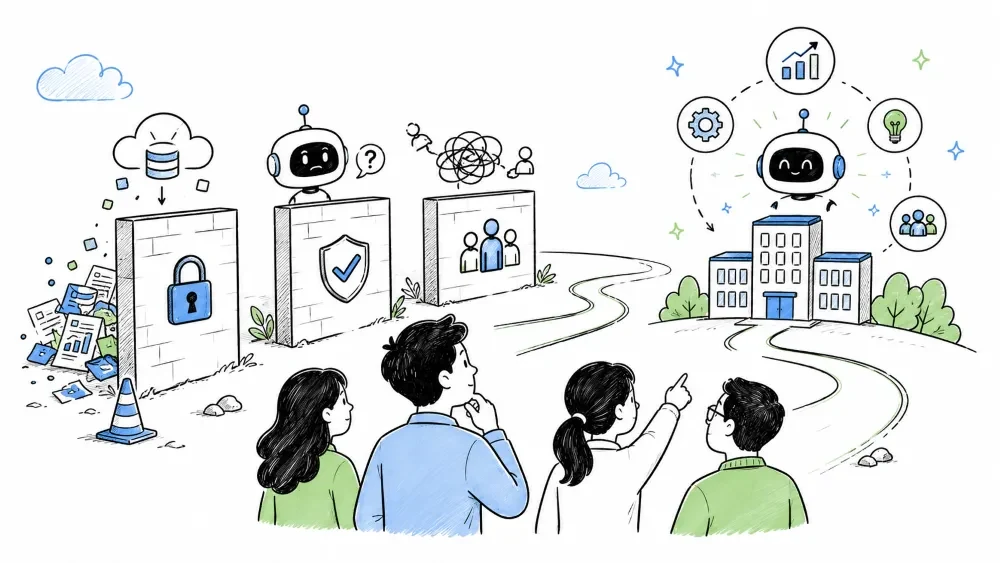
Most enterprise AI projects fail before the model is ever deployed — not from bad AI, but from neglected people, data, and process problems. This tutorial walks through the real challenges of adoption and how to anticipate them.
Deploying a model is a technical event. Adoption is a human and organizational process — and it takes longer.
Deployment question:   "Will the API return the right answer?"
Adoption question:     "Will a busy employee trust it and use it
                       instead of the old way?"
Almost every failure you'll hit is on the adoption side.
AI is only as good as what it reads. Messy, duplicate, or missing data quietly degrades results — and users notice.
def check_dataset(rows):
    missing = sum(1 for r in rows if not r["customer_id"])
    dupes   = len(rows) - len({r["email"] for r in rows if r["email"]})
    print(f"suspicious rows: {len(rows)}")
    print(f"missing customer_id: {missing}")
    print(f"duplicate emails: {dupes}")

check_dataset(load_crm_rows())
If your data is messy, your first AI project is really a data cleanup project. Plan for it.
Users lose faith fast when an AI confidently states a false "fact."
Rule of thumb: High risk the more it matters.
Keep a human in the loop whenever a wrong answer
causes business or legal harm.
People worry AI will replace them, or simply do what's familiar to them. Adoption stalls.
Cost: One user trying out the tool for a week
Tells you more than a perfect roadmap ever will.
AI eats data — and a lot of that data is sensitive. Concerns include data egress, access leaks, and regulatory exposure.
Whose job is AI? No clear owner means no accountability.
API tokens are cheap per call and expensive at scale. RAG retrieval, vector storage, GPU hosts, and fine-tuning add up.
$ LLM calls  (per-token, scales with usage)
+ Vector DB  (storage + search)
+ Embeddings (ingestion + query time)
+ Fine-tunes (one-off training cost, ongoing retrain)
+ Ops        (monitoring, people, evaluations)
──────────────────────────────
= Total cost of ownership, tracked monthly
A playbook is a short, written document that ties the work above together. It typically covers:
Without a playbook, adoption depends on whichever team shouts loudest.
Save your progress and earn XP for completing tutorials.
4 questions · Pass with 70%+
1The most common reason enterprise AI projects fail is:
2What is the recommended first step when data quality is poor?
3Which is a valid way to handle AI hallucinations in a high-stakes context?
4An executive sponsor without a product owner creates:
Technology
Forward Deployed Engineer
Lesson group
Enterprise AI Deployment
Progress
29% complete