Preparing your learning space...
43% through Enterprise AI Deployment tutorials
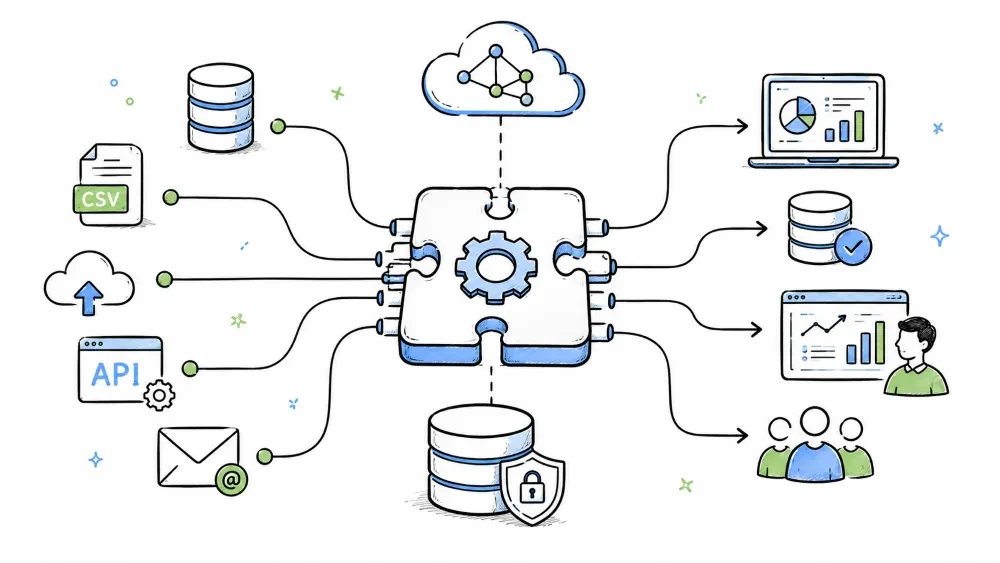
Every enterprise AI system runs on data — and that data is scattered across databases, APIs, warehouses, and files. This chapter explains how to bring that data together safely and reliably so your models can use it.
Data integration is the process of combining data from multiple sources into a consistent, usable view — so an AI system can query it as if it were one dataset.
Before:  Data split across CRM, warehouse, tickets, and PDFs.
After:   One retrieval layer any AI app can ask questions of.
Without integration, your AI only sees a fragment of the business, and every answer is partially blind.
Common sources you'll wire together:
sources:
  - type: postgres
    host: prod-db.internal
    database: customers
  - type: rest_api
    endpoint: https://salesforce.com/services/data/v60
    auth: oauth2
  - type: s3
    prefix: "documents/*.pdf"
The classic pattern: pull data out, reshape it, load it where AI reads it.
import pandas as pd

def extract():
    return pd.read_sql("SELECT * FROM orders", db_engine)

def transform(raw):
    raw["date"] = pd.to_datetime(raw["order_date"])
    raw["total"] = raw["qty"] * raw["unit_price"]
    return raw[raw["status"] != "deleted"]

def load(df):
    df.to_parquet("warehouse/orders.parquet")
    write_to_vector_store(df)   # for AI retrieval

load(transform(extract()))
extract pulls raw data, transform cleans and derives, load writes it where AI can find it.
Batch ETL is fine for daily jobs. For fresh results, process changes as they happen.
CDC (change data capture): watch the database log and react to
                           inserts/updates to rows.
Streaming:                 push events through a bus (Kafka) as they
                           occur instead of on a timer.
def on_new_ticket(event):
    vectorize_and_index(event.payload)   # available to AI immediately
This is how a support copilot knows about a ticket minutes after it's filed.
Raw data is never clean. Enforce rules at the source and track where each value came from.
REQUIRED = ["customer_id", "amount"]

def validate(row):
    missing = [f for f in REQUIRED if row.get(f) is None]
    if missing:
        raise ValidationError(f"missing: {missing}")
Lineage is the trail from a value back to its origin — essential for compliance and debugging. Know which field lives in which source before you answer a question with it.
Not all data goes straight to a model. For retrieval (RAG) you also need embeddings and chunks.
from sentence_transformers import SentenceTransformer

model = SentenceTransformer("all-distilroberta-v1")
chunks = split_into_chunks(clean_text)
vectors = [model.encode(c).tolist() for c in chunks]
bulk_index(vector_store, vectors, metadata=chunks)
Text is split into chunks, converted to vectors, and indexed so an AI app can search it.
A production pipeline is scheduled, monitored, and able to rerun.
pipeline:
  schedule: "0 */4 * * *"        # every 4 hours
  source:   "crm + warehouse"
  steps:    [extract, transform, validate, load]
  on_failure:
    alert:  "#data-ops"
    retry:  3
Save your progress and earn XP for completing tutorials.
4 questions · Pass with 70%+
1Which pattern delivers minute-level fresh data to an AI system?
2What is "lineage" in enterprise data integration?
3The standard order of steps in an ETL pipeline is:
4Which is a common mistake in enterprise data integration for AI?
Technology
Forward Deployed Engineer
Lesson group
Enterprise AI Deployment
Progress
43% complete