Preparing your learning space...
75% through FDE Career Preparation tutorials
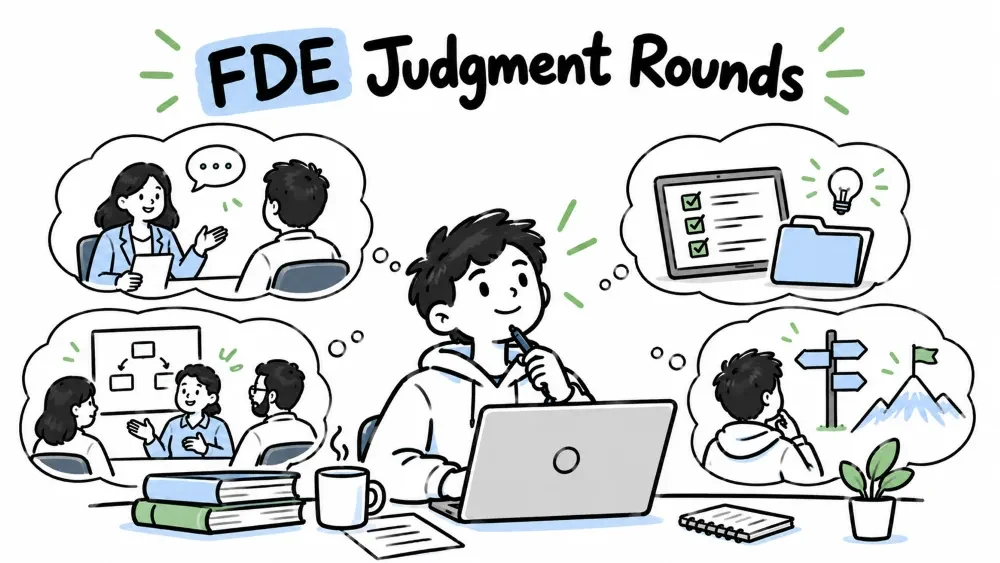
This tutorial covers the rounds that test you as a person and as a solo operator: the customer scenario and behavioral rounds (your judgment and rapport with people), and the take-home assignment and case-study rounds (your ability to produce a scoped, working, well-explained deliverable alone). These four formats run on the same skill — judgment under pressure — so they're grouped here, with frameworks and worked answers you can practice.
Technical rounds prove you can do the work. These rounds prove they can put you in front of a customer without damage control. A customer-facing role lives or dies on judgment and rapport — so interviewers weight these heavily, sometimes more than the coding ones.
There is no single right answer to a customer scenario, and no perfect candidate in behavioral. Interviewers look for patterns — do you ask before acting, do you take ownership, do you communicate under pressure, do you learn from mistakes? Show them those patterns and you've done the hard part.
The interviewer plays a role — often a difficult customer or a stakeholder — and feeds you a live, evolving problem. You respond in the moment, out loud.
Typical opener:
"I'm the VP of Operations at our biggest retail customer. We went live with
your integration last Friday, and now it's Wednesday and the night batch is
failing. Our staff can't see updated stock levels. What do you do?"
You're evaluated on how you approach unknowns under time pressure. Interviewers intentionally leave you without enough information, to see if you'll give a confident assumption or ask the room to surface constraints. Asking early is almost always the winning move.
Use this as your skeleton. It looks calm and structured even when everything's live.
1. Rationalize    — name what you actually know vs. what you're assuming.
                    Separate the customer's pain from the technical symptom.
2. Prioritize     — decide what MUST be true immediately vs. what can wait.
                    Usually: restore service first, then root-cause.
3. Communicate    — say what you're doing, in the customer's terms, and set
                    expectations on timing. Over-communicate beats silence.
4. Commit         — commit to a concrete next step and a check-in time, then
                    actually follow through on that cadence.
Run every scenario through those four moves out loud. It keeps you in control of a spiral and gives interviewers a recognizable, senior workflow to grade.
Setup. You go live on Monday with a clean dashboard. By Wednesday the customer asks to add four more widgets, two new reports, and a data export. They want it "by end of week."
Good pattern (out loud):
Rationalize: "I hear the launch is a success — that's great. Before I commit a
date, help me understand which of these unblocks your team first. Is the
export urgent because a weekly report is due, or is it nice-to-have?"
Prioritize: "I'll ship the export by Friday since it's tied to your report.
The two reports and four widgets I'd schedule for the following weeks — adding
all six at once risks a broken release for everyone."
Communicate: "Here's the plan: export Friday, then report 1, then we re-prioritize."
Commit: "If anything changes, I'll update you daily. Does that work?"
You didn't say "no" — you re-scoped, understood the driver behind the request, and protected the release.
Setup. You predicted the integration would be ready Thursday. Mid-week you hit a vendor API problem; realistically it's next Tuesday.
Good pattern (out loud):
Rationalize: "The blocker is the vendor's API response format, which I've worked
around by building a small translation layer — but I want to test it against
live data before calling it done."
Prioritize: "I will not ship broken by Thursday to hit a date. I'll trade the
full integration for a stable subset if needed — so they get working value
sooner than a broken promise."
Communicate: "I'm telling you now, proactively, not Friday afternoon, with a
new estimate and the reason. Here's what's done and what's left."
Commit: "Tuesday is my honest date. I'll check in daily so there are no surprises."
The senior signal is raising the risk early and offering a degraded-but-working option, rather than either over-promising or going silently dark.
Setup. You're presenting live to the customer's execs and the system starts erroring on screen.
Good pattern (out loud/on your feet):
Steady, not frantic: "Let me show you how we handle this live — that's actually
a feature of working with us."
Rationalize: "Let's see where it's failing." (Ask a quick diagnostic question /
check the obvious thing rather than guessing loudly in front of the execs.)
Communicate: "I'll verify the data's recoverable and share the finding in ten
minutes — no data is lost, this is a display/fetch issue."
Commit: "After this, I'll send the root-cause summary and the fix. Thank you
for catching it live — this is exactly why we monitor closely."
You reframed a meltdown into a demonstration of calm support. Grace under visible failure is one of the highest-value FDE traits.
Behavioral questions sound like "tell me about a time…" but they funnel to a small set of underlying traits:
| Common question | Trait being probed |
|---|---|
| "A time you disagreed with your manager" | Independence + how you handle authority |
| "A time you made a mistake / it went wrong" | Accountability + learning (no scapegoating) |
| "A time you had an unreasonable stakeholder" | Conflict handling + diplomacy |
| "A time you had too much on your plate" | Prioritization under pressure |
| "A time you worked across teams" | Collaboration + influence without authority |
| "A time you influenced a decision" | Persuasion + stakeholder communication |
Interviewers don't just want a story; they want to see your role in the outcome. The strongest answers force "what did YOU specifically do" to the front, even if the win was shared.
STAR is the structure for behavioral answers. The FDE twist is making sure the "Result" is tied to a customer/stakeholder outcome, not just "we shipped it."
S — Situation: set the scene in ~2 sentences. Give the stakes.
T — Task: what YOU specifically were responsible for.
A — Action: the concrete steps YOU took (I, not we).
R — Result: the measured outcome + what you learned.
Worked example:
S: "A customer's go-live was slipping because their internal team hadn't
   trained on our tool and trust was low after two buggy releases."
T: "My job: get them live and win back confidence without blaming their team."
A: "I ran a hands-on workshop, paired our engineers with theirs, and set a
   written milestone plan the customer co-owned. When one bug surfaced, I
   owned it publicly and fixed it the same day."
R: "We went live two days early; support ticket volume dropped 40% in a month,
   and the customer renewed. I learned that treating their team as partners,
   not users, is what unlocks adoption."
Each line shows your authorship, a concrete action, and a measurable outcome.
You can't improvise a good behavioral answer. Build a story bank ahead of time — five to eight real experiences, each pre-fitted to STAR.
To build yours:
Your goal is being able to find the right story fast and tell it cleanly under pressure. A structured real story told with ownership never feels canned.
Prepare at least one strong story per theme:
If you have one solid STAR story per theme, you'll never be caught empty.
Weaker:
"Q: Tell me about a time you made a mistake."
"A: Our team shipped a feature that had a bug. We fixed it quickly and moved on.
     It was a good learning experience."

Stronger:
"A: In the first integration I owned, I shipped a dashboard without validating
     against one customer's unusual data format, and it rendered wrong values
     for them. I caught it, owned it to the customer immediately, rebuilt that
     format check, and added it to our test suite so every customer since is
     covered. The fix cost us a day, but the customer's trust grew because I
     told them before they asked."
The weaker answer is vague and passive ("our team," no specifics). The stronger one is specific, uses "I," shows proactive accountability, and proves the learning was applied. Interviewers notice that difference instantly.
A 45-minute live round tells you something, but the take-home and case study let interviewers see real work: un-rushed, in depth, and explained. For a role whose core is "take an ambiguous customer need and deliver a working thing," these are the most predictive formats a company has.
They also evaluate the things a resume can't: how you structure a problem given generous time, how you document reasoning, and whether you can defend choices under questioning. Both reward the same habits — clarity, scoping, and outcome-focus.
| Take-Home | Case Study | |
|---|---|---|
| When | On your own, typically 24–72 hours | Live, during the interview call |
| Prompt | Written brief, realistic customer problem | A spoken/scripted client scenario |
| Output | Working code + README + a short writeup | A live walkthrough / presentation |
| Key risk | Over-building and not explaining | Going too deep or too shallow |
| How you win | A clean, scoped, documented deliverable | A clear, customer-grounded, defended design |
Both are graded on the same four signals: you scoped it, you built it, you explained it, and you can defend your choices.
Two decisions before writing code:
Mindset shift: a take-home is a mini-FDE engagement — you are, for the weekend, the engineer on a customer account. Treat it like professional work: scope it, build the MVP, document it, and pre-empt the questions they'll ask in review.
Hour 0–1      Read the brief twice. List unknowns. Decide the MVP: the smallest
              working thing that fully answers the prompt. Note what you'll cut.
Hour 1–4      Build the MVP. Keep it boring, correct, and runnable. Resist
              adding "impressive" extras until the core works.
Hour 4–5      Write the README: how to run it, what you built, your key
              decisions and tradeoffs, what you'd do next.
Hour 5–6      Self-review as the grader: does it run from scratch? Did you
              answer the actual prompt? Re-read the brief. Cut anything that
              adds risk of breaking.
A clean, correct MVP with a great README beats a sprawling half-working attempt with three extra libraries.
Under-thinking the README is the classic reason a technically-fine take-home loses.
Brief (condensed). A shipping company wants a reconciliation tool: given a CSV-ish file of their tracked packages and their carrier's API log, flag the packages where the amounts "don't match." You have 48 hours.
Your approach:
def reconcile(customer_rows, carrier_rows, threshold=0.01):
    carrier = {row["package_id"]: float(row["amount"]) for row in carrier_rows}
    flag = []
    for c in customer_rows:
        pid = c["package_id"]
        cust_amount = float(c["amount"])
        carr_amount = carrier.get(pid)
        if carr_amount is None or abs(cust_amount - carr_amount) > threshold:
            flag.append({"package_id": pid, "customer_amount": cust_amount,
                         "carrier_amount": carr_amount})
    return flag

customer = [{"package_id": "P1", "amount": "10.25"}, {"package_id": "P2", "amount": "45.00"}]
carrier  = [{"package_id": "P1", "amount": "10.25"}, {"package_id": "P2", "amount": "45.08"}]
print(reconcile(customer, carrier))   # only P2 flagged (0.08 over threshold)
An index lookup, a threshold comparison with float tolerance, and an explicit missing-match case (carr_amount is None). Obvious, correct, defensible.
Decisions & tradeoffs:
• Mismatch = |diff| > $0.01 (avoids float rounding noise) — floating-point
   amounts can't be compared with == safely.
• A package in the customer file but missing from carrier log IS flagged
   (a missing carrier record suggests an integration gap worth surfacing).
• I cut fuzzy package-id matching from scope — ids are consistent here, and the
   MVP answers the prompt without it. I'd add it as a follow-up if ids drift.
That section is where the reviewer sees your FDE reasoning: a float edge case, a data-governance call (missing = flagged), and proactive scope-cutting.
A live, in-depth problem — often longer and more detailed than a design prompt, sometimes with a written brief in advance. You'll present a view — your understanding, proposed solution, and reasoning — then defend it.
Two modes to be ready for:
The interviewer is testing whether your thought process is sound. Saying openly "here's the assumption I'm making, and here's what would change my approach" is a strength, not a hedge.
Setup. A customer's usage has grown. What started as a small nightly sync now needs 10x data and near-real-time freshness. Walk them from "it works for a small account" to "it scales without falling over."
Your presentation arc:
1. Understand first:  "Before proposing, what makes the current setup break at
                      10x — volume, frequency, or both? And what does 'near
                      real-time' actually mean — minutes or seconds?"

2. Diagnose the current single-threaded naive sync:
   • Polling a whole dataset is becoming slow → switch to incremental pulls
     using a watermark/cursor (only fetch what changed).
   • A single worker is a bottleneck and a single point of failure.

3. Propose the scaled shape:
   • Partition by a key (e.g., customer/region) so you can fan out workers.
   • Use a queue to decouple ingestion from processing and absorb bursts.
   • Make writes idempotent on a stable key so a parallel/replayed run is safe.
   • Shorten the poll interval, but only to the freshness the customer needs.

4. Communicate the tradeoff:
   • "The 10x headroom plus sub-minute freshness costs us a queue, a watermark,
     and partition-by-customer, but avoids a brittle monolith. If minutes is
     acceptable, I'd defer the queue and keep it simpler."
You start from diagnosing the current system before proposing and offer both the scaled version and its simpler alternative. That's scope judgment live.
A useful habit: give the one-sentence answer first, then the how, then offer the detail. That hierarchy means you never bury your main point, regardless of audience.
Save your progress and earn XP for completing tutorials.
4 questions · Pass with 70%+
1What is the correct order of the scenario framework?
2In a STAR behavioral answer, what does the "I, not we" rule prove?
3What is the biggest risk in a take-home assignment?
4In the reconciliation example, why is a package in the customer file but missing from the carrier log flagged?
Technology
Forward Deployed Engineer
Lesson group
FDE Career Preparation
Progress
75% complete