Preparing your learning space...
100% through FDE Career Preparation tutorials
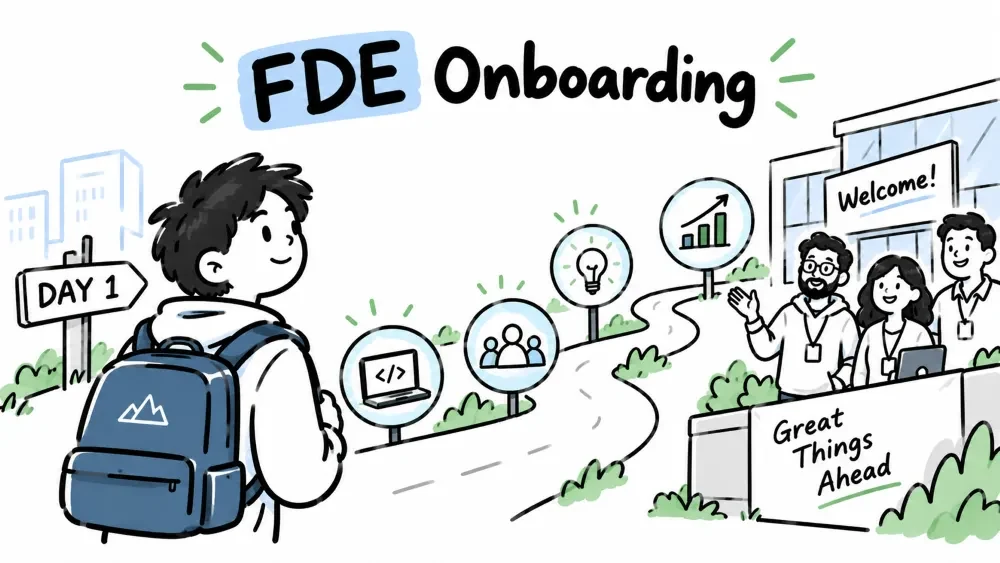
You got the offer — now you have to make it work. The first 30 days determine most of your trajectory: whether you earn the manager's trust, whether customers open up to you, and whether you build the reputation that earns you the good accounts and the growth. This is the final tutorial in the series, and it's a practical, week-by-week onboarding playbook for the FDE role — what to learn, who to meet, and what to deliver so you arrive at day 30 having added real value.
By day 30 you want to reach a point where your manager can say three things about you:
1. "They understand the product and their account."
2. "They've already delivered a small, real win."
3. "Customers trust them enough to share honest problems."
You do not need to have solved anything huge. You need to have learned correctly and moved something — however small — from "not working" to "working." Confidence comes from a string of small, real wins, not from having a big plan on day one.
Your first month runs on three parallel tracks at once. Balance them; don't spend the whole month on any one.
A good week mixes product time, people time, and operations time. Over-indexing on Product and ignoring People is the most common week-1 mistake.
Learn the product deeply. Don't just read docs — run a real install or a dev environment, complete a small task, and break something on purpose. Your goal is to be able to demo a genuine feature end-to-end within the week.
Introduce yourself with intent. Meet your manager, your team, the account/sales lead, and engineers on the shared platform team. Ask each two questions that earn real answers:
• "What's the most common thing customers struggle with right now?"
• "What do you wish someone had handed you when you started?"
Those two questions produce better onboarding intel than any org-chart tour. Write the answers down — they'll shape your first month.
Set a check-in cadence with your manager. Agree on weekly 1:1s and agree on what "done well in week 1" means to them. Align early so you never guess wrong about expectations later.
Shadow a frontline colleague. Sit in on a customer call, a demo, or even a support escalation with an experienced FDE. Watch not the tech but the human: how they lower a tense customer, how they ask for a decision, how they narrate an unknown. This is where you start absorbing the FDE communication style.
Map your customer's problem space. For your named account (or the account you'll take), start building a picture:
• Who is the economic buyer? Who is the daily user?
• What was the original pain the product was bought to solve?
• What risks could blow up the relationship in year one?
• What data / systems does the customer already run?
Learn the ops mechanics. Get access and run-throughs of the deploy, monitoring, and support tooling so you're not helpless the moment you need to ship a fix. Being able to operate is what separates an FDE from a consultant who only advises.
This is when you stop shadowing and start shipping. Identify one small, genuine task on your account — something annoying, low-risk, and clearly valuable — and own it to completion.
Good candidates for a first win:
The criteria: low risk of breaking, visibly useful to the customer, and something you can finish and explain cleanly. It doesn't need to impress anyone — its job is to teach you the full loop (scope → build → ship → explain) and to give your manager something concrete and signed-off.
Close out your week-3 task properly. Present it to your manager and, if appropriate, the account team — show the before, the after, and connect it to something the customer cares about. Frame it in their terms, not your engineering terms. A visible, well-communicated small win earns more trust than silent large effort.
Set the next 30-day direction. In your end-of-month 1:1, agree on the follow-up: what you'll own for month two, which customer relationship you'll deepen, and what "good" will look like. An agreed north star from day 30 gives month two momentum instead of drift.
Reflect honestly. Spend one short session writing down what you learned, what you'd redo, and who you still need to meet. That reflection is what converts experience into judgment.
Once your momentum is set, your days mostly mix:
A realistic FDE cadence keeps communication tight and builds small, shippable chunks constantly. Resist the urge to hoard a big, perfect solution; FDEs win by shipping and adapting.
The first 30 days end, but the skills they exercise never stop being the job. Keep compounding small wins, keep mapping your account's people and pain, and keep feeding what you learn back into the product. Months from now, that day-30 foundation — product fluency, trusted relationships, and a proven delivery loop — is what lets you take on larger accounts and grow toward Senior FDE and beyond.
Save your progress and earn XP for completing tutorials.
4 questions · Pass with 70%+
1What are the three onboarding tracks you balance during your first month?
2What should you have delivered by the end of week 3?
3Which habit is the biggest trust-builder available to you in the first 30 days?
4What separates an FDE from a consultant who only advises?
Technology
Forward Deployed Engineer
Lesson group
FDE Career Preparation
Progress
100% complete