Preparing your learning space...
100% through FDE Programming Foundations tutorials
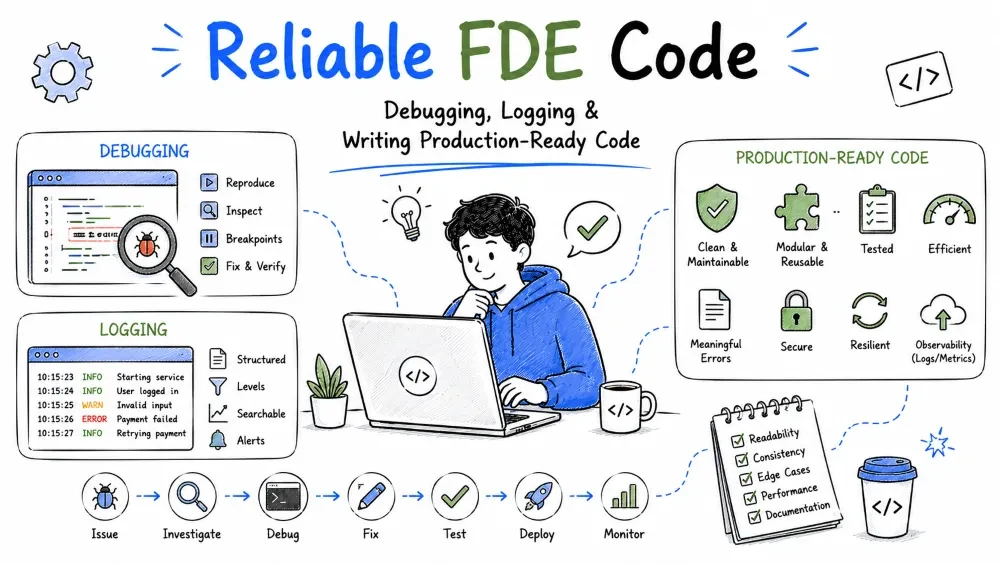
A demo that runs once is easy; code that survives weeks on a customer's flaky data needs debugging skill, logging, error handling, and production discipline. This tutorial covers all of it.
Debugging is the process of finding why code misbehaves. The fastest method: reproduce the problem, then isolate it by printing or stepping through values.
# instead of guessing, inspect the data
print(type(row), row)   # what is this really?
Why useful: FDE issues almost always come from unexpected customer data — logging the actual value reveals it fast.
Best Practice: Reproduce on a small sample before debugging the full dataset.
Common Mistake: "Fixing" by trial-and-error without understanding the root cause — it breaks again later.
Logging records what your program did, so you can diagnose issues after the fact without being there.
import logging
logging.basicConfig(level=logging.INFO)
logging.info("Fetched %d tickets", len(tickets))
logging.error("Failed to parse row: %s", row)
Explanation: info records normal steps; error records failures with context. Unlike print, logging can write to files and include timestamps.
Best Practice: Log the why and key values (counts, IDs), not just "done".
Note: FDEs rely on logs when a customer reports "it stopped working" three days ago.
Error handling lets your program fail gracefully instead of crashing. In Python you use try/except.
try:
    ticket = json.loads(raw)
except json.JSONDecodeError:
    logging.error("Bad JSON from customer API")
    ticket = {"subject": "unknown"}
Explanation: if parsing fails, the except block catches it, logs the issue, and provides a safe fallback — the script keeps running instead of dying.
Best Practice: Catch specific errors (not bare except:), and always log what went wrong.
Common Mistake: Swallowing errors silently (except: pass) — you'll never know why results are missing.
Production-ready code is reliable, observable, and maintainable by someone else. It handles bad input, fails safely, and tells you when something's wrong.
Why useful: FDEs hand code to customer teams — if it breaks obscurely, your credibility goes with it.
Keep behavior configurable and secrets out of code. (The mechanics of environment variables and safe key handling are covered in the APIs & Integrations tutorial — here we focus on the production pattern.)
import os
API_URL = os.getenv("API_URL", "https://api.example.com")
API_KEY = os.getenv("API_KEY")   # never hard-code
assert API_KEY, "API_KEY missing from environment"
Explanation: defaults live in code, customer-specific values come from the environment, and a missing key fails fast with a clear message instead of a cryptic error later.
Best Practice: Fail fast and loudly when required config is absent.
Combine error handling, logging, and validation:
import os, logging, requests

def fetch_tickets():
    API_URL = os.getenv("API_URL", "https://api.example.com")
    API_KEY = os.getenv("API_KEY")
    try:
        r = requests.get(API_URL, headers={"Authorization": f"Bearer {API_KEY}"})
        r.raise_for_status()              # error on 4xx/5xx
        return r.json()["tickets"]
    except requests.RequestException as e:
        logging.error("Ticket fetch failed: %s", e)
        return []
Explanation: raise_for_status() turns bad HTTP responses into caught errors; the fallback returns an empty list so the rest of the pipeline continues. Logs explain failures later.
Best Practice: Validate inputs, handle network failures, and log at the right level.
# summarize.py — summarizes customer tickets via the API
# ENV: API_URL, API_KEY
# Run: python summarize.py
Explanation: a short header tells the customer's team what the script does, what env vars it needs, and how to run it. Pair this with a README.
Best Practice: Write for the team that inherits the code — clear names, a README, and run instructions beat clever one-liners.
Save your progress and earn XP for completing tutorials.
4 questions · Pass with 70%+
1What is the fastest way to debug unexpected customer data?
2Why use logging instead of print?
3What does try/except let your program do?
4What is the danger of except: pass?
Technology
Forward Deployed Engineer
Lesson group
FDE Programming Foundations
Progress
100% complete