Preparing your learning space...
17% through FDE Project Management tutorials
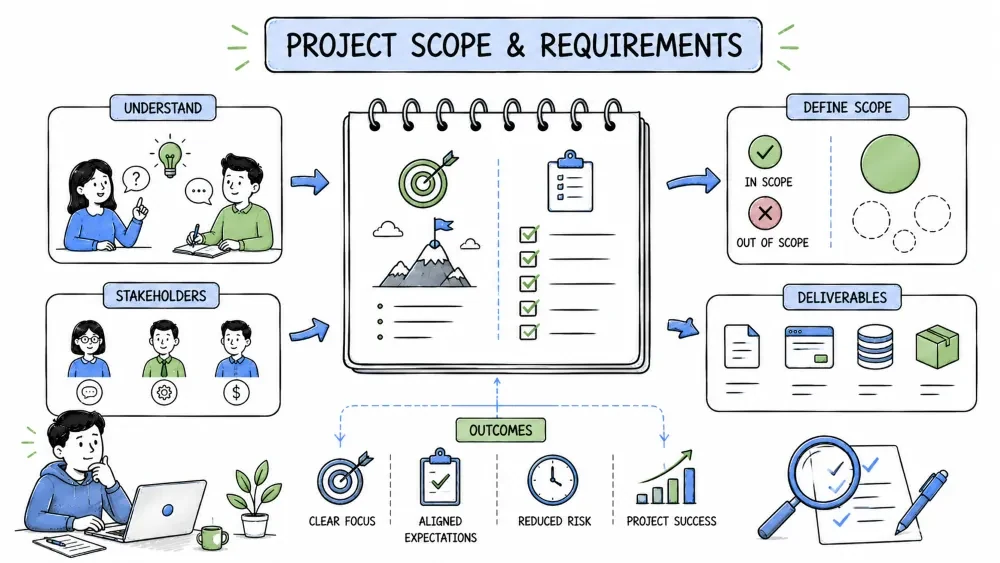
Every successful project starts with two questions: what are we actually building, and how will we know when it's done? This tutorial covers understanding project scope and defining clear requirements — the foundation of the FDE project lifecycle.
Scope is the boundary around a project — everything you have agreed to deliver, plus everything you have agreed not to. It defines what is in, what is out, and under what conditions the work happens.
Why it is useful: Without a clear boundary, small requests quietly become big projects. Scope gives you the authority to say no (or "let's plan that separately") when someone asks to add work mid-project.
Every project juggles three forces:
| Force | The question it answers |
|---|---|
| Scope | How much are we building? |
| Time | When does it need to be done? |
| Quality | How good does it have to be? |
Change any one and at least one other must move. If the customer adds scope but refuses to move the deadline, quality is the only thing left to give — and that's a conversation worth having early, not discovering late.
## Scope Statement — Customer Management Dashboard

**In scope**
- Customer list with search, filter, and pagination
- Add / edit / deactivate customer records
- CSV export of the filtered view
- Roles: Admin and Viewer

**Out of scope**
- Billing and invoicing features
- Mobile app
- Historical audit trail
- Self-service portal for customers

**Assumptions**
- Data comes from the existing customers table (SQL Server)
- No more than 500k rows in the table
- Admins are already managed by the company's SSO
This statement prevents most scope arguments before they start. The out of scope list is just as important as the in scope list — it is the written record of "we discussed it and chose not to."
Simple explanation: The scope statement lists the agreed boundaries in one place. The assumptions section is the sneaky part: you never wrote them down, and then a hidden constraint (like "500k rows only") blows up later.
Requirements are the specific, testable conditions the deliverable must meet. Where scope sets the boundary, requirements define the details inside that boundary.
Why it is useful: Requirements are the contract between you and the customer. A well-written requirement says "we'll know we're done when..." — so development, testing, and acceptance all run off the same document.
As an admin, I want to deactivate a customer account
so that inactive customers no longer appear in searches.

**Acceptance criteria**
- Given I am an admin, when I open a customer and click "Deactivate",
  the customer's status changes to Inactive.
- Given a customer is Inactive, when I search, they do not appear in results.
- Given a customer is Inactive, when a Viewer opens their profile,
  they see "Account deactivated" instead of editable fields.
Simple explanation: "As a… I want… so that…" states who needs it, what they need, and why — so the work has context, not just a feature name. The acceptance criteria are written as given / when / then conditions a tester can check with a yes or no.
| ID | Type | Requirement | Priority | Status |
|---|---|---|---|---|
| REQ-001 | Functional | Search by name, email, or phone | Must | In review |
| REQ-002 | Non-functional | List page loads in under 2s on 500k rows | Must | In review |
| REQ-003 | Non-functional | Works with screen readers | Should | Draft |
Tracking requirements in a table with IDs makes them referenceable. "Fix REQ-002" is unambiguous; "make the search better" is not.
Save your progress and earn XP for completing tutorials.
4 questions · Pass with 70%+
1Which of the following is the most important reason to write down out-of-scope items in a scope statement?
2If a customer adds new scope but refuses to move the deadline, what is the only remaining corner of the constraint triangle that can give?
3Which statement is the best example of a non-functional requirement?
4What makes a requirement truly testable?
Technology
Forward Deployed Engineer
Lesson group
FDE Project Management
Progress
17% complete