Preparing your learning space...
83% through FDE Project Management tutorials
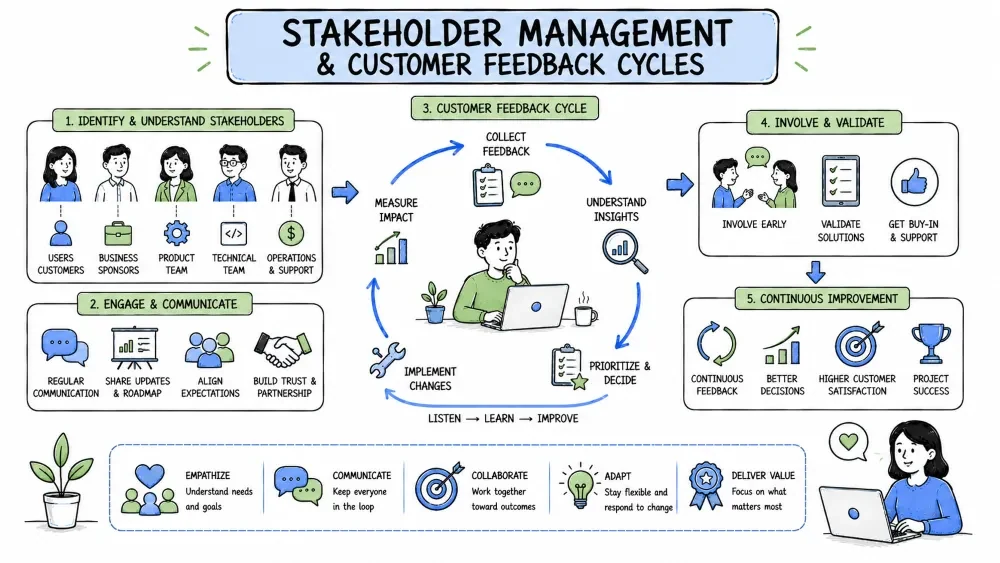
Software is built for people, and it succeeds only when the right people are informed, aligned, and involved at the right moments. This tutorial covers stakeholder management and the feedback cycles that keep a build honest.
A stakeholder is anyone who is affected by or can affect the project. Stakeholder management is systematically identifying these people, understanding their interest and influence, and keeping them informed and engaged.
Why it is useful: Most failed projects fail politically, not technically. A stakeholder you ignored — a security team, a support desk, a finance controller — can quietly block a launch that was working fine.
Plot each stakeholder on two axes to decide how much attention they need:
                HIGH INFLUENCE
   Keep satisfied              Manage closely
   (CISO, CFO)                 (Sponsor, customer IT lead)
   ---------------------+----------------------
   Monitor               Keep informed
   (other vendor teams)  (end users, support)
                LOW INFLUENCE
   ◄── LOW INTEREST ─────┼────── HIGH INTEREST ──►
| Activity | Sponsor | Customer IT | FDE | Support |
|---|---|---|---|---|
| Approve scope | A | C | R | I |
| Demo milestone | I | A | R | C |
| Deploy to production | C | A | R | I |
Simple explanation: RACI names the role each person plays in an activity. Responsible does the work, Accountable owns the outcome, Consulted gives input, Informed is kept in the loop. Filling this in kills the classic failure of "I thought they were handling it."
A feedback cycle is a recurring loop where the customer sees real progress, reacts to it, and their reaction shapes the next iteration. Shorter cycles mean less wasted work.
Why it is useful: Fixing a misunderstanding after two weeks of building costs days; catching it in a demo costs an hour. Feedback cycles are the cheapest correction mechanism you have.
feedback = [
    {"date": "2026-08-25", "source": "Ops demo",
     "note": "Need bulk edit for a group of customers",
     "triage": "deferred to v2", "action": None},
    {"date": "2026-08-25", "source": "Ops demo",
     "note": "Export shows the wrong timezone",
     "triage": "accepted", "action": "Fix and ship by 08-27"},
]

for f in feedback:
    print(f"{f['triage']}: {f['note']}")
Simple explanation: Every comment gets logged and triaged, just like a change request. Note the difference: one piece becomes real work, the other is consciously deferred with a reason. That's what separates a feedback loop from a pile of opinions. And yes — this connects straight back to the change-request loop in the steering tutorial. Same brain, same rules.
Save your progress and earn XP for completing tutorials.
4 questions · Pass with 70%+
1A stakeholder has high influence but low interest in the project. According to the influence/interest grid, how should you treat them?
2In a RACI matrix, what does the A stand for and mean?
3Why is "what surprised you?" a better demo question than "is everything okay?"
4What separates a feedback loop from a pile of opinions?
Technology
Forward Deployed Engineer
Lesson group
FDE Project Management
Progress
83% complete