Preparing your learning space...
14% through Production & Reliability tutorials
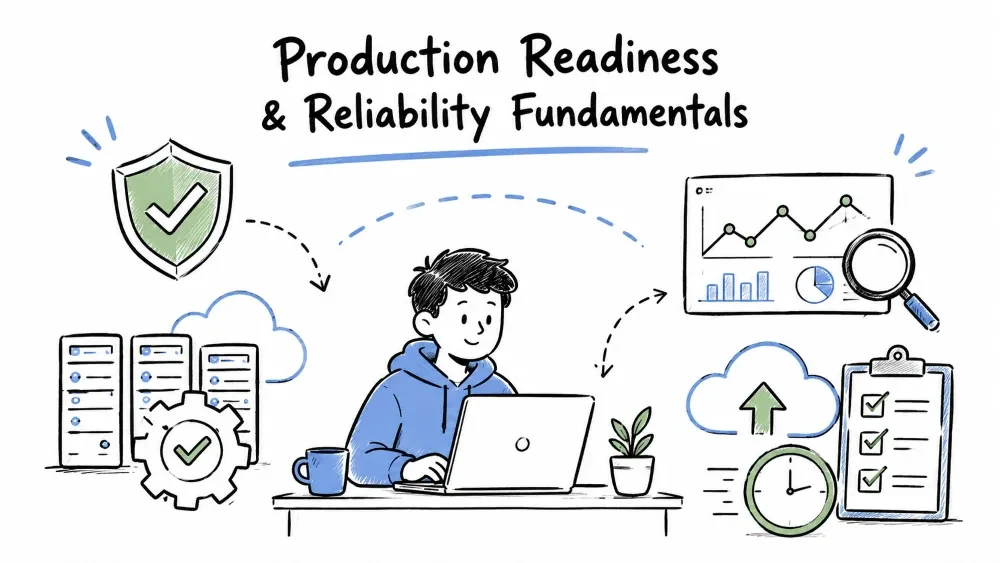
A solution that works in a demo is not the same as a solution that survives real users, real load, and real failures. Demo code gets a reset button; production doesn't. This tutorial walks through what it actually means to be "production-ready," then introduces the concepts that let you measure reliability — SLIs, SLOs, and error budgets — instead of just hoping things hold up.
Production readiness is the state a solution has to reach before you'd be comfortable trusting it with real users and real data: stable, observable, secure, recoverable, and supportable.
Why bother with a formal review? Because the first time most people learn a system "wasn't ready" is during an outage. A demo handles one user and gets wiped when it breaks. Production has no reset button. If you run through a readiness review before launch, those surprises surface as checklist items you can work through calmly instead of as a fire at 2 a.m.
Whether it's an internal tool or a SaaS feature, the same five areas keep coming back:
| Area | What "ready" means |
|---|---|
| Reliability | Handles expected load, fails gracefully, restarts cleanly |
| Observability | Logs, metrics, and health checks exist and are actually looked at |
| Security | Secrets managed, access controlled, data protected at rest and in transit |
| Recoverability | Backups run, restores are tested, a rollback path exists |
| Supportability | Docs, runbooks, and an owner who knows who to call |
A fast way to get a feel for where you stand: go down the checklist and mark each item true, false, or "don't know." Treat every "don't know" as a false. If you can't observe a thing, you can't claim it works.
readiness = {
    "reliability": {"load_testing_done": False, "graceful_shutdown": True},
    "observability": {"logging": True, "metrics": False, "health_check": True},
    "security": {"secrets_in_vault": True, "access_controlled": False},
    "recoverability": {"backups_running": True, "restore_tested": False},
    "supportability": {"runbook": True, "owner_assigned": True},
}

def score(area):
    items = readiness[area]
    passed = sum(items.values())
    return f"{area}: {passed}/{len(items)}"

for area in readiness:
    print(score(area))
This walks each area and prints how many checks pass. The code is deliberately dumb — there's no magic in it, and there shouldn't be. Its value is that you now have a written, shareable list anyone can read to see exactly what's blocking launch.
Reliability is the practice of keeping a system doing its job — answering requests, processing jobs, returning correct results — even as users, load, and time conspire against it. It's not a single feature you bolt on; it's a set of measurable goals plus the design choices that let you reach them.
The reason the vocabulary matters: "make it reliable" is a wish, but "meet a 99.9% availability target this quarter" is a spec. The fundamentals give you the words and the math to turn one into the other.
These three get mixed up all the time, but they're deceptively simple:
SLI:    what we measure     ->  % of requests that return success
SLO:    what we aim for     ->  >= 99.9% per month
SLA:    what we promise     ->  >= 99.9% or the customer gets a credit
One habit pays off constantly: set your SLO stricter than your SLA. Aim for 99.95% internally and you've got a buffer before you breach a 99.9% contract. Aim at the SLA exactly and one bad day puts you in penalty territory.
An error budget is the unreliability your SLO allows. If your SLO is 99.9%, you get 0.1% of a month — about 43 minutes — to be down.
This sounds restrictive, but it's actually liberating. You don't have to be perfect; you just can't spend more than the budget. You spend it on incidents, and you can also spend it deliberately — on a risky release, an experiment, a big refactor. Run out of budget and you stop shipping risky changes until it refills. That's how you turn "reliability vs. speed" from a philosophical argument into straightforward accounting.
MONTH_MINUTES = 30 * 24 * 60  # 43,200

def availability(ok_minutes, total_minutes=MONTH_MINUTES):
    return ok_minutes / total_minutes * 100

def error_budget_remaining(ok_minutes, target=99.9):
    actual = availability(ok_minutes)
    return actual - target

# 30 days of serving, with 25 minutes of downtime across the month
print(f"{availability(MONTH_MINUTES - 25):.3f}%")   # 99.942%
print(f"budget left: {error_budget_remaining(MONTH_MINUTES - 25):.3f}%")
The math is boring on purpose. Twenty-five minutes down in a month still lands you at 99.94%, comfortably inside a 99.9% target — and that's exactly the point of a budget: it tells you when to panic. A 30-minute outage eats most of a 99.9% target's budget; against a 99.5% target it's nothing worth waking anyone over.
Best Practice: keep your SLOs in a plain file or dashboard anyone can read, and review them monthly. An SLO nobody ever looks at is just a nice sentence.
Save your progress and earn XP for completing tutorials.
4 questions · Pass with 70%+
1What is an SLI?
2If your SLO is 99.9%, how much downtime does the error budget allow per month (30 days)?
3Why should your SLO be stricter than your SLA?
4What happens when the error budget is fully spent?
Technology
Forward Deployed Engineer
Lesson group
Production & Reliability
Progress
14% complete