Preparing your learning space...
25% through Getting Started tutorials
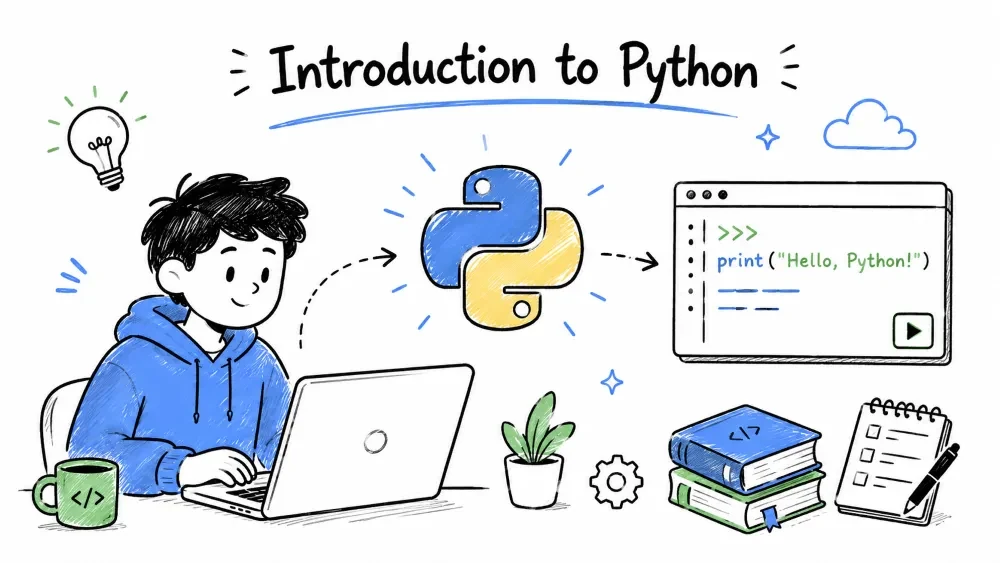
Table of Contents
Alright, let's start from the very beginning.
Python is a programming language — a way to tell a computer what to do. But it's not just any programming language. Python was created by Guido van Rossum back in 1991, and his main goal was simple: make a language that's easy to read and fun to use.
Here's the thing that sets Python apart — it reads almost like plain English. You don't need to wrestle with curly braces or semicolons just to print "Hello, World!" on the screen. Check this out:
print("Hello, World!")
That's it. One line. No fuss, no confusion.
Python is what we call a high-level, interpreted language. Fancy words, I know. Let me break them down:
You might be thinking — "There are a hundred programming languages out there. Why should I pick Python?"
Fair question. Here's why Python has become the go-to language for millions of developers:
I've taught programming to absolute beginners, and Python is always the smoothest ride. The syntax is clean, the rules are straightforward, and you spend more time solving problems than fighting the language itself.
Python isn't just a "toy language" for beginners. It runs:
When you're stuck — and you will get stuck, we all do — someone has already asked your question on Stack Overflow. Python's community is huge, friendly, and active.
Not that money should be your only motivation, but Python developers are in high demand. Data scientists, backend engineers, DevOps folks — they all use Python.
Let's talk about what makes Python special under the hood.
Python forces you to write clean code. Indentation isn't just for looks — it's part of the language structure.
# This is how Python groups code — with indentation
if 5 > 2:
    print("Five is greater than two!")  # Notice the indentation
No curly braces {}. No end if. Just clean, readable spacing.
You don't have to declare what type a variable is. Python figures it out.
name = "Alice"      # Python knows this is text
age = 25            # Python knows this is a number
pi = 3.14           # And this is a decimal
is_student = True   # And this is a boolean
Python comes with a huge standard library. Want to work with JSON? It's built in. Need to send an HTTP request? There's a module for that. File handling, regular expressions, dates and times — it's all there.
import random

# Pick a random number between 1 and 10
lucky_number = random.randint(1, 10)
print("Your lucky number is", lucky_number)
Python supports multiple programming styles. You can write simple scripts, build object-oriented programs, or use functional programming techniques. No rigid rules — just use what works.
Write your code once on Windows, and it runs on Mac and Linux too. (Well, mostly. Some system-specific stuff might differ, but for the most part, you're good.)
Let's look at where Python actually shines in the real world.
Frameworks like Django and Flask power websites and APIs. Instagram? Built on Django. Pinterest? Django. Spotify? Uses Python heavily.
This is Python's superpower. Companies use Python to analyze data, build reports, and make predictions.
# A tiny taste of data analysis with Python
data = [23, 45, 67, 12, 89, 34]
average = sum(data) / len(data)
print("Average:", average)
Python is the #1 language for AI. Self-driving cars, recommendation engines (Netflix, YouTube), voice assistants — a lot of that magic runs on Python.
This is where Python saves you hours. Need to rename a thousand files? Send automated emails? Scrape data from a website? Python can do it in a few lines.
import os

# Get the list of files in the current folder
files = os.listdir('.')
print("Files in this folder:", files)
Penetration testers and security researchers love Python for building tools and automating attacks (ethically, of course).
Schools and universities teach Python as the first programming language. It's the modern equivalent of learning with BASIC or Pascal back in the day.
Save your progress and earn XP for completing tutorials.
Technology
Python
Lesson group
Getting Started
Progress
25% complete