Preparing your learning space...
50% through Cyber Security Basics tutorials
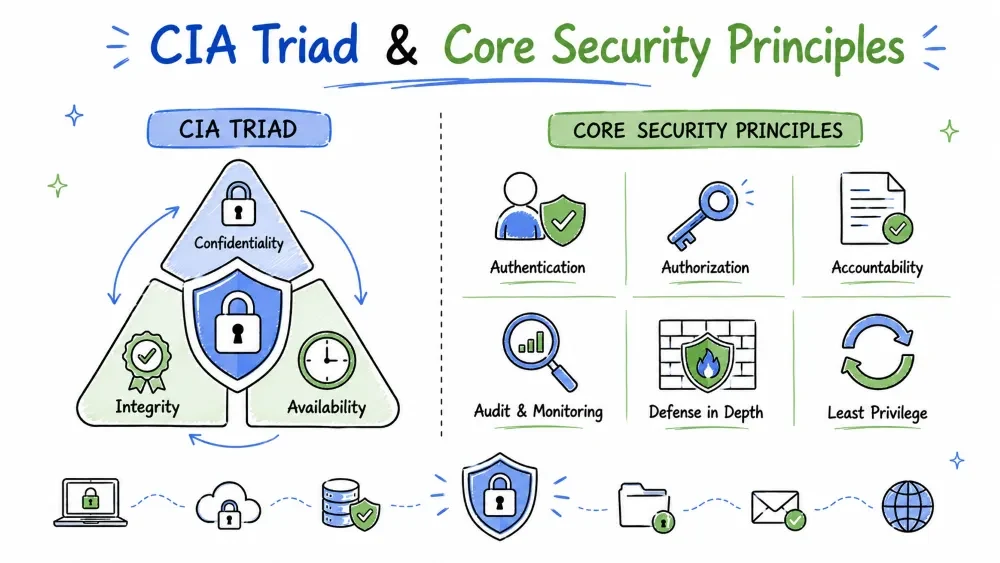
The CIA Triad is the foundation of all cyber security. Every security practice, tool, and policy you'll ever learn about exists to support one or more of these three principles.
C — Confidentiality — "Keep it secret"
I — Integrity      — "Keep it accurate"
A — Availability   — "Keep it accessible"
The CIA Triad has been a core concept in information security since the 1970s. It was formally established as a standard in the NIST (National Institute of Standards and Technology) guidelines and remains the fundamental model for understanding security goals.
Because all three principles are equally important and interconnected. If any one is broken, security fails completely:
| Scenario | Secure? | Why |
|---|---|---|
| ✅ Confidentiality + Integrity + Availability | Secure System | All three principles are maintained |
| ❌ Missing Confidentiality | Data leaks | Information is exposed to unauthorized parties |
| ❌ Missing Integrity | Untrusted data | You can't trust the accuracy of information |
| ❌ Missing Availability | System downtime | Users can't access systems when needed |
| CIA Principle | Banking Example | Why It Matters |
|---|---|---|
| Confidentiality | Only you and the bank know your balance | Prevents identity theft and financial fraud |
| Integrity | Your balance is accurate — no unauthorized changes | Ensures correct transactions and records |
| Availability | You can access your account 24/7 via app/website | Ensures you can pay bills, transfer money when needed |
| CIA Principle | Library Analogy |
|---|---|
| Confidentiality | Your borrowing history is private — only you can see it |
| Integrity | Books are in their correct places, pages aren't torn out |
| Availability | The library is open when you need it, books are on the shelves |
Whether you're:
| Principle Ignored | Real Incident | Consequence |
|---|---|---|
| Confidentiality | Equifax Breach (2017) | 147 million Social Security numbers exposed |
| Integrity | Stuxnet (2010) | Centrifuges destroyed by altered operational data |
| Availability | Dyn DDoS (2016) | Twitter, Netflix, Reddit offline for hours |
Confidentiality ensures that information is not disclosed to unauthorized people, entities, or processes — only the right people can see it.
Confidentiality is achieved through a combination of technical and administrative controls:
Confidentiality
├── Encryption
│   ├── At Rest (stored data is encrypted)
│   └── In Transit (data moving across networks is encrypted)
├── Access Controls
│   ├── Discretionary (owner decides)
│   └── Mandatory (system-enforced)
├── Authentication
│   ├── Passwords
│   ├── Biometrics
│   └── MFA
└── Data Classification
    ├── Public
    ├── Internal
    ├── Confidential
    └── Restricted
| Method | How It Works | Strength |
|---|---|---|
| Encryption | Scrambles data using algorithms; only authorized keys can decrypt | Very Strong (if strong algorithm used) |
| Access Control Lists (ACLs) | Specify exactly who can read/modify what | Good for structured access |
| Steganography | Hides data within other data (like hiding a message in an image) | Niche use case |
| Data Masking | Shows only partial data (e.g., credit card: --****-1234) | Good for display purposes |
| Physical Security | Locks, safes, secure server rooms | Prevents physical access |
| Scenario | Confidentiality In Action |
|---|---|
| WhatsApp messages | End-to-end encryption ensures only you and the recipient can read them |
| Bank login | Username + password keeps your account info private |
| Medical records | Only your doctor and authorized staff can view your health data |
| HTTPS websites | The padlock icon means your connection to the site is encrypted |
| Password managers | Your passwords are stored in an encrypted vault |
| Threat | How It Works | Prevention |
|---|---|---|
| Eavesdropping | Listening in on communications | Encryption (VPN, HTTPS) |
| Phishing | Tricking users to reveal passwords | Security awareness training |
| Data Breaches | Hacking databases to steal data | Strong access controls + encryption |
| Shoulder Surfing | Looking at someone's screen | Privacy screens, awareness |
| Man-in-the-Middle | Intercepting communication | Encryption, certificate verification |
| Social Engineering | Manipulating people to reveal info | Training, verification procedures |
Remember: Confidentiality = "Only authorized eyes can see this"
Integrity ensures that data is accurate, complete, and has not been tampered with — it remains exactly as it was when created or authorized.
Integrity is about trust. When you receive data, you need to be sure:
| Method | How It Works | Real-World Use |
|---|---|---|
| Hashing | Creates a unique "fingerprint" (hash) of data; any change completely changes the hash | Verifying downloaded files haven't been tampered with |
| Digital Signatures | Cryptographically signs data using private key; anyone can verify with public key | Signing emails, software packages |
| Checksums | Simpler version of hashing — verifies file integrity | ZIP files, network transfers |
| Version Control | Tracks every change, who made it, and when | Git, SVN for code; Google Docs version history |
| Audit Trails | Chronological record of all changes | Database change logs |
| Write-Once Media | Data that can't be modified after writing | CDs, legal document archives |
Original Data: "Hello World"
Hash (SHA-256): a591a6d40bf420404a011733cfb7b190d62c65bf0bcda32b57b277d9ad9f146e

Modified Data: "Hello World!" (added exclamation mark)
Hash (SHA-256): 7f83b1657ff1fc53b92dc18148a1d65dfc2d4b1fa3d677284addd200126d9069

→ The hashes are COMPLETELY different! Even a tiny change is detected.
| Scenario | Integrity In Action |
|---|---|
| Bank transfer | The amount you enter is exactly what gets transferred — no one modified it in between |
| Software download | The checksum on the website matches what you downloaded — file is authentic |
| Medical records | Your doctor's diagnosis is accurately recorded and not altered by anyone else |
| Voting systems | Your vote is counted exactly as you cast it — not modified |
| Blockchain | Each block is cryptographically linked to the previous one — tampering is evident |
| Threat | How It Works | Prevention |
|---|---|---|
| Man-in-the-Middle | Attacker intercepts and alters data in transit | HTTPS, digital signatures |
| Unauthorized Modification | Hacker changes database values | Access controls, audit logs |
| Malware | Virus modifies system files | Antivirus, file integrity monitoring |
| Human Error | Accidentally deleting or changing data | Backups, version control |
| Replay Attack | Attacker resends a valid data transmission | Timestamps, nonces |
Remember: Integrity = "This data hasn't been changed by anyone unauthorized"
Availability ensures that systems and data are accessible when needed by authorized users — no downtime when you need to work.
Availability is often the most visible principle — when systems go down, everyone notices immediately.
| Method | How It Works | Uptime Target |
|---|---|---|
| Redundancy | Backup systems (servers, power, network) kick in if primary fails | 99.9% - 99.999% |
| Backups | Regular copies of data for recovery | Varies by backup frequency |
| Load Balancing | Distributes traffic across multiple servers | Prevents overload |
| Disaster Recovery Plan | Documented process for restoring operations | Hours to days |
| Failover Clustering | Automatic switch to standby system | Seconds to minutes |
| RAID | Multiple hard drives working together | Survives single drive failure |
| Cloud Auto-Scaling | Automatically adds resources during high demand | Handles traffic spikes |
| Uptime % | Downtime per Year | Example Service |
|---|---|---|
| 99% | 3.65 days | Basic hosting |
| 99.9% ("Three Nines") | 8.76 hours | Standard enterprise |
| 99.99% ("Four Nines") | 52.56 minutes | Critical business apps |
| 99.999% ("Five Nines") | 5.26 minutes | Emergency services (911) |
| 99.9999% ("Six Nines") | 31.5 seconds | Stock exchanges |
| Scenario | Availability In Action |
|---|---|
| Netflix streaming | Servers remain available even with millions of concurrent users |
| Hospital systems | Patient records are accessible 24/7 for emergency care |
| Online banking | You can check your balance anytime, day or night |
| Air traffic control | Must be available 100% — lives depend on it |
| Google Search | Processes 40,000+ searches per second, always available |
| Threat | How It Works | Prevention |
|---|---|---|
| DDoS Attacks | Overwhelms servers with massive traffic | DDoS mitigation services, load balancers |
| Ransomware | Encrypts files and blocks access | Backups, offline copies |
| Hardware Failure | Server crashes, disk failures | Redundancy, RAID, cloud backups |
| Natural Disasters | Flood, fire, earthquake damage data centers | Geographic redundancy, cloud DR |
| Power Outage | Systems shut down unexpectedly | UPS generators, backup power |
| Software Bugs | System crashes due to coding errors | Testing, gradual rollouts |
| Human Error | Accidental configuration changes | Change management, automation |
Remember: Availability = "I can access this whenever I need it"
| Detail | Description |
|---|---|
| What Happened | Hackers exploited a known vulnerability (Apache Struts) |
| Data Compromised | 147 million Social Security numbers, 209 million credit card numbers |
| CIA Principle | Confidentiality was violated — personal data was exposed |
| Root Cause | Failed to patch a known vulnerability for 2 months |
| Cost | $1.4 billion in total costs, $575 million settlement |
| Detail | Description |
|---|---|
| What Happened | Sophisticated worm attacked Iranian nuclear centrifuges |
| How It Worked | Made centrifuges spin at damaging speeds while reporting "normal" readings |
| CIA Principle | Integrity was violated — monitoring data was falsified |
| Significance | First known cyber attack to cause physical damage |
| Detail | Description |
|---|---|
| What Happened | Massive DDoS attack on DNS provider Dyn |
| Impact | Twitter, Netflix, Reddit, Spotify, and many others went offline |
| CIA Principle | Availability was violated — services were inaccessible |
| Cause | IoT devices (cameras, DVRs) infected with Mirai botnet |
| Duration | Several hours of major outage |
In practice, you can't maximize all three equally — there are trade-offs:
        Confidentiality
              │
              │
              ▼
    ◄─────── YOU ───────►
              │
              │
              ▼
        Availability
| Scenario | Confidentiality | Integrity | Availability |
|---|---|---|---|
| Banking app | Very High | Very High | High |
| Social media | Medium | Medium | Very High |
| Military system | Very High | Very High | Medium |
| Public website | Low | Medium | Very High |
| Hospital records | Very High | Very High | Very High (all critical!) |
Bank Security: A bank could maximize security by locking all customer data in a vault with no network access. But then customers couldn't access their money (confidentiality ✓, availability ✗). So banks must find a balance — strong encryption and MFA (confidentiality) while ensuring 24/7 access (availability).
Beyond the CIA Triad, there are three additional core principles that form the AAA Model (also called the AAA of security):
| Principle | Question It Answers | Simple Definition |
|---|---|---|
| Authentication | Who are you? | Proving your identity |
| Authorization | What are you allowed to do? | What you can access |
| Accountability | What did you do? | Tracking your actions |
The AAA model supports the CIA Triad:
Authentication verifies that someone is who they claim to be — it's the process of proving your identity.
| Factor | What It Uses | Strength | Examples |
|---|---|---|---|
| Something you KNOW | Knowledge | Low-Medium | Password, PIN, security question answer |
| Something you HAVE | Possession | Medium-High | Phone (OTP), security key, smart card, ID badge |
| Something you ARE | Inherence | High | Fingerprint, facial recognition, iris scan, voice |
| Level | Factors Used | Example | Security |
|---|---|---|---|
| Single-Factor | 1 factor | Password only | Low |
| Two-Factor (2FA) | 2 factors | Password + SMS code | Medium |
| Multi-Factor (MFA) | 2+ factors | Password + Fingerprint + Security Key | High |
| Adaptive MFA | Varies by risk | Normal login → password; Suspicious login → password + fingerprint + location check | Very High |
1. User enters username + password
   ↓
2. System verifies password is correct (Something you KNOW)
   ↓
3. System prompts for second factor
   ↓
4. User opens authenticator app → gets 6-digit code
   ↓
5. User enters the code (Something you HAVE)
   ↓
6. ACCESS GRANTED — both factors verified
| Statistic | Source |
|---|---|
| MFA blocks 99.9% of automated attacks | Microsoft |
| Accounts with MFA are 99% less likely to be compromised | |
| 80% of data breaches involve weak or stolen passwords | Verizon DBIR |
| Method | Convenience | Security |
|---|---|---|
| SMS Code | High | Low (SIM swapping risk) |
| Authenticator App (Google/Microsoft) | Medium | High |
| Push Notification | High | High |
| Hardware Key (YubiKey) | Medium | Very High |
| Biometric | High | High |
Authorization determines what an authenticated user is allowed to do — what resources they can access and what actions they can perform.
Authentication: "You are John" (verifies identity)
Authorization:  "You can view reports but not edit them" (defines permissions)

Authentication always comes BEFORE authorization.
| Model | Description | Example |
|---|---|---|
| RBAC (Role-Based) | Access based on job role | Manager role → can view all reports |
| ABAC (Attribute-Based) | Access based on attributes | Access if: department=HR AND location=office AND time=9-5 |
| MAC (Mandatory) | System-enforced, user can't change | Military: Top Secret clearance needed |
| DAC (Discretionary) | Data owner decides access | You can share your Google Doc with anyone |
| Rule-Based | Based on rules | "Allow access if IP is from company network" |
User logs in (Authentication ✓)
  ↓
System checks: "What is this user's role?"
  ↓
┌──────────────────────────────────────┐
│ Role          │ Can Access           │
├──────────────────────────────────────┤
│ Employee      │ Department files     │
│ Manager       │ Department + Reports │
│ HR            │ Employee records     │
│ IT Admin      │ All systems          │
│ CEO           │ Everything           │
└──────────────────────────────────────┘
  ↓
User sees only what they're authorized to see
"Give a person only the permissions they absolutely need to do their job — nothing more."
Examples:
Accountability ensures that actions can be traced back to the person who performed them — no anonymous actions.
User Action → System Records → Audit Log → Investigation (if needed)
(Who? When? What?)           (Stored securely)  (Trace back to user)
| Tool | What It Records | Example |
|---|---|---|
| Audit Logs | Who accessed what, when, from where | "John accessed customer DB at 2:30 PM from IP 192.168.1.5" |
| SIEM | Centralized log analysis and alerting | Splunk, ELK Stack, Azure Sentinel |
| User Behavior Analytics | Detects unusual activity patterns | "John logged in from Russia at 3 AM — unusual!" |
| Digital Forensics | Detailed investigation after incident | Reconstruct attack timeline |
A security breach occurs: customer data was exported.
With accountability:
- Audit logs show: "User ID 1542 (Sarah, IT Admin) exported 50,000 records at 2:15 AM"
- Investigation reveals Sarah's account was compromised
- Action taken: Reset password, enhance MFA, review access
Without accountability:
- No one knows who exported the data
- Can't determine the scope of the breach
- Can't prevent it from happening again
Non-Repudiation ensures that someone cannot deny having performed an action — it provides cryptographic proof.
| Principle | Focus |
|---|---|
| Accountability | Tracks actions (internal monitoring) |
| Non-Repudiation | Proves actions (legally binding proof) |
| Method | How It Works | Legal Status |
|---|---|---|
| Digital Signatures | Cryptographically signs documents/emails | Legally binding in many countries |
| Blockchain/Immutable Ledgers | Transactions permanently recorded | Increasingly recognized |
| Biometric Verification | Fingerprint/face tied to action | Accepted as evidence |
| Secure Timestamping | Proves data existed at a specific time | Used in patent filings |
Email: You sign an email with your digital signature. Later, you can't claim "I didn't send that" because the signature proves it was you.
E-commerce: You place an order online. Non-repudiation prevents you from claiming "I didn't make that purchase" — the digital receipt proves the transaction.
Contracts: E-signatures on legal documents provide non-repudiation — signers can't deny signing.
Privacy is about controlling how your personal information is collected, used, shared, and stored.
| Concept | Focus | Question It Answers |
|---|---|---|
| Confidentiality | Protecting data from unauthorized access | "Who can see this data?" |
| Privacy | Your rights over your own data | "Who can USE this data and how?" |
| Scenario | Confidentiality | Privacy |
|---|---|---|
| Hospital encrypts medical records | ✅ Ensured (data is encrypted) | ❌ Not enough — who has access? |
| You choose which doctor sees your records | ✅ Related | ✅ Privacy in action |
| Facebook encrypts your messages | ✅ Ensured | ❌ They might still use message data for ads |
| You delete your Facebook account | ✅ Related | ✅ Privacy (right to be forgotten) |
| Principle | Meaning |
|---|---|
| Data Minimization | Collect only what you need |
| Purpose Limitation | Use data only for stated purpose |
| Consent | Get permission before collecting |
| Right to Access | Users can see what data you have |
| Right to Deletion | Users can request data deletion |
| Data Portability | Users can take their data elsewhere |
Don't rely on a single security measure — use multiple layers. (Covered in Tutorial 6)
Give users only the minimum access they need. (Covered in Tutorial 6)
When a system fails, it should fail in a secure state:
No single person should have too much power:
Keep security mechanisms as simple as possible — simpler systems are easier to verify and less likely to have hidden flaws.
Security should not depend on secrecy of the design — algorithms should be public, keys should be secret (Kerckhoffs's Principle).
You wake up and check your email:

  1. AUTHENTICATION → You enter your password (prove who you are)
  2. AUTHORIZATION → System checks you have permission to access email
  3. CONFIDENTIALITY → Your emails are encrypted during transmission (HTTPS)
  4. INTEGRITY → Your emails haven't been modified by anyone in transit
  5. AVAILABILITY → Gmail servers are up and running (99.9%+ uptime)
  6. ACCOUNTABILITY → All login attempts and actions are logged
  7. NON-REPUDIATION → Sent emails are digitally signed (proves you sent them)
  8. PRIVACY → Google doesn't share your email content without permission (GDPR)
              ┌─────────────┐
              │   PRIVACY   │  (Your rights over data)
              ├─────────────┤
              │NON-REPUDIAT.│  (Can't deny actions)
              ├─────────────┤
              │ACCOUNTABIL. │  (Track who did what)
              ├─────────────┤
              │AUTHORIZAT.  │  (What you can access)
              ├─────────────┤
              │AUTHENTICAT. │  (Prove who you are)
              ├─────────────┤
              │AVAILABILITY │  (Systems accessible when needed)
              ├─────────────┤
              │  INTEGRITY  │  (Data is accurate & untampered)
              ├─────────────┤
              │CONFIDENTIAL.│  (Data is private & secure)
              └─────────────┘
| Step | Principle(s) |
|---|---|
| Log in with password | Authentication |
| System shows your orders | Authorization (only your orders) |
| Credit card info is hidden | Confidentiality (encrypted storage) |
| Price displayed correctly | Integrity (accurate data from database) |
| Site loads quickly | Availability (load-balanced servers) |
| Purchase history tracked | Accountability (logs of all activity) |
| Digital receipt for purchase | Non-Repudiation (proof of transaction) |
| You control marketing preferences | Privacy (opt-in/opt-out choices) |
| Need | Principle | Why |
|---|---|---|
| Only doctors see patient records | Confidentiality | Protect sensitive health information |
| Lab results are accurate | Integrity | Incorrect results could lead to wrong treatment |
| Records available during emergency | Availability | Life-or-death situations require immediate access |
| Doctor logs in with fingerprint | Authentication | Quick, secure identity verification |
| Nurse can view but not edit prescriptions | Authorization | Clear role-based permissions |
| All access to records is logged | Accountability | Know who accessed what, when |
| Digital signatures on prescriptions | Non-Repudiation | Doctor can't deny authorizing medication |
| Need | Principle |
|---|---|
| Only you see your balance | Confidentiality |
| Your transactions are accurate | Integrity |
| You can access money 24/7 | Availability |
| Login requires password + fingerprint | Authentication (MFA) |
| You can only see your own accounts | Authorization |
| All transfers are logged | Accountability |
| Transfer confirmation is legally binding | Non-Repudiation |
Save your progress and earn XP for completing tutorials.
4 questions · Pass with 70%+
1In the CIA Triad, "C" stands for:
2Ensuring data is accurate and unmodified describes:
3A DDoS attack primarily violates which CIA principle?
4The "Principle of Least Privilege" means:
Technology
Cyber Security & Networking
Lesson group
Cyber Security Basics
Progress
50% complete