Preparing your learning space...
67% through Cyber Security Basics tutorials
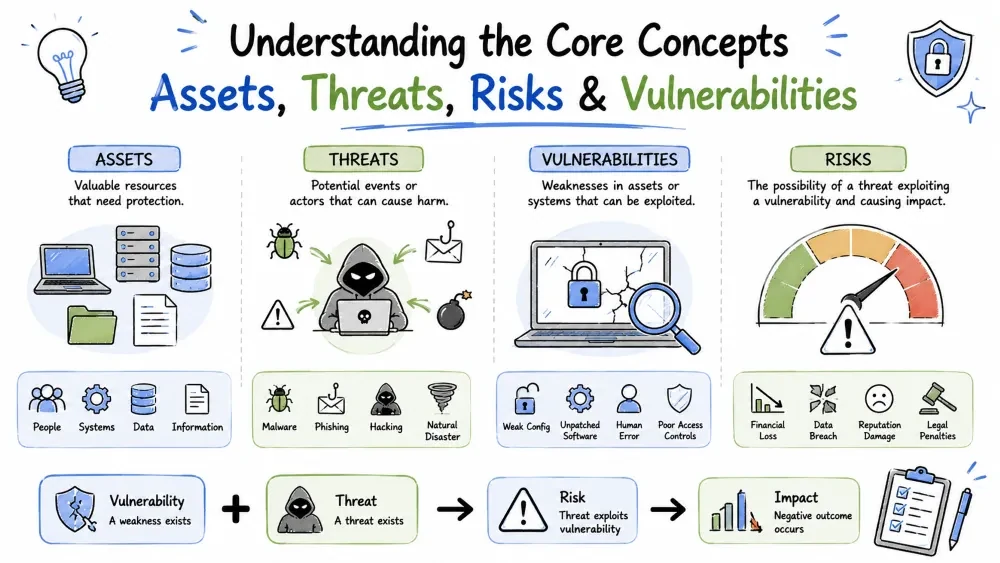
In cyber security, four terms form the foundation of risk analysis. Understanding these is essential before you can implement any security controls.
| Concept | Simple Definition | One-Word Summary |
|---|---|---|
| Asset | Something valuable that needs protection | Value |
| Threat | Something that can cause harm to an asset | Danger |
| Vulnerability | A weakness that can be exploited | Weakness |
| Risk | The potential for loss or damage | Uncertainty |
| Concept | House Analogy |
|---|---|
| Asset | Your home, your family, valuables inside (TV, jewelry, cash) |
| Threat | A burglar in the neighborhood looking for targets |
| Vulnerability | An unlocked window on the ground floor |
| Risk | The chance that the burglar enters through that unlocked window and steals your valuables |
| Concept | Health Analogy |
|---|---|
| Asset | Your body and health |
| Threat | Viruses and bacteria |
| Vulnerability | Weak immune system (if you haven't been sleeping/eating well) |
| Risk | The chance of getting sick during flu season |
| Control | Washing hands, getting vaccinated, wearing a mask |
The relationship is simple but powerful:
A THREAT exploits a VULNERABILITY to damage an ASSET
                       ↓
                    This is RISK
Risk = Likelihood (Threat × Vulnerability) × Impact (Asset Value)
┌──────────────────────────────────────────────────────────────┐
│                          RISK                                 │
│  ┌─────────────┐    ┌──────────────┐    ┌────────────────┐  │
│  │    ASSET    │    │   THREAT     │    │ VULNERABILITY  │  │
│  │  (Value)    │ ◄─ │  (Danger)    │ ◄─ │  (Weakness)    │  │
│  │             │    │              │    │                │  │
│  │- Customer   │    │- Hacker      │    │- Weak password │  │
│  │  database   │    │- Malware     │    │- Unpatched SW  │  │
│  │- Bank acct  │    │- Ransomware  │    │- Open port     │  │
│  │- Laptop     │    │- Insider     │    │- No firewall   │  │
│  └─────────────┘    └──────────────┘    └────────────────┘  │
└──────────────────────────────────────────────────────────────┘
A Threat (hacker) uses a Vulnerability (weak password) to damage an Asset (your bank account), creating Risk (potential financial loss).
An asset is anything of value that needs to be protected. In cyber security, assets can be tangible (physical) or intangible (non-physical).
| Category | Tangible? | Examples | Value Type |
|---|---|---|---|
| Hardware | ✅ Yes | Servers, computers, laptops, phones, routers, cables | Replacement cost |
| Software | ❌ No (license) | OS, apps, databases, custom software | License + development cost |
| Data | ❌ No | Customer records, financial data, IP, passwords | Sometimes priceless |
| People | ✅ Yes | Employees, contractors, their skills | Salary + training + knowledge |
| Reputation | ❌ No | Brand value, customer trust, public image | Hard to quantify |
| Infrastructure | ✅ Yes | Networks, cloud services, power, cooling | Replacement + downtime cost |
| Intellectual Property | ❌ No | Patents, copyrights, trademarks, trade secrets | Competitive advantage |
Assets are classified by how much damage would occur if compromised:
| Level | Description | Examples | Handling Requirements |
|---|---|---|---|
| Public | No harm if exposed | Marketing brochures, job postings, press releases | No special handling |
| Internal | Internal use only, limited harm | Company policies, org charts, internal wikis | Basic access control |
| Confidential | Significant harm if exposed | Customer PII, financial data, contracts | Encryption + strict access |
| Secret | Severe harm if exposed | Trade secrets, source code, acquisition plans | Strong encryption + limited access + logging |
| Top Secret | Catastrophic harm if exposed | Military plans, national security data | Maximum security, air-gapped |
Before you can protect assets, you need to know what you have:
Good Asset Inventory Includes:
├── Asset name & description
├── Owner (who is responsible)
├── Location (where is it stored)
├── Classification (how sensitive)
├── Value (monetary or otherwise)
└── Dependencies (what relies on it)
Ask yourself these 4 questions for every asset:
| Asset | Owner | Classification | Value |
|---|---|---|---|
| Customer Database | Sales Manager | Confidential | Very High |
| Company Laptops (10) | IT Manager | Internal | High (replace ~$15,000) |
| Website Code | Developer | Secret | High (competitive advantage) |
| Employee Emails | HR | Confidential | Medium |
A threat is any potential danger that could exploit a vulnerability and cause harm to an asset.
| Category | Examples | Source |
|---|---|---|
| Human (Intentional) | Hackers, cyber criminals, disgruntled employees, terrorists | External or Internal |
| Human (Unintentional) | Employee mistakes, accidental data deletion, misconfiguration | Internal |
| Technical | System failures, software bugs, network outages, power failure | System |
| Environmental/Natural | Earthquakes, floods, fires, lightning, pandemics | Nature |
| Actor | Primary Motivation | Typical Targets | Skill Level | Frequency |
|---|---|---|---|---|
| Script Kiddies | Fame, fun, proving themselves | Easy targets, websites | Low | Very Common |
| Hacktivists | Political/social cause | Government, corporations they disagree with | Low-Medium | Occasional |
| Cyber Criminals | Financial gain | Bank accounts, credit cards, ransomware victims | Medium-High | Very Common |
| Insider Threats | Revenge, financial gain, accidents | Their employer's data | Variable | Common |
| State-Sponsored | Espionage, warfare, political advantage | Government, military, critical infrastructure | Very High | Targeted |
| Cyber Terrorists | Fear, disruption, ideological goals | Critical infrastructure, public services | Medium-High | Rare |
| Competitors | Competitive advantage | Trade secrets, customer lists, R&D | Medium | Occasional |
| Threat Source | How It Works | Real-World Example |
|---|---|---|
| Malware | Malicious software that infects systems | WannaCry ransomware encrypting hospital files |
| Phishing | Deceptive emails/websites tricking users | Fake bank email stealing login credentials |
| DDoS | Overwhelming systems with traffic | Dyn attack taking down Twitter, Netflix |
| Social Engineering | Manipulating people to reveal info | Caller pretending to be IT support asking for password |
| Physical Theft | Stealing devices or media | Laptop stolen from coffee shop |
| Supply Chain Attack | Compromising through trusted partners | SolarWinds attack affecting 18,000+ orgs |
| Watering Hole | Infecting sites that targets visit | Hacker infects forum visited by bank employees |
Threat Intelligence is information about current and potential threats that helps organizations prepare:
| Type | What It Provides |
|---|---|
| Strategic | High-level trends, threat actor motivations |
| Tactical | Specific TTPs (Tactics, Techniques, Procedures) |
| Operational | Specific upcoming attacks |
| Technical | Specific indicators (IPs, file hashes, domains) |
Risk is the potential for loss, damage, or destruction of an asset due to a threat exploiting a vulnerability.
RISK = LIKELIHOOD × IMPACT

Where:
- Likelihood = Probability of the threat exploiting the vulnerability
- Impact = The damage caused if it happens
| Score | Level | Description | Action Required |
|---|---|---|---|
| 1-3 | Low | Unlikely to happen, minor impact | Monitor, accept |
| 4-6 | Medium | Possible, moderate impact | Plan and schedule action |
| 7-9 | High | Likely, significant impact | Take immediate action |
| 10+ | Critical | Very likely, severe impact | Act IMMEDIATELY |
| Likelihood \ Impact | Minor (1) | Moderate (2) | Major (3) | Severe (4) |
|---|---|---|---|---|
| Very Likely (4) | 4 (Med) | 8 (High) | 12 (Critical) | 16 (Critical) |
| Likely (3) | 3 (Low) | 6 (Med) | 9 (High) | 12 (Critical) |
| Possible (2) | 2 (Low) | 4 (Med) | 6 (Med) | 8 (High) |
| Unlikely (1) | 1 (Low) | 2 (Low) | 3 (Low) | 4 (Med) |
| Scenario | Likelihood (1-4) | Impact (1-4) | Score | Level |
|---|---|---|---|---|
| Weak password getting hacked | 4 (Very Likely) | 4 (Severe) | 16 | Critical |
| Laptop stolen from office | 2 (Possible) | 3 (Major) | 6 | Medium |
| Data center destroyed by earthquake | 1 (Unlikely) | 4 (Severe) | 4 | Medium |
| Minor software bug, no data exposure | 3 (Likely) | 1 (Minor) | 3 | Low |
| Employee falls for phishing | 3 (Likely) | 3 (Major) | 9 | High |
| Strategy | What It Means | When to Use | Example |
|---|---|---|---|
| Avoid | Eliminate the risk entirely | When risk is too high and cannot be mitigated | Don't use a vulnerable software library |
| Mitigate | Reduce likelihood or impact | When you can reduce risk to acceptable level | Install antivirus, use MFA, train employees |
| Transfer | Shift risk to someone else | When someone else can handle it better | Buy cyber insurance, use third-party security service |
| Accept | Acknowledge but take no action | When risk is low or cost of mitigation is higher than impact | Low-risk, low-impact scenarios |
Is the risk acceptable?
├── YES → Accept the risk (monitor periodically)
└── NO →
    ├── Can we avoid it? → Remove the risky activity
    ├── Can we mitigate it? → Implement controls
    ├── Can we transfer it? → Buy insurance, outsource
    └── Otherwise → Must accept residual risk
A vulnerability is a weakness in a system, process, or control that can be exploited by a threat to cause harm.
| Category | Examples | Difficulty to Fix |
|---|---|---|
| Technical | Unpatched software, misconfigured servers, weak encryption, open ports | Easy-Medium |
| Human | Weak passwords, lack of security awareness, social engineering susceptibility | Medium-Hard |
| Procedural | No security policies, poor access controls, no incident response plan | Medium |
| Physical | Unlocked doors, unsecured devices, no surveillance, lack of badge system | Easy-Medium |
| Vulnerability | Risk | Solution | Priority |
|---|---|---|---|
| Weak/Reused passwords | Account takeover | Password manager + MFA | High |
| Unpatched software | Malware infection | Regular updates, patch management | High |
| Open WiFi networks | Data interception | VPN + encryption | Medium |
| No backups | Data loss (permanent) | Implement 3-2-1 backup strategy | Critical |
| No access controls | Unauthorized access | Implement RBAC | High |
| No security training | Successful phishing | Regular security awareness training | High |
| Unnecessary open ports | Network intrusion | Close unused ports, firewall rules | Medium |
| No encryption on devices | Data theft | Full-disk encryption | High |
1. INTRODUCTION → 2. DISCOVERY → 3. DISCLOSURE → 4. PATCH RELEASE → 5. PATCH APPLIED
     │                 │               │               │                 │
     ▼                 ▼               ▼               ▼                 ▼
  Bug is           Hacker or       Discoverer     Vendor creates     System admin
  introduced       researcher      informs        and releases       applies the
  in code          finds the bug   the vendor     a security fix     update
There are three critical time windows for every vulnerability:
Window 1: [CODE WRITTEN] ────────────→ [PATCH RELEASED]
          (Bug exists, no one knows)     (Fix available)

Window 2: [PATCH RELEASED] ────────────→ [PATCH APPLIED]
          (Fix available, but not installed yet)

Window 3: [VULNERABILITY DISCOVERED] ──→ [PATCH RELEASED]
          (Known by attackers, NO FIX YET — THIS IS ZERO-DAY!)
| Aspect | Description |
|---|---|
| What is it? | A vulnerability unknown to the software vendor |
| Why "Zero Day"? | The vendor has had ZERO days to fix it |
| Why Dangerous? | No patch exists, no defense available |
| Who Finds Them? | Security researchers, hacking groups, state agencies |
| What Happens? | Attackers exploit them until a patch is developed |
| How Long to Fix? | Days to months depending on complexity |
| Value on Dark Web | $5,000 to $2.5 MILLION depending on target |
Famous Zero-Day Example:
Stuxnet (2010) used FOUR zero-day vulnerabilities to attack Iranian nuclear centrifuges — the most sophisticated cyber attack at the time.
RISK = (Threat × Vulnerability × Asset Value) — Controls

Where:
- Threat = Capability + Intent of the attacker
- Vulnerability = Severity + Exploitability of the weakness
- Asset Value = Importance + Sensitivity of the asset
- Controls = Effectiveness of existing security measures
| Factor | Scenario A (Weak Password) | Scenario B (Strong Password + MFA) |
|---|---|---|
| Threat | High (many hackers) | High (many hackers) |
| Vulnerability | High (easy to exploit) | Low (hard to bypass MFA) |
| Asset Value | High (bank account) | High (bank account) |
| Risk | CRITICAL | LOW |
| Controls | None | Strong (MFA) |
Step 1: CONTEXT ESTABLISHMENT
        └── Define scope, objectives, risk appetite
                ↓
Step 2: RISK IDENTIFICATION
        └── Identify assets, threats, vulnerabilities
                ↓
Step 3: RISK ANALYSIS
        └── Determine likelihood and impact
                ↓
Step 4: RISK EVALUATION
        └── Compare against risk criteria, prioritize
                ↓
Step 5: RISK TREATMENT
        └── Select controls (Avoid/Mitigate/Transfer/Accept)
                ↓
Step 6: MONITOR & REVIEW
        └── Continuous monitoring, reassessment
                ↓
        ← (Back to Step 1 — it's a cycle!)
| Asset | Threat | Vulnerability | Likelihood | Impact | Risk Level | Recommended Control |
|---|---|---|---|---|---|---|
| Customer Database | Hacker (external) | Weak firewall (port 1433 open) | High | Very High | Critical | Configure firewall, close unused ports |
| Employee Laptops | Theft | No disk encryption | Medium | High | High | Enable BitLocker/FileVault |
| Email System | Phishing attack | No employee training | High | High | Critical | Security awareness training + email filtering |
| Office Servers | Fire (electrical) | No fire suppression | Low | Very High | Medium | Install fire suppression system |
| Company Website | DDoS attack | No DDoS protection | Medium | Medium | Medium | Use CloudFlare or similar DDoS protection |
| Employee Credentials | Brute force | No account lockout policy | High | High | Critical | Implement account lockout after 5 attempts |
Based on judgment, categories (Low/Medium/High). Most common.
| Pros | Cons |
|---|---|
| Easy to understand | Subjective |
| Quick to perform | Can be inconsistent |
| Good for prioritization | Hard to compare across teams |
Based on numbers, monetary values, percentages.
| Pros | Cons |
|---|---|
| Objective, data-driven | Complex and time-consuming |
| Easy to present to management | Requires accurate data |
| Good for ROI calculations | Can miss qualitative factors |
Combines qualitative and quantitative — most organizations use this.
ASSET: Your bank account (contains $10,000)
  ↓
THREAT: Hackers trying to steal money
        - Automated bots scanning for weak passwords
        - Phishing emails targeting bank customers
        - Credential stuffing from other breaches
  ↓
VULNERABILITY: You use "password123" as your password
        - Also reusing this password on other sites
        - No MFA enabled
        - Your email (used for password reset) has same password
  ↓
RISK ASSESSMENT:
        Likelihood: Very High (4/4)
        Impact: Severe (4/4)
        Risk Score: 16/16 → CRITICAL
  ↓
CONTROLS IMPLEMENTED:
        - Changed to strong password (18 chars, random)
        - Enabled MFA via authenticator app
        - Used unique password for bank only
        - Enabled transaction alerts
  ↓
RESULT: Risk reduced from CRITICAL to LOW
CONTEXT: Small online store with 1000 customer records

    ASSETS:
    ├── Customer Database (1000 records with names, emails, purchase history)
    ├── E-commerce Website (company's main source of revenue)
    ├── Employee Laptops (2 laptops, 1 shared desktop)
    └── Company Bank Account (for payments)

    IDENTIFIED THREATS:
    ├── Ransomware attack (via email phishing)
    ├── Website hacking (SQL injection)
    ├── Employee error (accidentally deleting data)
    └── Physical theft (laptop stolen)

    VULNERABILITIES FOUND:
    ├── No regular backups (last backup: 6 months ago)
    ├── Outdated antivirus on all computers
    ├── Website has no Web Application Firewall
    ├── Employees never received security training
    └── No access controls — everyone has admin rights

    RISK PRIORITIZATION:
    ┌─────────────────────────────────────────────────────┐
    │ 1. CRITICAL: Ransomware attack                      │
    │    → No backups, outdated AV, no training           │
    │    → Could lose ALL customer data + business income │
    ├─────────────────────────────────────────────────────┤
    │ 2. HIGH: Website hack                                │
    │    → No WAF, old plugins                            │
    │    → Could expose customer data                     │
    ├─────────────────────────────────────────────────────┤
    │ 3. MEDIUM: Laptop theft                             │
    │    → No encryption on devices                       │
    ├─────────────────────────────────────────────────────┤
    │ 4. LOW: Accidental deletion                          │
    │    → Some backups exist, but outdated               │
    └─────────────────────────────────────────────────────┘

    CONTROLS IMPLEMENTED (in priority order):
    Week 1: Set up daily automated backups (3-2-1 rule)
    Week 2: Updated antivirus on all computers
    Week 3: Installed WAF on website
    Week 4: Conducted security awareness training
    Week 5: Implemented access controls (no more shared admin)

    RESULT: Overall risk reduced from CRITICAL to MEDIUM
ASSET: Patient medical records (PII + health data)
THREAT: Ransomware, data breach, insider threat
VULNERABILITY: Outdated medical devices, untrained staff
RISK: CRITICAL — patient safety at risk, HIPAA penalties

Why it's different from other scenarios:
- Lives are at stake (not just money)
- Strict regulatory requirements (HIPAA)
- Legacy systems that can't be easily updated
- 24/7 availability required for emergency care
Reality: Automated attacks target everyone indiscriminately.
Reality: Insider threats (intentional or accidental) are equally dangerous.
Reality: These are the risks that can destroy an organization (like a data center fire).
Reality: Threats and vulnerabilities change constantly — risk must be continuously reassessed.
Reality: You can be fully compliant and still be insecure. Compliance is minimum baseline.
Reality: Your vendors' security becomes your security (SolarWinds, Target breaches).
Save your progress and earn XP for completing tutorials.
Technology
Cyber Security & Networking
Lesson group
Cyber Security Basics
Progress
67% complete