Preparing your learning space...
70% through AI Engineering for FDEs tutorials
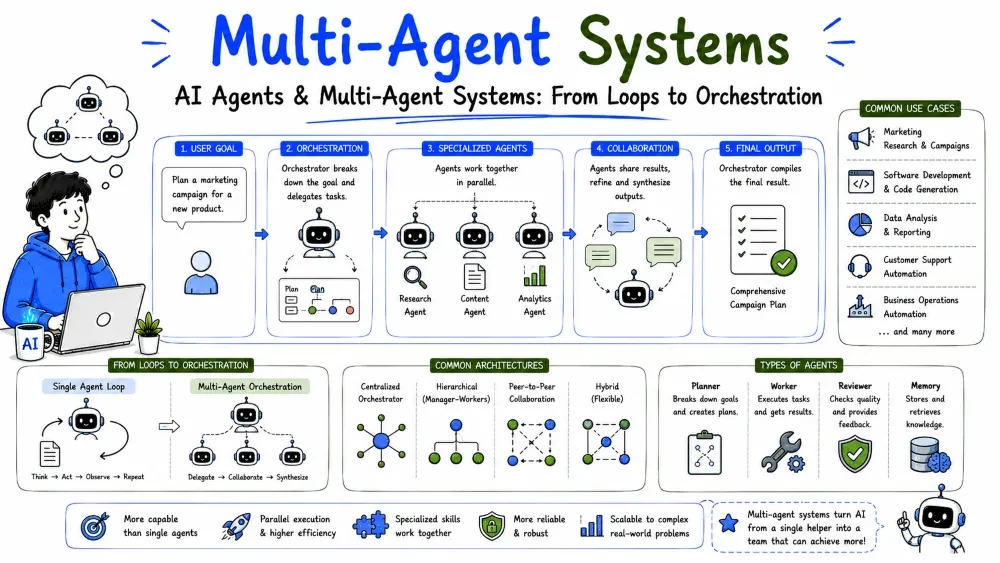
An agent is an LLM that can act — plan, call tools, observe results, and keep going until a goal is met. Move from single-turn prompts to a loop that decides what to do next, and you've built an agent. This tutorial covers the agent loop, then how multiple agents can collaborate as a team.
An agent is a model wrapped in a loop where it can take actions. It doesn't just answer — it decides to look something up, call a tool, then decide again based on what it found, repeating until it reaches a goal or gives up.
The key difference from a plain prompt: the model drives the next step. You hand it a goal and a set of tools; it chooses how to get there.
These get confused, so let's separate them:
Prompt:    "Summarize this."                    -> one answer
Workflow:  extract -> classify -> summarize     -> fixed path you wrote
Agent:     goal + tools; model picks the steps  -> flexible, unpredictable path
Why it matters: workflows are predictable and safe; agents are flexible and powerful. Choose based on how much you trust the model to steer.
Every agent runs some version of this loop:
Loop:
  model -> "calls lookup_order(8821)"
  run it -> result
  model -> "calls get_shipment_status(tracking)"
  run it -> result
  model -> "Your order ships tomorrow."
  stop.
Explanation: the agent keeps calling tools until it has enough information to answer. Each iteration adds to the message history, so the model remembers what it already found.
Agents need to remember across steps. That memory lives in the message history you resend every iteration (the API is stateless). Longer-lived memory can also live outside the prompt.
Working memory (per loop):  request + tool calls + results + reasoning
Long-term memory (across):  notes written to disk, recalled next session
Best Practice: Keep only what the agent needs in the prompt. A history that grows forever bloats cost and confuses the model — trim or summarize old steps.
A minimal agent is the tool-calling loop from Tutorial 5, wrapped so the model can call tools multiple times until it's ready to answer.
def run_agent(goal):
    messages = [{"role": "user", "content": goal}]
    while True:
        resp = client.messages.create(model="claude-sonnet-5",
                                      max_tokens=300, tools=tools, messages=messages)
        # Did the model answer, or ask to call a tool?
        if not any(b.type == "tool_use" for b in resp.content):
            return resp.content[0].text
        # Run every requested tool and append results, then loop again.
        messages.append({"role": "assistant", "content": resp.content})
        for block in resp.content:
            if block.type == "tool_use":
                result = run_tool(block.name, block.input)
                messages.append({"role": "user",
                                 "content": [{"type": "tool_result",
                                              "tool_use_id": block.id,
                                              "content": str(result)}]})
Explanation: the while loop keeps calling the model. If the reply contains a tool call, the code runs it and feeds the result back, then loops. The loop exits only when the model returns a plain text answer.
Note: Add a safety cap (if steps > 10: break) so a stuck agent can't loop forever, spending money.
A multi-agent system is several agents working together, each with a specialty or role, coordinating on a larger task that one agent handles poorly. Think of a team instead of a single worker.
Why they exist: one agent doing everything gets muddled. Splitting roles — a researcher, a writer, a reviewer — lets each focus and improves quality and oversight.
Three common ways agents organize:
Orchestrator:
   Coordinator
     ├─ researcher agent  -> gathers data
     ├─ analyst agent     -> interprets it
     └─ writer agent      -> drafts the report

Review:
   writer produces draft -> reviewer flags issues -> writer revises
Explanation: the orchestrator routes work to specialists; the review pattern uses a second opinion to catch errors. Both trade extra cost and latency for better, more reliable output.
Best Practice: Prefer one capable agent with good tools over a complex team unless the task genuinely needs division of labor. Multi-agent adds cost, latency, and failure modes.
Multi-agent is a heavy hammer. Avoid it when:
"Summarize a PDF"              -> one agent, or even one prompt
"Research + draft + fact-check a report" -> consider a team
Common Mistake: building a multi-agent system for a job a single prompt does fine. Complexity is a tax you pay for flexibility — don't pay it without reason.
Save your progress and earn XP for completing tutorials.
4 questions · Pass with 70%+
1What makes an agent different from a plain prompt?
2Which is a fixed pre-scripted sequence of steps you decide in advance?
3Where does an agent's working memory live?
4When is a multi-agent system usually the wrong choice?
Technology
Forward Deployed Engineer
Lesson group
AI Engineering for FDEs
Progress
70% complete