Preparing your learning space...
43% through Automation for FDEs tutorials
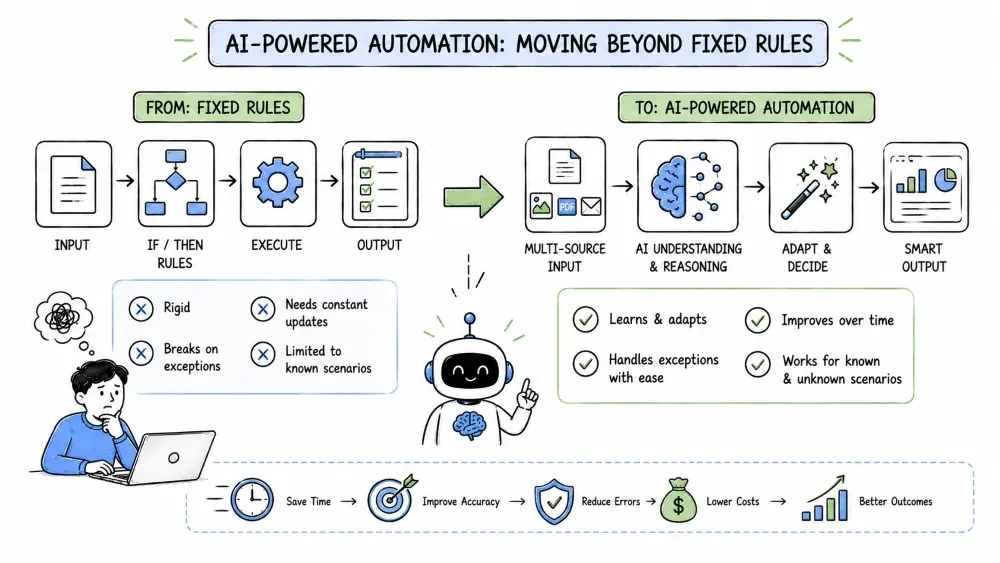
AI-Powered Automation combines artificial intelligence techniques with traditional automation to create systems that can learn, adapt, and make decisions based on data and patterns, going beyond rule-based automation.
AI-Powered Automation integrates machine learning, natural language processing, computer vision, and other AI technologies with automation workflows to handle complex, variable, and judgment-based tasks.
Why it is useful: AI-Powered Automation extends automation to tasks that require understanding context, making predictions, handling unstructured data, or adapting to changing conditions—scenarios where traditional rule-based automation falls short.
import pandas as pd
from sklearn.feature_extraction.text import TfidfVectorizer
from sklearn.naive_bayes import MultinomialNB
import joblib
import os
import re

class EmailClassifier:
    def __init__(self):
        self.vectorizer = TfidfVectorizer(max_features=1000)
        self.classifier = MultinomialNB()
        self.categories = ['Support', 'Sales', 'Invoice', 'Spam', 'Other']

    def preprocess_text(self, text):
        # Convert to lowercase and remove special characters
        text = re.sub(r'[^a-zA-Z\s]', '', text.lower())
        return text

    def train(self, emails, labels):
        # Preprocess emails
        processed_emails = [self.preprocess_text(email) for email in emails]

        # Vectorize text
        X = self.vectorizer.fit_transform(processed_emails)

        # Train classifier
        self.classifier.fit(X, labels)
        print("Model trained successfully!")

    def predict_category(self, email):
        processed_email = self.preprocess_text(email)
        X = self.vectorizer.transform([processed_email])
        prediction = self.classifier.predict(X)[0]
        probability = max(self.classifier.predict_proba(X)[0])

        return {
            'category': prediction,
            'confidence': probability
        }

    def save_model(self, filepath):
        joblib.dump({
            'vectorizer': self.vectorizer,
            'classifier': self.classifier,
            'categories': self.categories
        }, filepath)

    def load_model(self, filepath):
        model_data = joblib.load(filepath)
        self.vectorizer = model_data['vectorizer']
        self.classifier = model_data['classifier']
        self.categories = model_data['categories']

# Usage example
if __name__ == "__main__":
    # Sample training data
    training_emails = [
        "I need help with my account login issue",
        "Looking to purchase your premium package",
        "Please find attached invoice #12345",
        "You've won a free vacation! Click here!",
        "What are your business hours?"
    ]
    training_labels = ['Support', 'Sales', 'Invoice', 'Spam', 'Support']

    # Train and use classifier
    classifier = EmailClassifier()
    classifier.train(training_emails, training_labels)

    # Test with new email
    new_email = "Can you reset my password?"
    result = classifier.predict_category(new_email)
    print(f"Email classified as: {result['category']} (confidence: {result['confidence']:.2f})")

    # Save model for later use
    classifier.save_model("email_classifier_model.pkl")
Save your progress and earn XP for completing tutorials.
4 questions · Pass with 70%+
1Which type of AI handles unstructured data like emails, documents, and images?
2Why is quality training data essential for ML-powered automation?
3What is a common risk of expecting AI to handle a task without sufficient training data?
4When should you decide NOT to use AI?
Technology
Forward Deployed Engineer
Lesson group
Automation for FDEs
Progress
43% complete