Preparing your learning space...
71% through Automation for FDEs tutorials
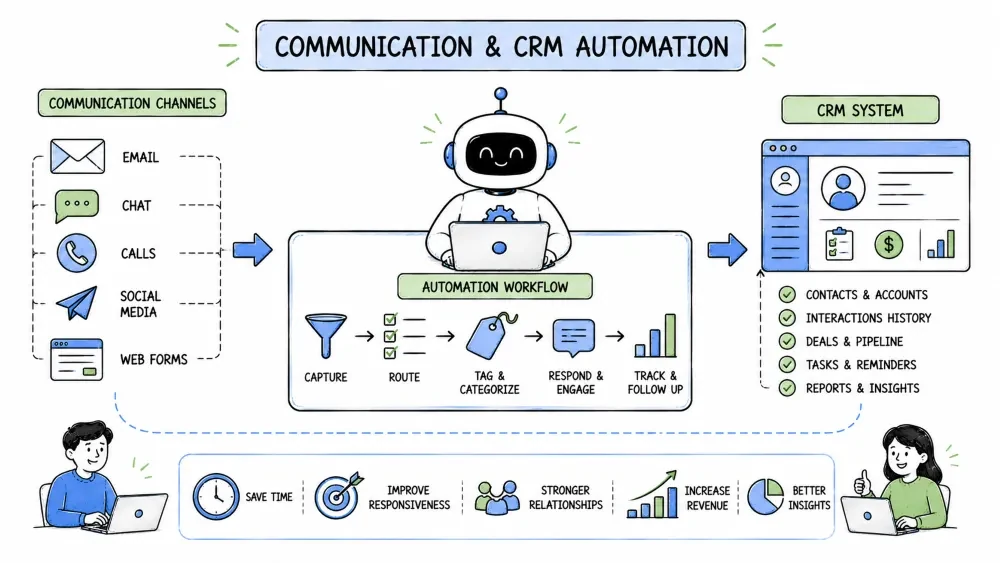
Communication & CRM Automation focuses on automating customer relationship management and business communication processes, including customer interactions, support systems, and team collaboration tools like Slack.
CRM (Customer Relationship Management) automation involves programmatically managing customer data, interactions, sales processes, and marketing campaigns to improve customer relationships and sales efficiency.
Why it is useful: CRM automation provides a 360-degree view of customers, ensures timely follow-ups, reduces manual data entry, enables personalized marketing, and improves sales forecasting accuracy.
import sqlite3
import smtplib
from email.mime.text import MIMEText

class LeadAutomation:
    def __init__(self, db_path="leads.db"):
        self.db_path = db_path
        self.init_database()

    def init_database(self):
        conn = sqlite3.connect(self.db_path)
        cursor = conn.cursor()
        cursor.execute('''
            CREATE TABLE IF NOT EXISTS leads (
                lead_id INTEGER PRIMARY KEY AUTOINCREMENT,
                email TEXT UNIQUE,
                company TEXT,
                job_title TEXT,
                score INTEGER DEFAULT 0,
                status TEXT DEFAULT 'new'
            )
        ''')
        conn.commit()
        conn.close()

    def capture_lead(self, form_data):
        email = form_data.get('email', '').strip().lower()
        if '@' not in email:
            raise ValueError("Valid email required")

        conn = sqlite3.connect(self.db_path)
        cursor = conn.cursor()

        # Check if the lead already exists (email is UNIQUE)
        cursor.execute('SELECT lead_id FROM leads WHERE email = ?', (email,))
        existing = cursor.fetchone()

        if existing:
            lead_id = existing[0]
            # Update existing lead rather than creating a duplicate
            cursor.execute('''
                UPDATE leads SET company = ?, job_title = ?
                WHERE lead_id = ?
            ''', (form_data.get('company', ''), form_data.get('job_title', ''), lead_id))
            is_new = False
        else:
            cursor.execute('''
                INSERT INTO leads (email, company, job_title)
                VALUES (?, ?, ?)
            ''', (email, form_data.get('company', ''), form_data.get('job_title', '')))
            lead_id = cursor.lastrowid
            is_new = True

        conn.commit()
        conn.close()

        # Score and route the lead
        if lead_id:
            self.score_lead(lead_id, form_data)
            if is_new:
                self.send_welcome_email(email)
        return lead_id

    def score_lead(self, lead_id, form_data):
        score = 0
        job_title = form_data.get('job_title', '').lower()
        if any(t in job_title for t in ['manager', 'director', 'vp', 'ceo']):
            score += 20  # Decision maker
        company = form_data.get('company', '').lower()
        if any(k in company for k in ['inc', 'corp', 'llc']):
            score += 10
        score += 5 * sum(1 for f in ['company', 'job_title'] if form_data.get(f))

        conn = sqlite3.connect(self.db_path)
        cursor = conn.cursor()
        cursor.execute('UPDATE leads SET score = ? WHERE lead_id = ?', (score, lead_id))
        if score >= 25:
            cursor.execute('UPDATE leads SET status = ? WHERE lead_id = ?', ('hot', lead_id))
        conn.commit()
        conn.close()

    def send_welcome_email(self, recipient):
        msg = MIMEText("Thanks for your interest! Our team will be in touch soon.")
        msg['Subject'] = "Welcome!"
        msg['From'] = "noreply@company.com"
        msg['To'] = recipient
        print(f"Welcome email queued for {recipient}")

# Usage
# lead_sys = LeadAutomation()
# lead_sys.capture_lead({
#     'email': 'jane@techcorp.com',
#     'company': 'TechCorp Inc',
#     'job_title': 'VP of Engineering'
# })
Slack automation involves programmatically interacting with Slack workspaces to automate notifications, workflows, data sharing, and team collaboration processes through Slack's API and custom applications.
Why it is useful: Slack automation reduces context switching, ensures timely information delivery, enables self-service operations, and integrates Slack with other business systems for seamless workflows.
import requests

class SlackBot:
    def __init__(self, bot_token):
        self.token = bot_token
        self.api_url = "https://slack.com/api/"

    def send_message(self, channel, text, blocks=None):
        headers = {
            "Authorization": f"Bearer {self.token}",
            "Content-Type": "application/json"
        }
        payload = {"channel": channel, "text": text}
        if blocks:
            payload["blocks"] = blocks

        response = requests.post(
            f"{self.api_url}chat.postMessage",
            headers=headers,
            json=payload
        )
        return response.json()

    def send_deployment_notification(self, deployment_info):
        blocks = [
            {
                "type": "header",
                "text": {"type": "plain_text", "text": ":rocket: Deployment Update"}
            },
            {
                "type": "section",
                "fields": [
                    {"type": "mrkdwn", "text": f"*App:*\n{deployment_info['app']}"},
                    {"type": "mrkdwn", "text": f"*Status:*\n{deployment_info['status'].title()}"}
                ]
            }
        ]
        return self.send_message(
            channel=deployment_info.get('channel', '#deployments'),
            text=f"Deployment: {deployment_info['app']} {deployment_info['status']}",
            blocks=blocks
        )

# Usage
# bot = SlackBot(os.getenv("SLACK_BOT_TOKEN"))
# bot.send_deployment_notification({
#     'app': 'Customer Portal',
#     'status': 'success',
#     'channel': '#deployments'
# })
Save your progress and earn XP for completing tutorials.
4 questions · Pass with 70%+
1What is lead scoring used for in CRM automation?
2Why did we change INSERT OR IGNORE to a check-then-insert approach in the lead example?
3Which Slack API feature handles user interactions like button clicks and modals?
4Why must automated communications include opt-out mechanisms?
Technology
Forward Deployed Engineer
Lesson group
Automation for FDEs
Progress
71% complete