Preparing your learning space...
86% through Automation for FDEs tutorials
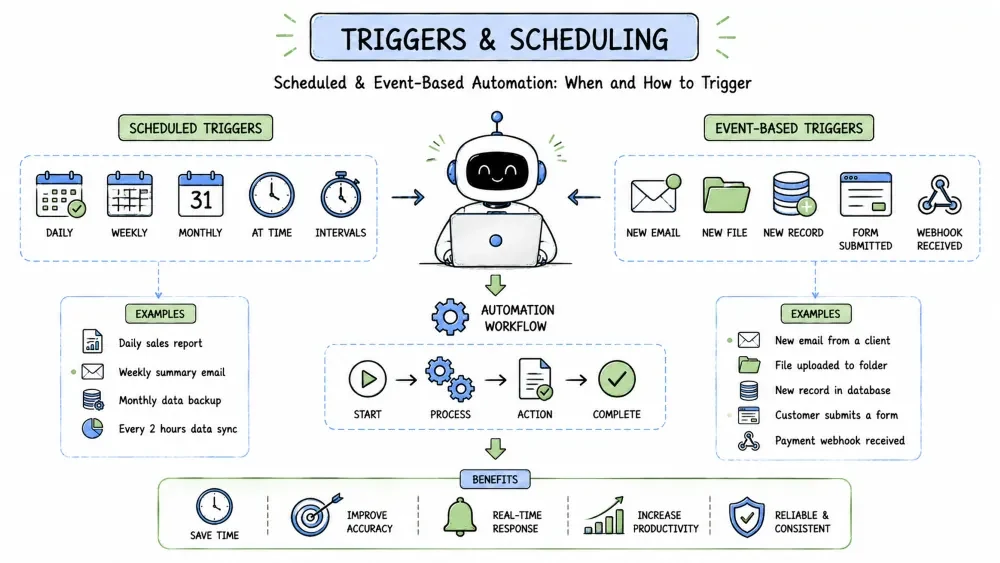
Automation Triggers and Scheduling covers the mechanisms that initiate automated processes based on time intervals, events, or conditions—essential for creating responsive and timely automation systems.
Scheduled automation involves executing automated tasks at predetermined times or intervals using time-based triggers, enabling regular maintenance, reporting, and batch processing without manual intervention.
Why it is useful: Scheduled automation ensures timely execution of routine tasks, enables off-peak processing to minimize system impact, provides predictable automation windows, and supports regular business cycles like daily reports or monthly billing.
* * * * * command-to-execute*: Every value,: List of values (e.g., 1,3,5)-: Range of values (e.g., 9-17)/: Step values (e.g., */15 every 15 minutes)import schedule
import time
import shutil
import os
from datetime import datetime
import logging
class ScheduledBackup:
def __init__(self, source_dir, backup_dir, retention_days=30):
self.source_dir = source_dir
self.backup_dir = backup_dir
self.retention_days = retention_days
self.setup_logging()
def setup_logging(self):
logging.basicConfig(
level=logging.INFO,
format='%(asctime)s - %(levelname)s - %(message)s'
)
self.logger = logging.getLogger(__name__)
def create_backup(self):
timestamp = datetime.now().strftime("%Y%m%d_%H%M%S")
backup_path = os.path.join(self.backup_dir, f"backup_{timestamp}")
try:
shutil.copytree(self.source_dir, backup_path)
self.logger.info(f"Backup created: {backup_path}")
self.cleanup_old_backups()
except Exception as e:
self.logger.error(f"Backup failed: {e}")
def cleanup_old_backups(self):
cutoff = time.time() - (self.retention_days * 86400)
for folder in os.listdir(self.backup_dir):
folder_path = os.path.join(self.backup_dir, folder)
if os.path.getmtime(folder_path) < cutoff:
shutil.rmtree(folder_path)
self.logger.info(f"Removed old backup: {folder}")
def run_scheduler(self):
# Daily at 2 AM
schedule.every().day.at("02:00").do(self.create_backup)
# Weekly on Sunday at 3 AM
schedule.every().sunday.at("03:00").do(self.create_backup)
self.logger.info("Scheduler started")
while True:
schedule.run_pending()
time.sleep(60)
# Usage
# backup = ScheduledBackup("/data", "/backups")
# backup.run_scheduler()
# Edit with: crontab -e

# Daily backup at 2:00 AM
0 2 * * * /usr/bin/python3 /scripts/daily_backup.py >> /var/log/backup.log 2>&1

# Weekly full backup Sunday 3:00 AM
0 3 * * 0 /usr/bin/python3 /scripts/weekly_backup.py >> /var/log/backup.log 2>&1

# Cleanup old backups daily at 4:00 AM
0 4 * * * /usr/bin/python3 /scripts/cleanup_backups.py >> /var/log/backup.log 2>&1
Event-based automation involves executing automated processes in response to specific occurrences or changes in systems, applications, or environments—enabling real-time responsiveness and reactive workflows.
Why it is useful: Event-based automation provides immediate response to important changes, reduces polling overhead, enables real-time workflows, and creates more responsive and efficient automation systems compared to pure scheduled approaches.
import time
import os
import shutil
from watchdog.observers import Observer
from watchdog.events import FileSystemEventHandler
import logging

class DocumentHandler(FileSystemEventHandler):
    def __init__(self, watch_dir, processed_dir):
        self.watch_dir = watch_dir
        self.processed_dir = processed_dir
        os.makedirs(processed_dir, exist_ok=True)
        logging.basicConfig(level=logging.INFO)
        self.logger = logging.getLogger(__name__)

    def on_created(self, event):
        if not event.is_directory:
            self.process_file(event.src_path)

    def on_moved(self, event):
        if not event.is_directory:
            self.process_file(event.dest_path)

    def process_file(self, file_path):
        filename = os.path.basename(file_path)
        self.logger.info(f"Processing: {filename}")

        time.sleep(1)  # Wait for file write to complete

        try:
            # Move to processed folder with timestamp
            name, ext = os.path.splitext(filename)
            timestamp = time.strftime("%Y%m%d_%H%M%S")
            new_name = f"{name}_{timestamp}{ext}"
            dest = os.path.join(self.processed_dir, new_name)
            shutil.move(file_path, dest)
            self.logger.info(f"Moved {filename} to processed")
        except Exception as e:
            self.logger.error(f"Error processing {filename}: {e}")

def start_watcher(watch_dir, processed_dir):
    handler = DocumentHandler(watch_dir, processed_dir)
    observer = Observer()
    observer.schedule(handler, watch_dir, recursive=False)
    observer.start()

    try:
        while True:
            time.sleep(1)
    except KeyboardInterrupt:
        observer.stop()
    observer.join()

# Usage
# start_watcher("./incoming", "./processed")
from flask import Flask, request, jsonify
import hmac
import hashlib
import os

app = Flask(__name__)
WEBHOOK_SECRET = os.getenv("GITHUB_WEBHOOK_SECRET")

@app.route("/webhook/github", methods=["POST"])
def github_webhook():
    # Verify signature
    signature = request.headers.get("X-Hub-Signature-256", "")
    payload = request.get_data()

    if not verify_signature(payload, signature):
        return jsonify({"error": "Invalid signature"}), 401

    event_type = request.headers.get("X-GitHub-Event", "")
    data = request.json

    if event_type == "push":
        handle_push_event(data)
    elif event_type == "pull_request":
        handle_pr_event(data)

    return jsonify({"status": "ok"})

def verify_signature(payload, signature):
    if not WEBHOOK_SECRET:
        return True  # Skip in dev
    expected = "sha256=" + hmac.new(
        WEBHOOK_SECRET.encode(), payload, hashlib.sha256
    ).hexdigest()
    return hmac.compare_digest(expected, signature)

def handle_push_event(data):
    repo = data["repository"]["full_name"]
    commits = len(data["commits"])
    print(f"Push to {repo}: {commits} commits")
    # Trigger CI/CD, deploy, notify team, etc.

def handle_pr_event(data):
    action = data["action"]
    pr = data["pull_request"]["number"]
    print(f"PR #{pr} {action}")
    # Run tests, notify reviewers, etc.

# Run: python app.py
Save your progress and earn XP for completing tutorials.
4 questions · Pass with 70%+
1In a cron expression 0 3 * * 0, what does the final 0 represent?
2Which is the BEST choice for a task that must respond immediately when a file is uploaded?
3Why should resource-intensive tasks be scheduled during off-peak hours?
4What is the purpose of verifying event sources with signatures (like the Slack/GitHub webhook check)?
Technology
Forward Deployed Engineer
Lesson group
Automation for FDEs
Progress
86% complete