Preparing your learning space...
40% through Introduction tutorials
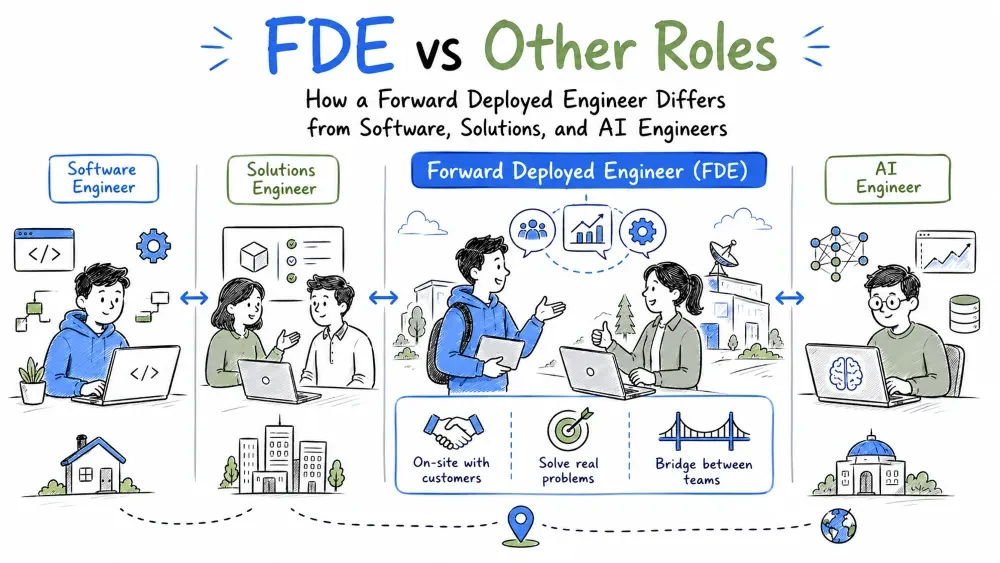
FDE is often confused with software, solutions, and AI engineering because the titles overlap and the work can look similar from the outside. This tutorial separates them with clear comparisons so you know what makes an FDE distinct.
A traditional Software Engineer builds and maintains the product itself — features, services, infrastructure — usually working from specs and tickets, often far from any single customer. An FDE uses that same engineering skill but points it at the customer's specific problem, frequently writing code that lives outside the core product.
| Dimension | Software Engineer | Forward Deployed Engineer |
|---|---|---|
| Main focus | The product | The customer's use of the product |
| Who defines the task | PMs, tech leads, roadmaps | Customer needs + product |
| Code location | Core codebase | Customer environment, integrations, prototypes |
| Success metric | Shipped features, reliability | Customer outcome, adoption |
| Customer contact | Rare | Frequent and direct |
In short: a software engineer asks "what should we build?" An FDE asks "how do we make what we built actually work for this customer, right now?"
A Solutions Engineer (SE) also works with customers, often during sales, to show that a product can solve their problem. The difference is depth of building. SEs typically configure, demo, and architect solutions but write less production code. FDEs go further: they write real code, often post-sale, to build custom integrations and handle messy technical reality.
| Dimension | Solutions Engineer | Forward Deployed Engineer |
|---|---|---|
| Typical phase | Pre-sale / evaluation | Post-sale / adoption and build |
| Coding depth | Light scripting, config | Production-grade code |
| Goal | Win the deal / prove fit | Make it actually work and scale |
| Ownership | Demo and proposal | Working solution in customer hands |
Note: At many companies the line is blurry and one person does both. The useful distinction is how much real engineering the role demands day to day.
An AI Engineer builds AI systems — models, pipelines, retrieval, fine-tuning, evaluation — usually as part of the product. An FDE may use AI engineering heavily (especially at AI companies), but their defining trait is the customer proximity, not the AI specialty. An AI Engineer can work entirely internally; an FDE cannot.
| Dimension | AI Engineer | Forward Deployed Engineer |
|---|---|---|
| Core expertise | ML/LLM systems | Customer-facing engineering |
| Works with customers? | Often no | Yes, centrally |
| Builds the model? | Frequently | Rarely; applies existing models |
| Primary environment | Internal infra | Customer's data and systems |
Think of it this way: an AI Engineer makes the AI capable. An FDE makes the AI useful to a specific customer — and increasingly, an FDE needs AI Engineer skills to do that well.
Save your progress and earn XP for completing tutorials.
4 questions · Pass with 70%+
1How does a Software Engineer's focus differ from an FDE's?
2What is the key difference between a Solutions Engineer and an FDE?
3An AI Engineer's defining feature is:
4Which role is most likely to work entirely internally without customer contact?
Technology
Forward Deployed Engineer
Lesson group
Introduction
Progress
40% complete